

New Delhi: India has recorded one of the most rapid declines in poverty globally over the past decade, according to the World Bank’s October 2026 Poverty and Equity Brief for India. The report, released on Friday, documents substantial progress across both monetary and non-monetary measures between 2011 and 2023, while also flagging persistent challenges related to wage gaps, regional concentration of poverty, and the quality of new jobs.
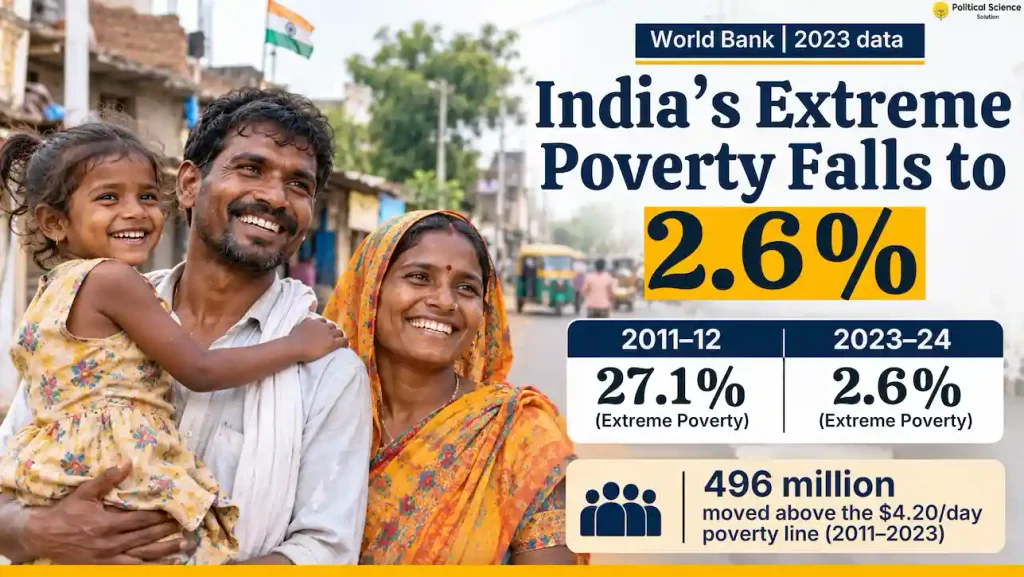
Extreme poverty, measured at the $3.00-a-day line using 2021 purchasing power parity, fell from 27.1 percent in 2011 to 2.6 percent in 2023. Over the same period, the share of the population living below the lower-middle-income country poverty line of $4.20 a day declined from 57.7 percent to 16.1 percent. These shifts lifted an estimated 496 million people above the $4.20 threshold. The World Bank described the overall trajectory as “remarkable progress” and one of the fastest poverty reductions observed anywhere in the world.
Looking ahead, the institution projects that poverty will continue to ease, though at a slower pace. Under the $4.20-a-day measure, the rate is expected to decline from 14.2 percent in 2026 to 12.1 percent by 2028. These forward-looking figures are based on microsimulations and remain subject to revision as fresh labour-market and macroeconomic data become available.
Non-monetary dimensions of poverty have also improved markedly. The Oxford Poverty and Human Development Initiative’s Multidimensional Poverty Index shows the incidence of multidimensional poverty falling from 53.8 percent in 2005-06 to 16.4 percent in 2019-21. The World Bank’s own multidimensional poverty measure stood at 15.5 percent in 2022-23. Access to electricity reached 99 percent of the population according to 2022 survey data cited in the brief.
Drivers of the Decline
The World Bank attributes the gains primarily to three reinforcing factors: strong growth in household consumption, rising employment—especially among women—and the expansion of social transfers, including food subsidies. Between 2017 and 2023, total employment rose by approximately 134 million people, nearly twice the increase in the working-age population. Rural women accounted for a large share of this expansion as they entered paid work and raised the number of earners within their households. Both rural and urban households registered substantial welfare gains, with faster progress in rural areas helping to narrow the rural–urban gap. At the $4.20-a-day line, rural poverty stood at 19.3 percent in 2023 compared with 8.6 percent in urban areas.
Finance Minister Nirmala Sitharaman welcomed the findings. In a detailed social-media post, she highlighted the movement of 496 million people above the lower-middle-income poverty line, the drop in extreme poverty to 2.6 percent, the addition of 13.4 crore jobs between 2017 and 2023, the contribution of rural women, the narrowing of the rural–urban welfare gap, and the near-universal access to electricity. She credited sustained policy efforts under the leadership of Prime Minister Narendra Modi for strengthening the foundations of inclusive growth and greater economic opportunity. The minister reiterated the government’s commitment to building on these gains through productive employment, stronger household incomes, and effective delivery of public services.
Remaining Challenges: Wage Gaps, Geography, and Job Quality
Despite the broad-based reduction in poverty, several structural issues persist. As overall poverty declined, it became increasingly concentrated among households with lower educational attainment, fewer productive assets, limited access to stable employment, and higher dependency ratios. Wage disparities remain pronounced: median earnings among the top 10 percent of workers were about 13 times those of the bottom 10 percent in 2023.
Poverty has also become more geographically concentrated. While living standards improved across most states, households located in a contiguous belt stretching from Uttar Pradesh to West Bengal still account for roughly 57 percent of India’s poor population. Further progress will therefore depend heavily on the creation of productive employment opportunities in these regions.
Labour-market indicators present a mixed picture. Although aggregate employment expanded rapidly, real earnings remained broadly unchanged. Much of the job growth occurred in relatively low-productivity activities. Youth unemployment edged upward from 14.6 percent in the first quarter of FY2026 to 15.9 percent in the first quarter of FY2027, with the rise particularly noticeable among rural young women.
The World Bank also reported India’s Gini index at 23.0 in 2023. The index measures the overall distribution of income or consumption and ranges from zero (perfect equality) to 100 (maximum inequality). A reading of 23 indicates a relatively equal distribution on the measure used by the Bank. At the same time, the institution cautioned that household surveys may not fully capture consumption among the wealthiest households and are therefore likely to understate inequality. The coexistence of a low Gini figure and a 13-fold gap between the median earnings of the top and bottom deciles of workers illustrates that different metrics capture different aspects of the distribution.
Measurement Notes and Outlook
The poverty estimates rest on household consumption surveys. The World Bank noted that some of the recent measured gains may reflect improvements in survey methodology alongside genuine welfare improvements. Both the $3.00 and $4.20 lines are expressed in 2021 purchasing-power-parity terms, allowing consistent international comparison.
Taken together, the October 2026 Poverty and Equity Brief presents a picture of rapid, broad-based poverty reduction over a twelve-year span, driven by consumption growth, rising female labour-force participation in rural areas, and expanded social protection. It simultaneously underscores unfinished tasks: closing large wage gaps, raising the productivity of new jobs, addressing youth unemployment—especially among rural young women—and accelerating progress in the states that still contain the majority of the country’s remaining poor.
The report’s findings arrive at a moment when India continues to pursue policies aimed at productive employment, stronger household incomes, and reliable public-service delivery. How effectively those efforts translate into higher-quality jobs and more evenly shared gains will determine whether the next phase of poverty reduction matches the pace achieved between 2011 and 2023.
FAQs
1. What does the World Bank’s October 2026 Poverty and Equity Brief say about the scale of poverty reduction in India between 2011 and 2023?
According to the World Bank, extreme poverty (measured at the $3.00-a-day line in 2021 purchasing-power parity) fell from 27.1 percent in 2011 to 2.6 percent in 2023. Over the same period, the share of the population living below the lower-middle-income country poverty line of $4.20 a day dropped from 57.7 percent to 16.1 percent. These changes lifted an estimated 496 million people above the $4.20 threshold. The institution described the overall progress as “remarkable” and one of the fastest poverty reductions recorded anywhere in the world.
2. What factors does the World Bank identify as the main drivers of this poverty decline?
The report attributes the gains primarily to three reinforcing elements: strong growth in household consumption, a large rise in employment (especially among women), and the expansion of social transfers, including food subsidies. Between 2017 and 2023, total employment increased by about 134 million people—nearly twice the growth of the working-age population. Rural women entering paid work accounted for a substantial share of this expansion and raised the number of earners per household. Both rural and urban households recorded welfare gains, with faster progress in rural areas helping to narrow the rural–urban gap. Access to electricity reached 99 percent of the population by the 2022 survey data cited in the brief.
3. What remaining challenges does the World Bank highlight despite the sharp fall in poverty?
Several structural issues persist. Poverty has become more concentrated among households with lower education, fewer assets, limited access to stable employment, and higher dependency ratios. Median earnings of the top 10 percent of workers were about 13 times those of the bottom 10 percent in 2023. Geographically, households in a contiguous belt from Uttar Pradesh to West Bengal still account for roughly 57 percent of India’s poor population. Real earnings remained broadly unchanged even as employment grew, and much of the new work was concentrated in relatively low-productivity activities. Youth unemployment also rose from 14.6 percent in the first quarter of FY2026 to 15.9 percent in the first quarter of FY2027, particularly among rural young women. At the $4.20-a-day line, rural poverty stood at 19.3 percent compared with 8.6 percent in urban areas.
4. How has multidimensional (non-monetary) poverty changed, and what are the World Bank’s near-term projections?
Non-monetary poverty has declined sharply as well. The Oxford Poverty and Human Development Initiative’s Multidimensional Poverty Index fell from 53.8 percent in 2005-06 to 16.4 percent in 2019-21. The World Bank’s own multidimensional poverty measure stood at 15.5 percent in 2022-23. Looking ahead, the Bank projects that poverty measured at the $4.20-a-day line will continue to ease, though more gradually—from an expected 14.2 percent in 2026 to 12.1 percent by 2028. These forward estimates are based on microsimulations and may be revised as new labour-market and macroeconomic data become available. The Bank also notes that some recent measured gains may partly reflect improvements in survey methodology alongside genuine welfare improvements.
5. How did India’s Finance Minister respond to the findings, and what does the report say about inequality measures?
Finance Minister Nirmala Sitharaman welcomed the report and highlighted the movement of 496 million people above the lower-middle-income poverty line, the drop in extreme poverty to 2.6 percent, the addition of 13.4 crore jobs between 2017 and 2023, the role of rural women, the narrowing rural–urban gap, and near-universal electricity access. She credited sustained policy efforts under the leadership of Prime Minister Narendra Modi. On inequality, the World Bank reported India’s Gini index at 23.0 in 2023, a relatively low reading on a 0–100 scale. At the same time, the institution cautioned that household surveys may not fully capture consumption among the wealthiest households and are therefore likely to understate inequality. The coexistence of a low Gini figure and a 13-fold earnings gap between the top and bottom deciles of workers shows that different metrics capture different aspects of the distribution.