

New Delhi: The Balochistan Liberation Front has publicly launched what it terms Operation Almas, asserting that its fighters carried out coordinated assaults across Gwadar district on Thursday. The group claims seven Pakistani security personnel were killed, that its members entered and briefly controlled a major military engineering camp, seized a police station, and struck a military convoy. These assertions, issued through BLF spokesperson Major Gwahram Baloch, have not received independent verification. Pakistani authorities have yet to release a detailed public response confirming or denying the specific claims of fatalities, site control, or material losses.
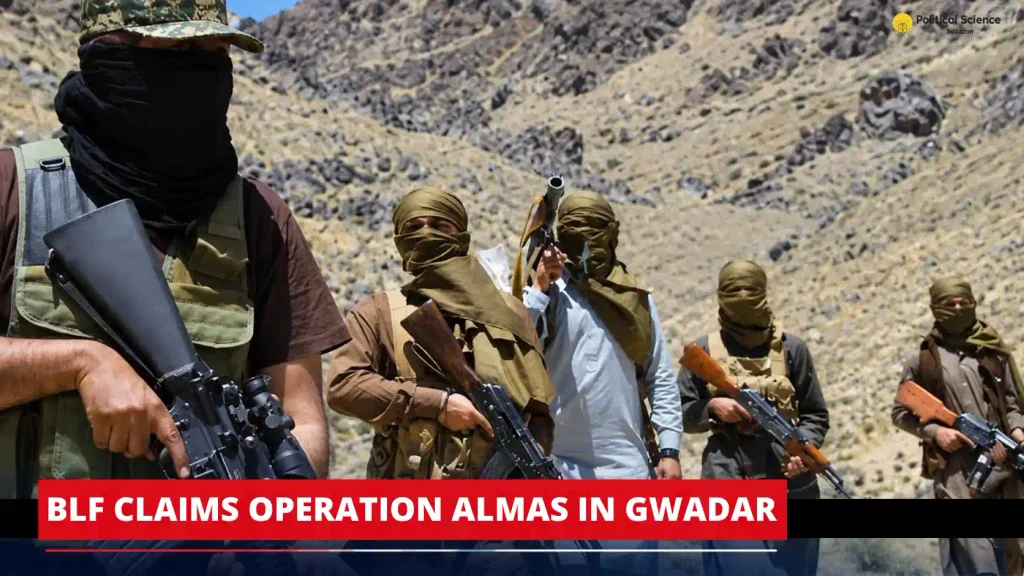
BLF Declares Start of Operation Almas Across Multiple Locations
Major Gwahram Baloch stated that fighters from the group’s special Saddo Operational Battalion, supported by additional units, are participating in the offensive. According to the spokesperson, the operation began with simultaneous actions at several points in Gwadar district and remains active. He indicated that a comprehensive assessment of casualties and damage would be released only after the current phase of fighting concludes. The BLF presented the campaign as a deliberate, multi-front effort rather than isolated raids.
Assault on Frontier Works Organisation Camp at Gwadar Zero Point
The opening move, the group said, targeted the Pakistan Army’s Frontier Works Organisation camp located at Gwadar Zero Point. The Frontier Works Organisation functions as a military engineering entity responsible for major infrastructure and construction projects across Pakistan, including extensive work in Balochistan tied to national development priorities. In a subsequent statement the BLF claimed its fighters had entered the installation, taken control of the site, and raised the organisation’s flag there. During the fighting, the group asserted, a captain from Pakistan’s Military Intelligence and several personnel belonging to the Special Services Group were killed. The BLF further stated that government weapons and equipment were seized during the action at the camp.
Seizure of Mazani Police Station and Capture of Gabd Cross Post
In parallel, the BLF reported that its fighters overran the Mazani police station. The group claimed one police officer was killed in the clashes and that its members confiscated government weapons and other equipment from the facility. Separately, the organisation said it had captured a police post at Gabd Cross, extending its asserted temporary control over local security outposts in the district.
Attack on Military Convoy in Gabd Area
The BLF also claimed responsibility for an attack on a Pakistani military convoy travelling in the Gabd area of Gwadar district. According to the statement, one military vehicle was destroyed in the strike, resulting in several Pakistani personnel killed or injured. This incident formed part of the broader sequence of actions attributed to Operation Almas.
Claimed Casualties Include Named Officers
The group’s account lists seven Pakistani security personnel among the dead. Named individuals include Lieutenant Colonel Mujahid Hussain and Military Intelligence Captain Sajjad. The BLF has not released a fuller list of ranks or additional identities at this stage. These claimed losses, if confirmed, would represent a notable toll on both regular army and intelligence elements operating in the area. Independent sources have not corroborated the numbers or the identities provided by the group.
Strategic Significance of Gwadar and the China-Pakistan Economic Corridor
Gwadar sits on Pakistan’s southwestern coast and serves as a deep-water port of high strategic value. The city forms a central component of the China-Pakistan Economic Corridor, a network of infrastructure, energy, and connectivity projects intended to link western China with the Arabian Sea. Because of this role, security around the port, its logistics facilities, and associated engineering sites carries national and regional importance. Any disruption to operations at locations such as the Frontier Works Organisation camp has potential implications for project timelines and the broader perception of stability along the corridor.
Long-Running Baloch Insurgency and Patterns of Targeting
Armed Baloch groups have for years conducted attacks against Pakistani security forces and infrastructure projects in the province. They consistently accuse the federal government of exploiting Balochistan’s natural resources while denying the local population meaningful political representation and economic benefits. Pakistan designates these organisations as terrorist entities and has responded with repeated military operations. The claims surrounding Operation Almas fit within this established pattern of intermittent but persistent violence directed at both hard security targets and symbols of state presence.
The Frontier Works Organisation’s involvement in large-scale construction across Balochistan makes its installations frequent points of focus for such groups. Similarly, police stations and mobile military convoys represent accessible targets that allow armed organisations to demonstrate reach and to attempt the capture of weapons. The asserted raising of a flag at a military camp and the reported seizure of police facilities carry clear symbolic intent, projecting an image of temporary territorial challenge even if the duration of any occupation proves limited.
Absence of Independent Verification and Official Silence
As of the latest available information, no independent journalists, monitors, or official Pakistani statements have confirmed the BLF’s assertions regarding control of the Frontier Works Organisation camp, the Mazani police station, the Gabd Cross post, or the precise extent of damage to the military convoy. Earlier episodes of violence in Balochistan have occasionally revealed discrepancies between militant claims and subsequent official accounts. Until on-the-ground verification or a detailed government release appears, the public record rests primarily on the group’s own communications.
Major Gwahram Baloch has emphasised that Operation Almas continues on multiple fronts. The BLF has promised further updates, including a final evaluation of results, once the offensive concludes. In the interim, security forces in the district remain on heightened alert, consistent with standard responses to reported multi-site activity.
Broader Implications for Security and Development in Balochistan
The latest claims arrive against the backdrop of a protracted insurgency that has tested successive Pakistani governments. Authorities have combined kinetic operations with development initiatives intended to undercut support for separatist narratives. Critics of the prevailing approach argue that economic benefits have been unevenly shared and that underlying grievances over resource control and autonomy persist. Defenders of the state’s policy maintain that violence must be met firmly and that corridors such as the China-Pakistan Economic Corridor offer the most practical route toward long-term stability and prosperity for the province.
For residents of Gwadar district, periods of intensified activity translate into restricted movement, increased checkpoints, and heightened uncertainty for commercial and fishing communities. The port city’s dual identity as both a strategic asset and a local population centre means that security incidents quickly affect daily life and business operations. Insurance considerations, shipping schedules, and investor confidence can all register the impact of sustained or high-profile violence.
The BLF’s decision to brand the campaign Operation Almas and to highlight the participation of a specialised battalion reflects an effort to frame the actions as coordinated and sustained. Whether the group possesses the logistical capacity to maintain simultaneous pressure across several locations will become clearer as events develop. Historical patterns in the region show that spikes in activity are frequently followed by quieter intervals as both armed groups and security forces adjust.
Pakistani forces have long conducted clearance operations, intelligence-led raids, and protective deployments across Balochistan’s expansive and difficult terrain. Porous borders and the presence of multiple armed organisations with shifting alliances complicate efforts to impose lasting control. The current claims, centred on Gwadar Zero Point, Mazani, Gabd, and associated routes, illustrate the continuing challenge of securing both fixed installations and mobile assets in the district.
Overall, the Balochistan Liberation Front has presented Operation Almas as a significant multi-site offensive that produced seven Pakistani fatalities, temporary control of a Frontier Works Organisation camp, the seizure of a police station and an additional police post, and damage to a military convoy. Named officers are among those listed as killed. The group states that fighting continues and that further details will follow. Independent confirmation of these specific assertions remains unavailable. Gwadar’s role within the China-Pakistan Economic Corridor ensures that any credible disruption draws attention well beyond the immediate locality, while the underlying dynamics of the Baloch insurgency continue to shape security calculations in the province.
FAQs
1. What is Operation Almas and who claimed responsibility for it?
The Balochistan Liberation Front (BLF) announced the launch of Operation Almas as a coordinated multi-front offensive in Pakistan’s Gwadar district. BLF spokesperson Major Gwahram Baloch stated that fighters from the group’s special Saddo Operational Battalion and other units carried out the attacks, which the group said were continuing at multiple locations. The operation included claimed assaults on a Frontier Works Organisation (FWO) camp, a police station and a military convoy.
2. How many Pakistani security personnel did the BLF claim were killed, and were any officers named?
The BLF claimed that seven Pakistani security personnel were killed during the attacks. Named individuals include Lieutenant Colonel Mujahid Hussain and Military Intelligence Captain Sajjad. The group also stated that a captain from Military Intelligence and several Special Services Group (SSG) personnel died in fighting at the FWO camp, while one police officer was killed during the seizure of the Mazani police station. These figures and identities have not been independently verified.
3. Which specific sites and locations in Gwadar did the BLF claim to have attacked or seized?
According to the BLF, the operation began with a large-scale assault on the Pakistan Army’s Frontier Works Organisation camp at Gwadar Zero Point, where fighters allegedly entered the installation, raised the group’s flag and seized weapons. The group also claimed to have taken control of the Mazani police station, captured a police post at Gabd Cross, and attacked a military convoy in the Gabd area of Gwadar district, destroying one vehicle and leaving several personnel dead or injured.
4. Why is Gwadar considered strategically important in the context of these claims?
Gwadar is a deep-water port city on Pakistan’s southwestern coast and a key node of the China-Pakistan Economic Corridor (CPEC). It plays a central role in infrastructure, connectivity and logistics projects linking western China to the Arabian Sea. The Frontier Works Organisation, whose camp was targeted, is a military engineering body involved in major construction projects across Balochistan, including those tied to CPEC. Attacks in the area therefore carry implications for both Pakistani security and regional economic initiatives.
5. Have the BLF’s claims about Operation Almas been independently verified?
No. The reported deaths of seven security personnel, the alleged control of the FWO camp and Mazani police station, the capture of the Gabd Cross post, and the damage to the military convoy have not been independently confirmed. Pakistani authorities consider groups such as the BLF terrorist organisations and have conducted military operations against them, but no detailed official rebuttal or confirmation of the specific claims had been issued at the time of the statements. The BLF indicated that further information, including a final assessment of casualties and damage, would be released after the offensive concluded.