

New Delhi: The Indian Parliament’s monsoon session witnessed intense confrontations and legislative action on Tuesday as the Rajya Sabha passed the Tribunals Reforms Bill, 2026, while the Lok Sabha approved the Kerala (Alteration of Name) Bill, 2026, and the National Co-operative Development Corporation (Amendment) Bill, 2026. Proceedings in both Houses remained disrupted by sustained Opposition protests demanding Home Minister Amit Shah’s presence and a detailed statement on police action against student demonstrators and alleged irregularities involving Ram temple donations in Ayodhya. The ruling NDA responded with counter-protests targeting Congress leader Rahul Gandhi.
The monsoon session, which began on July 20 and is scheduled to end on August 13, has been marked by repeated adjournments. On Tuesday, the pattern continued with both Houses facing sloganeering, walkouts, and early closures even as the government pushed through key legislation.
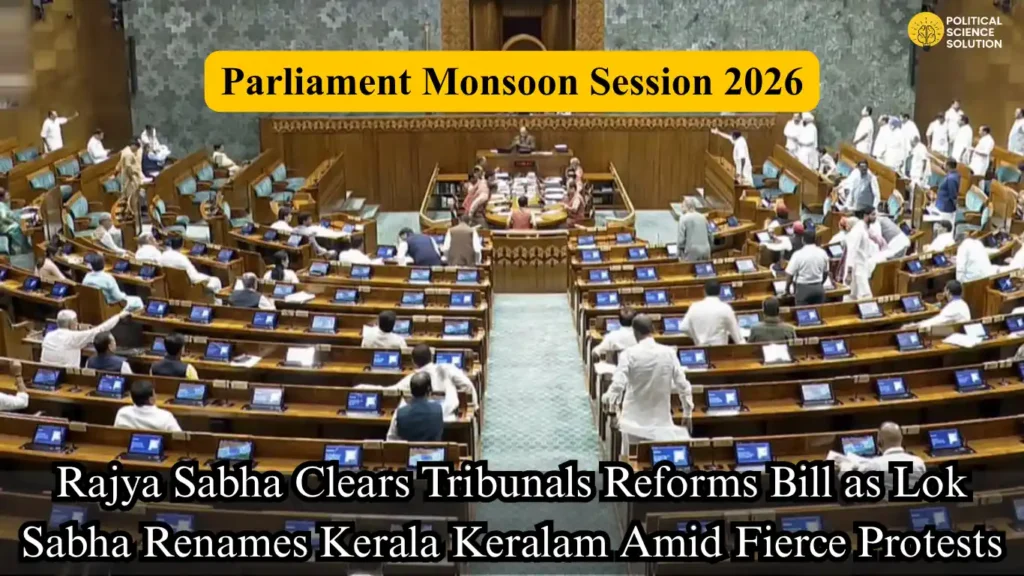
Tribunals Reforms Bill 2026 Passed by Rajya Sabha
The Rajya Sabha cleared the Tribunals Reforms Bill, 2026, by voice vote. The legislation had already been passed by the Lok Sabha the previous day without discussion amid uproar. Law and Justice Minister Arjun Ram Meghwal moved the Bill and replied to the limited debate that took place.
Meghwal described the measure as part of a broader reform agenda under Prime Minister Narendra Modi aimed at creating a modern, independent, and uniform tribunal system. He emphasised that tribunals complement rather than replace regular courts and handle specialised matters including taxation, company law, environment, securities, intellectual property, and other regulatory domains. The goal, he said, is faster and more effective delivery of justice.
The Bill replaces the Tribunals Reforms Act, 2021, and incorporates directions issued by the Supreme Court in the Madras Bar Association case. Its centrepiece is the creation of a National Tribunals Commission (NTC). This statutory body will handle selections, performance reviews, and disciplinary oversight for 16 tribunals. The NTC will be headed by a chairperson who is a former Supreme Court judge or former High Court Chief Justice, supported by two judicial members (former High Court Chief Justices or judges) and two technical members with at least 25 years of domain experience.
Appointments to the NTC will be made by the Central Government, with consultation with the Chief Justice of India required for the chairperson and judicial members. Members will serve a five-year term or until the age of 70. Tribunal chairpersons and members will be appointed by the Central Government on the recommendation of a Search-cum-Selection Committee. Chairpersons will hold office for five years or until age 70, while members will serve five years or until age 65. The government must finalise appointments within three months of receiving recommendations.
The Bill also mandates a National Tribunals Data Grid – a centralised digital portal that will contain all case-related information to enable performance tracking. Meghwal stressed that the legislation introduces no changes to the jurisdiction of existing tribunals. He presented it as a step toward greater transparency, reduced political influence in selections, judicial independence, and improved ease of doing business and access to justice through global best practices in institutional design.
Opposition INDIA bloc parties staged a walkout from the Rajya Sabha in the post-lunch session after Leader of Opposition Mallikarjun Kharge was not initially permitted to speak while the Bill was under discussion. The Chair repeatedly urged members to confine remarks to the legislation under consideration.
Lok Sabha Passes Kerala Name Change and NCDC Amendment
In the Lok Sabha, the Kerala (Alteration of Name) Bill, 2026, was passed by voice vote without debate amid continuous sloganeering. Minister of State for Home Affairs Nityanand Rai moved the Bill in place of Home Minister Amit Shah, who was absent. The legislation renames the state of Kerala as Keralam. Rai questioned what objection existed to the change. The House was later adjourned for the day after clearing this and one other measure.
The National Co-operative Development Corporation (Amendment) Bill, 2026, was also passed without discussion. Minister of State for Cooperation Murlidhar Mohol moved the Bill. It expands the mandate of the National Cooperative Development Corporation, established in 1963 under the 1962 Act, allowing it to provide loans and grants directly to cooperative societies. The NCDC’s existing functions cover planning, promotion, and financing of programmes related to production, processing, marketing, storage, and trade in agricultural produce, foodstuffs, and other notified commodities.
Of the 11 Bills cleared by the Lok Sabha during the session so far, only two have undergone debate. The remaining legislation has been approved amid disruptions.
Opposition Demands and Government Response on Student Protests
The dominant political flashpoint remained the Opposition’s insistence on a statement from Home Minister Amit Shah regarding police handling of student protests. On July 20, demonstrators in Delhi protesting the NEET paper leak and seeking the resignation of the then Education Minister faced lathi charge, tear gas, and water cannons near Ashoka Road, Janpath, and Bhai Vir Singh Marg. Similar unrest involving job aspirants and alleged recruitment exam irregularities occurred in Jharkhand, where the state Assembly was also adjourned early amid protests.
Leader of Opposition in the Lok Sabha Rahul Gandhi and other INDIA bloc leaders have demanded that Shah explain who ordered the use of force, including reports of pellet guns in some accounts, and address related accountability issues. Congress general secretary Jairam Ramesh highlighted Shah’s 17-day absence from both Houses, calling it unprecedented and questioning whether he was well or whether relations between the Prime Minister and the Home Minister were strained. Ramesh described the absence as proof that “those who intimidate are themselves cowards.”
Parliamentary Affairs Minister Kiren Rijiju countered that the government had been ready for a full discussion since Monday. He stated that Shah was prepared to reply and that the government preferred a detailed debate over a mere statement. Rijiju accused the Congress of repeatedly walking out, raising slogans outside, and avoiding a proper exchange. He used the phrase “Bhaago Mat” directed at Rahul Gandhi and asserted that the Opposition was running away from discussion while the government stood ready. Rijiju noted that the entire monsoon session risked being wasted due to continuous disruption, placing an unnecessary burden on the public.
Priyanka Gandhi Vadra confirmed that Rahul Gandhi had met protesting students in Jharkhand and reiterated the demand for Shah to make a statement in the House. She observed that the ruling side had been forced into staging its own protest, remarking that it was the first time she had seen NDA MPs demonstrate in this manner.
Counter-Protests and Political Crossfire Outside Parliament
NDA MPs organised a march and protest at Makar Dwar and the main entrance of Parliament House. They focused on police action against students in Jharkhand and accused Rahul Gandhi of silence on the use of force in a state governed by an Opposition ally. BJP MP Aparajita Sarangi publicly asked Gandhi to explain his silence. Union Minister Chirag Paswan charged the Opposition with constantly shifting goalposts and disrupting proceedings despite the government’s willingness to discuss all issues.
Both sides held face-to-face counter-protests. Opposition MPs, including Priyanka Gandhi Vadra, Akhilesh Yadav, and Dimple Yadav, raised the twin issues of alleged Ram temple donation theft in Ayodhya and the Jharkhand student action. NDA members targeted the Congress leadership for avoiding parliamentary debate while agitating outside.
Speaker Om Birla in the Lok Sabha and Chairman C.P. Radhakrishnan in the Rajya Sabha repeatedly appealed for order, noting that Question Hour shapes national policy and that the House is meant for discussion. Both Houses saw multiple adjournments – Lok Sabha until 2 pm and then for the day; Rajya Sabha until 12 pm and later until 2 pm – before limited legislative business could be conducted.
Additional Legislative and Related Developments
President Droupadi Murmu gave assent to a Bill granting legal protection to Vande Mataram. The government is considering referring the Foreign Contribution (Regulation) Amendment Bill, 2026, to a joint parliamentary committee for further scrutiny following demands from several parties for its withdrawal or deeper examination. The Bill, introduced earlier, seeks tighter oversight of NGOs and foreign funding.
Other parliamentary disclosures included the decision to establish a Central Jungle Warfare College of the CRPF in Bijapur, Chhattisgarh, and a Regional Training Centre of the CISF in Kishanganj, Bihar. A parliamentary standing committee recommended mandatory kidney function tests every six months for all persons aged 20 and above, free for those below the poverty line under the National Programme for Prevention and Control of Non-Communicable Diseases, along with annual screening for high-risk individuals.
Finance Minister Nirmala Sitharaman’s remarks criticising Communist parties during a debate on a taxation Bill were expunged by the Rajya Sabha Chairman after objections. Data presented in the House showed that SEBI regulatory measures reduced aggregate net losses of retail investors in equity derivatives to ₹91,685 crore in FY26 from ₹1.12 lakh crore the previous year, though average per-person losses rose slightly and overall volumes declined.
The government also informed the Lok Sabha that climate change is intensifying extreme rainfall events in the Himalayas, with human factors compounding disaster risks, and that a multi-sectoral central team has been constituted to address cloudbursts and related incidents in Himachal Pradesh.
Broader Context of a Disrupted Session
Throughout the day, both sides traded accusations of responsibility for the loss of productive time. Hemant Soren stated that all efforts had been made to ensure the House functioned but that the Opposition had thwarted them. Government spokespersons maintained readiness for discussion on the student protests while criticising continuous disruption. Opposition leaders insisted that meaningful accountability required Shah’s personal presence and a substantive response rather than procedural assurances.
The Tribunals Reforms Bill, once it receives presidential assent, will establish a new institutional architecture intended to improve independence, transparency, and efficiency across specialised adjudicatory bodies. The renaming of Kerala as Keralam and the expanded powers for the NCDC represent additional legislative outcomes achieved despite the prevailing atmosphere of protest.
As the monsoon session enters its final days, the unresolved demand for a comprehensive discussion on the July student protests and related accountability questions continues to dominate the political conversation both inside and outside the two Houses. The events of August 11 underscored the deep polarisation that has characterised this sitting of Parliament, even as the government succeeded in advancing its legislative priorities through voice votes amid the din.
FAQs
1. What is the Tribunals Reforms Bill, 2026, and why was it passed?
The Tribunals Reforms Bill, 2026 replaces the 2021 Act and creates a National Tribunals Commission to handle appointments, performance reviews, and discipline for 16 tribunals. It follows Supreme Court directions from the Madras Bar Association case, sets fixed tenures (five years or age limits of 70/65), requires government action on recommendations within three months, and introduces a National Tribunals Data Grid for transparency. The Rajya Sabha passed it by voice vote on August 11, 2026, after the Lok Sabha cleared it the previous day, as part of efforts to improve independence, efficiency, and uniformity in specialised adjudication.
2. Why was the Kerala (Alteration of Name) Bill, 2026 introduced, and what does it change?
The Bill officially renames the state of Kerala as Keralam. It was passed by the Lok Sabha on August 11, 2026, by voice vote without debate amid Opposition sloganeering. Minister of State for Home Affairs Nityanand Rai moved the Bill in the absence of Home Minister Amit Shah and stated there was no issue with the change reflecting the state’s preferred nomenclature.
3. What were the main reasons for the protests and disruptions in Parliament on August 11, 2026?
Opposition parties demanded Home Minister Amit Shah’s presence and a detailed statement on police action against student protesters on July 20 in Delhi (lathi charge, tear gas, water cannons) and related unrest in Jharkhand over job exam issues, plus alleged Ram temple donation theft in Ayodhya. NDA MPs staged counter-protests targeting Rahul Gandhi’s alleged silence on Jharkhand police action. Both Houses faced repeated adjournments, walkouts, and sloganeering, limiting debate on legislation.
4. What changes does the National Co-operative Development Corporation (Amendment) Bill, 2026 bring?
The Bill expands the NCDC’s powers so it can give loans and grants directly to cooperative societies. Passed by the Lok Sabha on August 11, 2026, without discussion, it builds on the corporation’s existing role (established in 1963) of planning, promoting, and financing programmes for agricultural produce, foodstuffs, and other notified commodities under the Ministry of Cooperation.
5. How did the government and Opposition differ on holding a discussion about the student protests?
Parliamentary Affairs Minister Kiren Rijiju said the government, including Amit Shah, had been fully prepared since Monday for a detailed discussion rather than a limited statement and accused the Congress of walking out and avoiding debate. Opposition leaders, including Jairam Ramesh and Priyanka Gandhi Vadra, insisted Shah must personally appear, answer who ordered the use of force, and address his prolonged absence from Parliament, calling a full reply essential for accountability.