
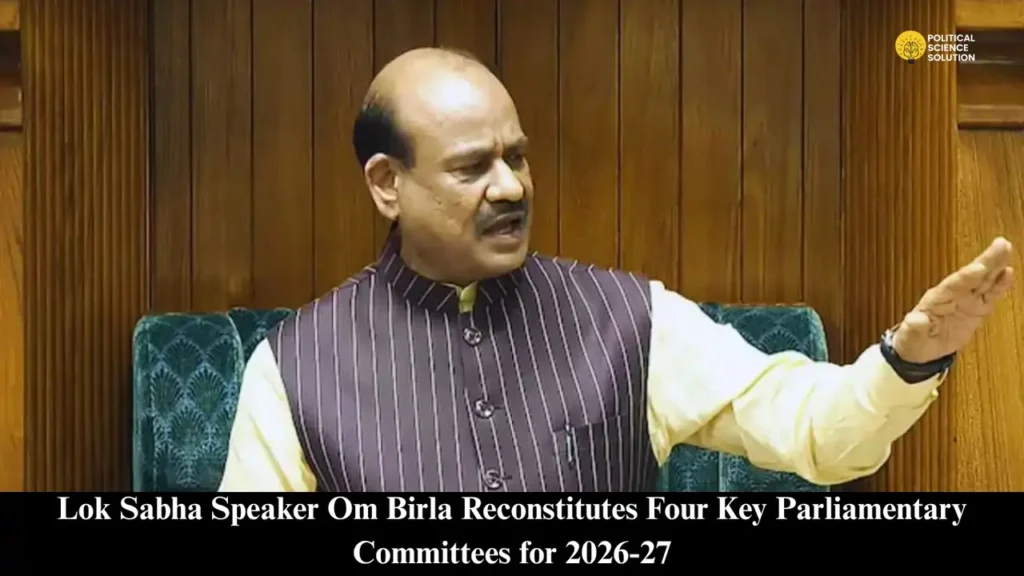
New Delhi: In a significant development aimed at strengthening legislative oversight and executive accountability, Lok Sabha Speaker Om Birla has reconstituted four major Parliamentary Committees for the financial year 2026-27. The move, announced recently, ensures continued scrutiny of government functioning, public expenditure, and welfare initiatives through structured parliamentary mechanisms.
The reconstituted panels include the Committee on Estimates, the Public Accounts Committee, the Committee on Public Undertakings, and the Committee on the Welfare of Scheduled Castes and Scheduled Tribes. These committees will operate for a one-year term beginning May 1, 2026, and concluding on April 30, 2027. This timely reconstitution reflects the regular annual exercise to maintain uninterrupted parliamentary scrutiny even as the House manages its legislative calendar.
Parliamentary Committees serve as the backbone of detailed legislative work in India’s democracy. Formed primarily from Members of Parliament, these bodies examine policies, budgets, laws, and government performance with greater depth than is possible during full House sessions. They bridge the gap between the executive and legislature, promoting transparency, efficiency, and social justice.
Understanding the Structure and Types of Parliamentary Committees
Parliamentary Committees in India fall into two broad categories: Standing Committees and Ad Hoc Committees. Standing Committees are permanent in nature and handle regular, ongoing responsibilities. This group includes powerful Financial Committees and the 24 Departmentally Related Standing Committees (DRSCs) that oversee specific ministries and departments.
Ad Hoc Committees, on the other hand, are temporary bodies created for specific tasks, such as examining particular bills. They dissolve automatically once their assigned work is complete. Examples include Select Committees and Joint Committees on Bills.
These committees play several critical roles. They provide continuous legislative oversight beyond the limited sitting days of Parliament. Members engage in detailed scrutiny of policies, conduct clause-by-clause examination of bills, and evaluate the performance of government bodies, including Public Sector Undertakings (PSUs). This process helps reduce executive overreach and supports more informed law-making.
However, the system faces notable challenges. Committee recommendations are non-binding and advisory only. Most panels, including DRSCs, have short one-year tenures, leading to frequent reconstitutions that can disrupt momentum. Delays in forming committees, low member attendance, and occasional bypassing of these forums for major legislation remain persistent issues. Experts have also pointed to the absence of dedicated expert advisers as a limitation, a concern highlighted by commissions such as the Venkatachaliah Commission.
Despite these shortcomings, Parliamentary Committees remain vital instruments for democratic accountability.
Committee of Estimates: Focus on Efficient Public Spending
The Committee of Estimates has been reconstituted with 30 members drawn exclusively from the Lok Sabha. Dr. Sanjay Jaiswal, a senior BJP MP from the Lower House, has been appointed as its Chairperson.
This committee holds a pivotal position among financial oversight bodies. Its primary mandate involves examining how the government allocates and utilizes public funds. Members review estimates of expenditure, suggest economies in spending, and recommend ways to improve operational efficiency across ministries. By highlighting areas of unnecessary or wasteful expenditure, the Committee of Estimates helps ensure that taxpayer resources deliver maximum value for national development priorities.
The reconstitution of this committee under Dr. Jaiswal’s leadership comes at a time when fiscal prudence and optimal resource utilization remain key governance priorities. With its focused membership from the Lok Sabha, the panel is well-positioned to provide targeted recommendations on budget implementation and expenditure management.
Public Accounts Committee: Guardian of Government Expenditure
One of the most influential financial watchdogs in the Indian parliamentary system, the Public Accounts Committee (PAC) has been reconstituted with 15 members from the Lok Sabha and 7 from the Rajya Sabha. Congress MP K.C. Venugopal from the Lok Sabha has been named its Chairperson.
The PAC scrutinizes government spending based on audit reports prepared by the Comptroller and Auditor General (CAG) of India. It examines whether funds granted by Parliament have been spent economically, efficiently, and in accordance with approved policies. This committee’s work covers a wide range of ministries and departments, making it a cornerstone of financial accountability.
A notable convention associated with the PAC is that it is traditionally chaired by a member from the opposition. This practice underscores the democratic principle of checks and balances, allowing the ruling dispensation to be held accountable by representatives from other parties. K.C. Venugopal’s appointment aligns with this established norm and is expected to bring a balanced perspective to the committee’s deliberations during 2026-27.
Committee on Public Undertakings: Evaluating PSU Performance
The Committee on Public Undertakings will be chaired by BJP MP Baijayant Panda. Like the PAC, it comprises 15 members from the Lok Sabha and 7 from the Rajya Sabha.
This committee conducts comprehensive reviews of the functioning and performance of government-owned Public Sector Undertakings. It examines reports of the CAG specifically related to PSUs and assesses whether these enterprises operate efficiently while aligning with broader national objectives. The panel also evaluates aspects such as management practices, financial health, and service delivery of key public enterprises.
In an era of economic reforms and disinvestment discussions, the Committee on Public Undertakings plays a crucial role in ensuring that PSUs contribute effectively to economic growth while maintaining accountability to Parliament and the public.
Committee on Welfare of Scheduled Castes and Scheduled Tribes
Addressing social justice and inclusive development, the Committee on the Welfare of Scheduled Castes and Scheduled Tribes has been reconstituted under the chairmanship of BJP MP Faggan Singh Kulaste from the Lok Sabha. This larger panel includes 20 members from the Lok Sabha and 10 from the Rajya Sabha.
The committee’s core focus is the protection and promotion of rights and welfare measures for SC and ST communities. It reviews government policies, programs, and schemes designed for these sections of society. Members examine implementation effectiveness to ensure that intended benefits actually reach the most marginalized groups. This includes scrutiny of educational, economic, and social empowerment initiatives as well as monitoring of constitutional safeguards.
By maintaining consistent oversight on welfare delivery, the committee contributes significantly to the broader goals of social equity and inclusive growth enshrined in the Indian Constitution.
Constitutional Foundation and Operational Framework
Parliamentary Committees derive their authority from Articles 105 and 118 of the Indian Constitution. Article 105 deals with the powers, privileges, and immunities of both Houses of Parliament and their committees. Article 118 empowers each House to make rules for regulating its procedure and conduct of business.
These provisions provide a strong constitutional backing, allowing committees to function with considerable independence while remaining accountable to the parent House. Committees operate under the overall direction of the Speaker of the Lok Sabha or the Chairman of the Rajya Sabha, as the case may be. Their reports and recommendations are presented to the respective Houses for consideration.
The concept itself draws inspiration from the British parliamentary tradition but has evolved to suit India’s unique democratic needs. Over the decades, these committees have become essential for detailed legislative scrutiny, especially given the increasing complexity of governance and policy-making.
Significance of the 2026-27 Reconstitution
The reconstitution by Speaker Om Birla assumes importance against the backdrop of ongoing demands for stronger parliamentary oversight. With these four committees now in place, Parliament will be better equipped to monitor public finances, evaluate government performance, and safeguard the interests of vulnerable sections of society.
Effective functioning of these panels can help address some of the systemic issues, such as delays in law-making and inadequate examination of major legislations. Regular attendance by members and timely submission of reports will be key to maximizing their impact.
As India progresses toward its development goals, the role of Parliamentary Committees in ensuring transparency, efficiency, and social justice becomes even more relevant. The coming year under these reconstituted committees will be watched closely by political observers, policy analysts, and citizens alike.
The appointments reflect a mix of ruling party and opposition voices, particularly with the PAC chair going to the opposition, which is expected to foster healthy democratic debate within these forums.
This development reinforces the commitment to institutional mechanisms that strengthen India’s parliamentary democracy. As these committees begin their work from May 1, 2026, their contributions will play a vital part in shaping accountable governance and responsive administration in the year ahead.
FAQ
1. Who has been appointed as the Chairperson of the four reconstituted Parliamentary Committees for 2026-27?
Lok Sabha Speaker Om Birla has appointed the following chairpersons:
- Committee of Estimates: Dr. Sanjay Jaiswal (BJP MP, Lok Sabha)
- Public Accounts Committee: K.C. Venugopal (Congress MP, Lok Sabha)
- Committee on Public Undertakings: Baijayant Panda (BJP MP)
- Committee on the Welfare of Scheduled Castes and Scheduled Tribes: Faggan Singh Kulaste (BJP MP, Lok Sabha)
These appointments were made for the one-year term from May 1, 2026 to April 30, 2027.
2. What is the composition and tenure of these four Parliamentary Committees?
- Committee of Estimates: 30 members (all from Lok Sabha)
- Public Accounts Committee: 15 members from Lok Sabha + 7 from Rajya Sabha
- Committee on Public Undertakings: 15 members from Lok Sabha + 7 from Rajya Sabha
- Committee on Welfare of SCs & STs: 20 members from Lok Sabha + 10 from Rajya Sabha
All four committees have a one-year tenure starting from 1st May 2026 to 30th April 2027.
3. What are the main functions of these important Parliamentary Committees?
• Committee on Welfare of SCs & STs: Monitors government policies and schemes for Scheduled Castes and Scheduled Tribes to ensure benefits reach the targeted communities.
• Committee of Estimates: Examines government expenditure estimates, suggests ways to reduce wasteful spending, and recommends improvements in fund utilization.
• Public Accounts Committee (PAC): Scrutinizes government accounts and expenditure on the basis of CAG reports. It is traditionally chaired by an opposition member.
• Committee on Public Undertakings: Reviews the performance, efficiency, and functioning of Public Sector Undertakings (PSUs) and examines CAG reports related to them.
4. Why are Parliamentary Committees important in the Indian democratic system?
Parliamentary Committees act as a vital link between the Legislature and the Executive. They enable detailed scrutiny of bills, budgets, policies, and government functioning that is not possible during regular Parliament sessions. They promote transparency, accountability, and efficiency while reducing executive arbitrariness. Key constitutional backing comes from Articles 105 and 118 of the Indian Constitution.
5. What are the major challenges faced by Parliamentary Committees in India?
Some common issues include:
- Non-binding nature of their recommendations (advisory only)
- Short one-year tenure leading to frequent reconstitutions
- Delays in committee formation
- Low attendance of members
- Occasional bypassing of committees for important legislation
- Lack of expert advisers
These challenges sometimes limit the overall effectiveness of the committees despite their critical role.