

New Delhi: In a firm diplomatic stance, India has categorically rejected the latest award issued by the Court of Arbitration (CoA) regarding maximum pondage limits at its hydroelectric projects on the Indus river system. The Ministry of External Affairs (MEA) reiterated on May 16, 2026, that the country does not recognize the legitimacy of this tribunal, emphasizing that the Indus Waters Treaty (IWT) continues to remain in abeyance. This development underscores ongoing tensions between India and Pakistan over water-sharing arrangements established more than six decades ago.
The rejection comes amid a long-standing dispute triggered by Pakistan’s objections to the design features of key Indian projects, specifically the Kishenganga and Ratle hydroelectric plants. Indian officials have consistently maintained that such technical matters should be addressed through the Neutral Expert mechanism under the World Bank rather than through an arbitral panel that India views as improperly constituted.
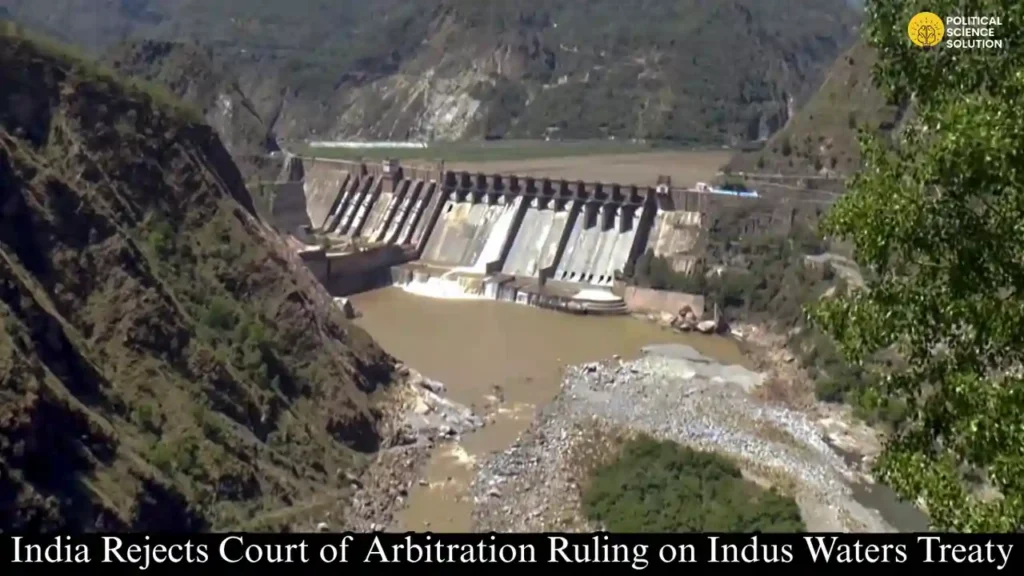
Understanding the Indus Waters Treaty: Historical Foundation and Water Allocation Framework
The Indus Waters Treaty, signed in 1960 between India and Pakistan with the World Bank serving as a key facilitator and signatory, stands as one of the most significant water-sharing agreements in modern history. Its primary objective was to equitably distribute the waters of the Indus River and its major tributaries between the two neighboring countries following the partition.
Under the treaty’s provisions, the rivers of the Indus basin are clearly divided into two categories. The Eastern Rivers — Sutlej, Beas, and Ravi — are allocated entirely to India for unrestricted use. This allocation provides India with full rights to utilize these waters for irrigation, power generation, and other domestic purposes without limitations imposed by the treaty.
In contrast, the Western Rivers — Jhelum, Chenab, and the main Indus River itself — are designated primarily for Pakistan. India is obligated to allow the unrestricted flow of waters from these rivers to Pakistan, with specific exceptions permitted under the treaty. These exceptions include limited domestic uses, non-consumptive needs, and certain agricultural or hydroelectric applications as explicitly outlined in the agreement. This framework was designed to balance the agricultural and energy requirements of both nations while preventing conflicts over this vital resource.
The treaty’s comprehensive nature covers not just the main stem of the Indus but extends to the entire basin, reflecting careful negotiations facilitated by international expertise at the time of its signing. For India, the ability to harness the Eastern Rivers has been crucial for development in northern states, while the restrictions on Western Rivers have shaped the country’s approach to run-of-the-river hydroelectric projects in Jammu and Kashmir.
Dispute Resolution Mechanism Under the Indus Waters Treaty
The IWT incorporates a structured, multi-tiered mechanism to resolve any differences that may arise between the two parties. This graduated approach aims to promote dialogue and technical resolution before escalating to higher levels of adjudication.
Step 1: Permanent Indus Commission (PIC)
At the foundational level, the treaty establishes the Permanent Indus Commission, comprising one commissioner from each country. This body serves as the primary forum for regular interaction and dispute resolution. The commissioners meet annually, with sessions alternating between India and Pakistan, to discuss implementation issues, exchange data, and address emerging concerns related to treaty compliance.
Step 2: Neutral Expert
If the Permanent Indus Commission fails to resolve a matter, the dispute can be referred to a Neutral Expert. This expert is appointed by the World Bank and possesses specialized technical knowledge relevant to the issues at hand. The Neutral Expert’s decisions are binding, providing a mechanism for impartial, expert-driven resolution of technical disagreements, particularly those concerning project design and engineering parameters.
Step 3: Court of Arbitration
The third and final tier involves the establishment of a Court of Arbitration. This step is activated either through mutual agreement between the parties or at the request of one side. The Court is intended to handle more complex legal interpretations or persistent disputes that cannot be settled at lower levels. However, its activation has become a point of significant contention in the current scenario.
The Court of Arbitration Controversy: Constitution and India’s Consistent Position
The current Court of Arbitration is a five-member arbitral panel constituted in January 2023 at Pakistan’s unilateral request. Pakistan had challenged the technical design aspects of India’s Kishenganga and Ratle hydroelectric projects, prompting the formation of this body. India has steadfastly refused to participate in the proceedings, arguing that the nature of the disputes falls squarely within the domain of the Neutral Expert appointed in parallel by the World Bank.
India has never recognized the establishment or authority of this particular CoA. Officials maintain that proceeding through the Court of Arbitration bypasses the appropriate channels defined in the treaty. This position has remained unchanged despite multiple pronouncements from the tribunal.
In its August 2025 Award on Issues of General Interpretation, the CoA reportedly ruled in ways that largely favored Pakistan’s perspective. The award imposed restrictions on how India could calculate permissible pondage for run-of-river hydroelectric plants and narrowed the design flexibility available to India under the treaty provisions. These interpretations directly impact India’s ability to optimize power generation while adhering to flow requirements.
Latest Developments: Rejection of the Pondage Supplemental Award
On May 15, 2026, the Court of Arbitration issued what it described as a supplemental award concerning maximum pondage at Indian hydroelectric projects on the Indus river system. India’s Ministry of External Affairs swiftly responded the following day, with spokesperson Randhir Jaiswal issuing a strong statement.
“India categorically rejects the present so-called award, just as it has firmly rejected all prior pronouncements of the illegally constituted CoA,” Jaiswal stated. He emphasized that any proceeding, award, or decision issued by this body is “null and void.” The MEA further clarified that India’s decision to hold the entire Indus Waters Treaty in abeyance continues to remain in full force.
This latest rejection follows a three-day hearing conducted by the CoA on April 28, 2026. The hearing addressed Pakistan’s request for interim measures and examined the overall status of the treaty itself. Pakistan was represented by Acting Co-Agent Syed Haider Shah, along with a team of legal counsel including Sir Daniel Bethlehem KC and Prof. Philippa Webb KC. India, consistent with its position, did not respond to invitations to participate and did not appear before the tribunal.
Notably, as of the latest updates, no official communication detailing this specific pondage award has been made publicly available on the website of the Permanent Court of Arbitration (PCA), which serves as the secretariat for the CoA. The most recent press release on the PCA site, dated May 11, 2026, pertained to the conclusion of the April hearing rather than the substantive award itself.
Timeline of Key Events Leading to Current Standoff
The sequence of events reveals a pattern of escalating differences:
- 1960: Signing of the Indus Waters Treaty.
- January 2023: Constitution of the five-member CoA chaired by Prof. Sean D. Murphy at Pakistan’s request.
- August 2025: CoA issues Award on Issues of General Interpretation, which India rejects.
- April 2025: India places the IWT in abeyance following the Pahalgam terror incident (as referenced in official communications).
- April 28, 2026: CoA conducts hearing on interim measures and treaty status.
- May 15, 2026: CoA issues supplemental award on pondage.
- May 16, 2026: India issues formal rejection through MEA.
Throughout this period, India has maintained parallel proceedings with the Neutral Expert mechanism, highlighting its commitment to the treaty’s originally envisaged dispute resolution pathways.
Implications for Regional Water Security and Bilateral Relations
The ongoing impasse over the Indus Waters Treaty carries significant implications for water management, energy security, and diplomatic relations in South Asia. For India, the ability to develop hydroelectric capacity on the Western Rivers within treaty-permitted limits is essential for meeting growing energy demands and supporting economic development in strategically important regions.
Pakistan’s challenges to project designs have centered on concerns regarding pondage — the temporary storage of water in run-of-river schemes — and its potential downstream effects. The CoA’s interpretations have sought to restrict these parameters, which India views as infringing upon the treaty’s intended flexibility for non-consumptive uses and power generation.
By holding the treaty in abeyance, India has signaled that comprehensive review and potential renegotiation may be necessary in light of changed circumstances, including security concerns and evolving needs. This position aligns with India’s long-standing assertion that the treaty must be implemented in its true spirit, without selective interpretations that disadvantage one party.
India’s Commitment to Treaty Principles Amid Rejection of Parallel Proceedings
Despite rejecting the CoA’s legitimacy, Indian authorities have consistently expressed commitment to the core principles of water cooperation as originally envisioned. The emphasis remains on technical resolution through neutral expertise rather than adversarial legal proceedings that lack mutual consent.
The Kishenganga and Ratle projects represent critical infrastructure for India’s renewable energy goals. Run-of-river designs are engineered to minimize environmental impact while generating clean power, operating within the constraints of mandatory environmental flows specified under the treaty.
Experts following the dispute note that the parallel tracks — Neutral Expert and CoA — have created procedural complexities that the treaty’s framers may not have fully anticipated when multiple mechanisms are invoked simultaneously. India’s preference for the Neutral Expert route reflects confidence in technical adjudication over broader legal interpretations.
Future Outlook and Broader Context
As the situation evolves, both nations continue to navigate the complexities of shared river systems in a region facing climate change pressures, population growth, and increasing water stress. The World Bank’s continued involvement as a treaty signatory and facilitator adds another layer of international oversight to potential resolutions.
India’s unambiguous rejection of the latest CoA award reinforces its consistent policy: the tribunal lacks jurisdiction, its decisions hold no validity, and the treaty’s abeyance status persists until underlying issues are addressed through appropriate channels.
This episode highlights the enduring challenges in implementing historical water agreements in contemporary geopolitical contexts. For stakeholders across South Asia, the resolution of these differences will be pivotal in ensuring sustainable water utilization, energy security, and peaceful bilateral engagement.
The Ministry of External Affairs has made it clear that India will continue to safeguard its rights and interests under the Indus Waters Treaty framework while rejecting what it considers extraneous and illegitimate parallel processes. As developments unfold, close monitoring of both technical expert proceedings and diplomatic communications will be essential for understanding the path forward.
FAQs
Q1: Why has India rejected the latest Court of Arbitration (CoA) award on the Indus Waters Treaty?
India has categorically rejected the supplemental award issued by the CoA on May 15, 2026, concerning maximum pondage at the Kishenganga and Ratle hydroelectric projects. The Ministry of External Affairs stated that India has never recognised the establishment of this CoA, viewing it as illegally constituted. Any proceeding, award, or decision by the tribunal is considered “null and void.” India’s position remains that the treaty is currently held in abeyance, and technical disputes should be resolved through the Neutral Expert appointed by the World Bank rather than this parallel arbitral process.
Q2: What is the Indus Waters Treaty and how does it divide the rivers?
The Indus Waters Treaty was signed in 1960 between India and Pakistan, with the World Bank as a facilitator and signatory. It governs the distribution of waters in the Indus River basin. The Eastern Rivers (Sutlej, Beas, and Ravi) are allocated entirely to India for unrestricted use. The Western Rivers (Jhelum, Chenab, and Indus) are primarily for Pakistan, with India required to let the waters flow freely except for limited domestic, non-consumptive, and other specific uses permitted under the treaty. This framework has guided water sharing for over six decades.
Q3: What is the dispute resolution mechanism outlined in the Indus Waters Treaty?
The treaty provides a three-step process:
- Permanent Indus Commission (PIC): Commissioners from both countries meet annually to discuss and resolve issues.
- Neutral Expert: Appointed by the World Bank for binding technical decisions.
- Court of Arbitration: Can be formed by mutual agreement or at the request of one party for broader disputes. India argues that the current dispute over the design of Kishenganga and Ratle projects falls under the Neutral Expert’s remit, not the CoA.
Q4: What are the Kishenganga and Ratle projects, and why are they controversial?
Kishenganga and Ratle are Indian run-of-the-river hydroelectric projects located on the Western Rivers in Jammu & Kashmir. Pakistan challenged their design features, particularly regarding pondage (temporary water storage). In its August 2025 award, the CoA ruled largely in Pakistan’s favour by restricting how India calculates permissible pondage and narrowing design flexibility. India maintains these are technical issues best handled by a Neutral Expert and that the projects comply with the treaty’s provisions for non-consumptive use and power generation.
Q5: What is the current status of the Indus Waters Treaty and what happens next?
India placed the Indus Waters Treaty in abeyance in April 2025 (following the Pahalgam terror incident) and this decision remains in force as of May 2026. The country continues to reject all pronouncements of the CoA, including the latest pondage supplemental award. No official details of the May 15 award are yet publicly available on the Permanent Court of Arbitration website. India has consistently participated in the parallel Neutral Expert process while refusing to engage with the CoA, chaired by Prof. Sean D. Murphy. The situation highlights deep differences over interpretation and implementation of the 1960 treaty.