

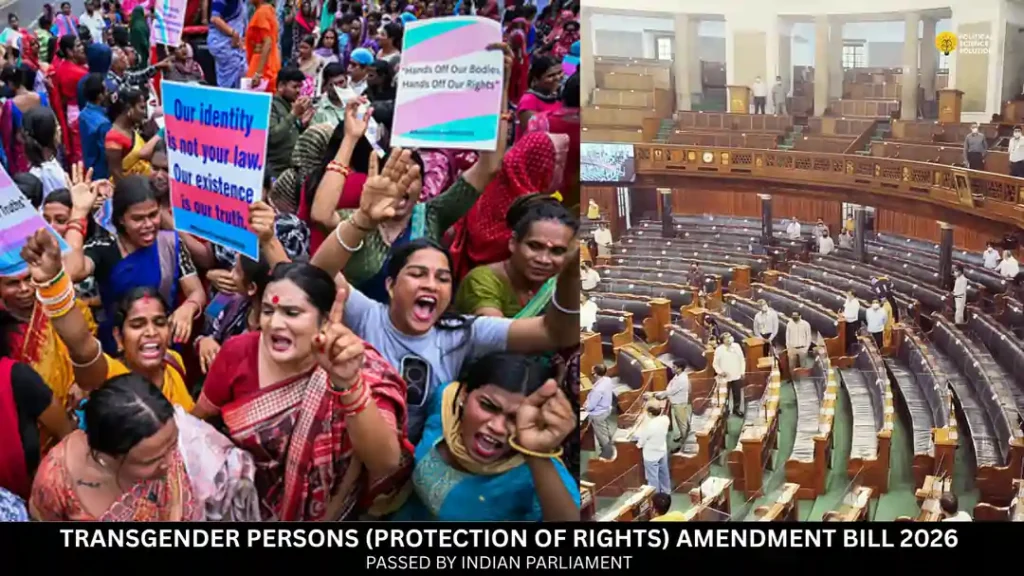
New Delhi: In a move that has ignited fierce debate across India, Parliament passed the Transgender Persons (Protection of Rights) Amendment Bill, 2026 this week, amending the landmark 2019 legislation. The bill introduces a revised definition of transgender persons, eliminates the right to self-determination of gender, mandates verification by medical boards, and strengthens penal provisions with punishments extending to life imprisonment. While the government maintains the changes will better protect the most marginalized and streamline welfare delivery, transgender activists, opposition parties, and even members of the National Council for Transgender Persons have condemned it as regressive, exclusionary, and violative of constitutional rights.
The legislation, which received presidential assent after clearing both houses, marks a significant shift from the self-identification principle upheld by the Supreme Court in the 2014 NALSA judgment. With an estimated two million transgender persons in India—though activists insist the actual figure is higher—the bill has triggered protests in cities including Mumbai and Delhi, resignations from key council members, and calls for judicial intervention.
Key Features of the Transgender Persons (Protection of Rights) Amendment Bill, 2026
The amendment redefines transgender persons to focus on socio-cultural identities such as kinner, hijra, aravani, and jogta, along with biological variations and intersex conditions. Unlike the broader 2019 Act, it narrows recognition to those facing discrimination due to biological or physical traits and traditional community identities, explicitly aiming to exclude social orientations from legal protection.
A major change is the removal of Section 4(2) from the original Act, which had guaranteed the right to self-determination of gender. In its place, the bill establishes a verification authority in the form of a medical board headed by a Chief Medical Officer or Deputy Chief Medical Officer, appointed by the Central Government, State Governments, or Union Territory administrations. This board will assist district authorities in verifying transgender identity.
Penal provisions have been strengthened with a graded punishment system based on the severity of offences against transgender persons, including penalties up to life imprisonment for grave violations. Additionally, the composition of the National Council for Transgender Persons has been modified to include representation from State Governments and Union Territories on a rotational basis, ensuring wider geographic input.
The government has argued that these measures address vagueness in the 2019 definition, prevent exploitation and trafficking, and ensure welfare benefits—such as job reservations and healthcare support—reach only those who are “real” transgenders by birth or traditional identity, rather than “fake” ones created through forced or social means.
Major Concerns Raised by Activists and Critics
Critics, however, view the bill as a fundamental rollback of hard-won rights. The shift from self-identification to state-mandated medical recognition is seen as a loss of agency, forcing transgender individuals to undergo invasive examinations that violate privacy and human dignity. Medical boards are accused of promoting a pathological approach, potentially leading to harassment, gatekeeping, and denial of certificates to many.
The narrower definition is said to effectively exclude trans-men, non-binary people, and gender-queer individuals from legal protections, leaving large sections of the community vulnerable. Activists argue that mandatory certification for gender-affirming surgeries further undermines autonomy. The bill’s passage without referral to a Standing Committee or any formal consultation with the transgender community has been labelled undemocratic and insensitive.
A Supreme Court-appointed advisory panel headed by former Delhi High Court judge Justice Asha Menon has formally requested the government to withdraw the bill. The panel warned that removing self-identification directly contradicts the 2014 NALSA vs Union of India verdict, which recognised transgender persons as a third gender and affirmed their right to self-identify.
Resignations from National Council for Transgender Persons Highlight Deep Rift
The backlash reached a crescendo on March 26, 2026, when two prominent members of the National Council for Transgender Persons (NCTP) resigned in protest. Kalki Subramanium, the southern states representative, and Rituparna Neog, the North East region representative, submitted their resignations to Union Minister of Social Justice and Empowerment Virendra Kumar, terming the bill “regressive” and “existential.”
In her detailed resignation letter, Subramanium wrote that the bill’s introduction and passage without consultation had created an “untenable position.” She emphasised her mandate to advise the government on legislation affecting the community and noted weeks of dialogue with transgender and intersex groups across southern states and the nation. The consensus, she stated, was that the bill represents a “step backward for our fundamental rights to self-identification and dignity.”
Speaking to The Wire, Subramanium revealed there was “no consultation through email, messages or meetings.” She accused decisions being made by “cis-representatives with their stereotypical, homophobic perspective” and questioned the purpose of her role if community voices were ignored. She also recounted a recent “urgent” meeting where members met senior economic adviser Yogita Swaroop instead of the minister. When Subramanium queried the discrimination in rape punishment between women and transgender persons, Swaroop reportedly replied, “because the anatomy is not the same,” offering no further explanation.
Rituparna Neog echoed these sentiments, stating she did not wish to continue as a “token” member. “Community is first,” she told The Wire. “If I have no role to play in decision making, I do not want to continue to be part of it as a token.” Both resignations came hours after the Rajya Sabha cleared the bill on March 25, 2026.
The NCTP, established in 2020 as a ten-member statutory body to oversee the 2019 Act’s implementation, was itself built on the NALSA principles. Subramanium and Neog have announced plans to approach the Supreme Court, expressing continued faith in the Constitution and due process.
Protests, Opposition Outcry, and Community Voices
Transgender rights activists have held multiple rallies over the past fortnight. Laxmi Narayan Tripathi declared, “It has shattered our identity.” Grace Banu, addressing a press conference in Delhi, demanded “recognition without invasion” and “rights without humiliation,” calling the bill “not protection, but violation.” Lawyer N Kavitha Rameshwar wrote in The Times of India that the removal of self-determination is an “attack on the privacy and dignity of the individual.”
Opposition leaders were equally vocal. Congress leader Rahul Gandhi labelled it a “brazen attack” on transgender rights. Supriya Sule of the Nationalist Congress Party questioned the “hasty manner” of its introduction. In Parliament, MPs from various parties—including SP’s Jaya Bachchan, RJD’s Manoj Kumar Jha, TMC’s Saket Gokhale, DMK’s Tiruchi Siva, and Congress’s Renuka Chowdhury—raised objections.
During the Rajya Sabha debate on March 25, 2026, opposition members urged referral to a select committee. Jaya Bachchan stressed the need for adequate transgender representation in both Houses and criticised the timing during the Budget Session. Manoj Kumar Jha questioned the move away from a rights-based approach. Saket Gokhale called the bill a “trashy colonial legislation,” noting that only 32,000 persons had obtained certificates under the 2019 Act out of five lakh recorded in the 2011 Census, largely due to fear. BJP MP Medha Kulkarni supported the bill, arguing it would deliver justice to “real” transgenders by birth and punish “fake” identities.
Social Justice Minister Virendra Kumar defended the legislation, stating it aims to “take along all segments of society together” and protect those discriminated against due to biological issues. He highlighted added identification processes, penal provisions, and a redefined scope after careful thought. The bill was passed in the Lok Sabha on March 24 by voice vote amid an opposition walkout, and in the Rajya Sabha on March 25 after a motion to refer it to a select committee was negated by voice vote.
Historical Context and Existing Welfare Initiatives
The 2014 NALSA judgment remains the constitutional bedrock, recognising transgender persons as a third gender with self-identification rights. The 2019 Act established protections, followed by the National Council for Transgender Persons, a National Portal for online identity certificates and benefits, and the SMILE scheme for rehabilitation and empowerment, including Garima Grehs shelters.
Despite these measures, many transgender individuals continue to face discrimination in education, healthcare, employment, and daily life, often relying on traditional occupations.
Broader Parliamentary Session Context
The transgender bill was debated amid a packed Budget Session. On March 25, the Lok Sabha passed the Finance Bill 2026 by voice vote with 32 government amendments after Finance Minister Nirmala Sitharaman’s reply. The Rajya Sabha discussed the Central Armed Police Forces (General Administration) Bill 2026 and other matters, including Insolvency and Bankruptcy Code amendments. Parliament also decided not to sit on the March 28-29 weekend due to the “ongoing situation” and upcoming Assembly elections in Assam, Kerala, and Puducherry.
What Lies Ahead?
With the bill now law, transgender community leaders vow to challenge it in the Supreme Court, citing violations of Articles 14, 15, 19, and 21. The resignations, protests, and panel recommendations underscore a deepening trust deficit. As India navigates this contentious chapter, the focus remains on balancing legal recognition, welfare delivery, and the fundamental dignity of transgender citizens.
The Transgender Persons (Protection of Rights) Amendment Bill 2026 has become a litmus test for inclusive governance. Whether it strengthens protections or dilutes rights will ultimately be decided in the courts and by the lived experiences of the community it seeks to serve.
FAQs
1. What is the Transgender Persons (Protection of Rights) Amendment Bill 2026?
The Transgender Persons (Protection of Rights) Amendment Bill, 2026 is a legislation passed by both houses of the Indian Parliament in March 2026 that amends the Transgender Persons (Protection of Rights) Act, 2019.
Key changes include:
- A revised, narrower definition of transgender persons focused on socio-cultural identities (kinner, hijra, aravani, jogta) and biological variations.
- Removal of the right to self-determination of gender (omitting Section 4(2) of the 2019 Act).
- Mandatory verification of transgender identity by a medical board headed by a Chief Medical Officer or Deputy CMO.
- Introduction of graded punishments for offences against transgender persons, with penalties up to life imprisonment.
- Changes in the composition of the National Council for Transgender Persons to include rotational representation from states and UTs.
The government claims these changes will ensure welfare benefits reach the most marginalised and prevent exploitation, while critics argue it undermines self-identification rights granted by the 2014 NALSA judgment.
2. Why was the Transgender Persons Amendment Bill 2026 criticized as regressive?
The bill has been widely criticized for shifting from self-identification to state-mandated medical verification, which many see as a violation of privacy, dignity, and autonomy.
Main concerns include:
- Exclusion of trans-men, non-binary, and gender-queer individuals from legal protections due to the narrower definition.
- Mandatory medical board examinations, labelled as “medical gatekeeping” and a return to a pathological approach.
- Complete lack of consultation with the transgender community or the National Council for Transgender Persons before passage.
- Removal of the right to self-determination, going against the Supreme Court’s 2014 NALSA verdict.
Two NCTP members, Kalki Subramanium and Rituparna Neog, resigned in protest, calling the bill “regressive” and “existential.” A Supreme Court-appointed advisory panel has also urged the government to withdraw the bill.
3. What are the main changes in the definition of transgender persons in the 2026 Amendment Bill?
The 2026 Amendment Bill significantly narrows the definition compared to the 2019 Act. It now defines transgender persons primarily through:
- Socio-cultural identities such as kinner, hijra, aravani, and jogta.
- Biological variations and intersex conditions.
It removes recognition based on “self-perceived” or social gender identity. The government argues the previous definition was too vague and allowed misuse. Critics say this change effectively excludes many trans-men, non-binary people, and gender-fluid individuals, limiting legal recognition and access to welfare schemes only to those who can prove their identity through medical boards.
4. What happens to transgender identity certification after the 2026 Amendment Bill?
After the passage of the Transgender Persons (Protection of Rights) Amendment Bill 2026, transgender identity certification will no longer rely on self-declaration.
Instead:
- A medical board (headed by a Chief Medical Officer or Deputy CMO) will verify the transgender identity.
- District authorities will rely on the medical board’s recommendation for issuing identity certificates.
- Certification becomes mandatory especially for those undergoing gender-affirming surgeries.
This replaces the self-identification process introduced under the 2019 Act and upheld by the 2014 Supreme Court judgment. Activists fear this will create barriers, delays, harassment, and potential denial of rights to many in the community.
5. Will the Transgender Persons Amendment Bill 2026 be challenged in the Supreme Court?
Yes. Transgender activists, including resigned NCTP members Kalki Subramanium and Rituparna Neog, have announced they will approach the Supreme Court.
A Supreme Court-appointed advisory panel headed by former Delhi High Court judge Justice Asha Menon has already passed a resolution urging the Centre to withdraw the bill, stating that removal of self-identification violates the 2014 NALSA judgment.
Legal experts argue the bill may contravene Articles 14, 15, 19, and 21 of the Indian Constitution (equality, non-discrimination, freedom, and right to life and dignity). Many believe the Supreme Court will be asked to examine whether the new medical verification process and narrowed definition are constitutional.