

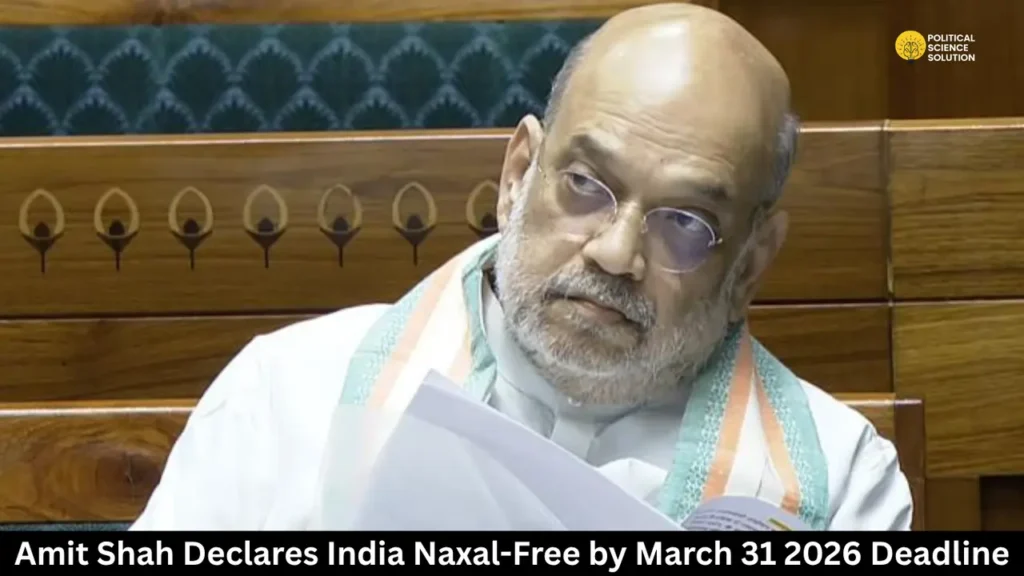
New Delhi: In a landmark address to the Lok Sabha on March 30 2026, Union Home Minister Amit Shah announced that India has effectively achieved a Naxal-free status, meeting the government’s self-imposed deadline of March 31 2026 for eliminating Left Wing Extremism (LWE) across the country. Shah stated that barring one absconding member, the entire top leadership of the Communist Party of India (Maoist) has been dismantled, with the Politburo and central structure almost completely wiped out through a combination of targeted operations, surrenders, and strategic policy shifts.
The Home Minister revealed precise figures on the scale of the anti-Maoist campaign over the past three years: 706 Maoists were killed in encounters, 2,218 were arrested, and more than 4,800 cadres surrendered. These numbers underscore the intensity of the operation that has transformed vast swathes of central India previously known as the Red Corridor.
At the start of 2024, the Maoists had 21 members in their Politburo and Central Committee. Shah detailed their fate with clinical precision: one has been arrested, seven have surrendered, 12 have been killed in operations, and dialogue is actively underway with the remaining absconding member, who is expected to surrender shortly. “Thus, their Politburo and central structure have been almost completely dismantled,” he declared, adding that the country will be formally informed once the final administrative processes are completed. “I can say without hesitation that we have become Naxal-free,” Shah asserted.
The announcement came during a dedicated discussion in the Lok Sabha on “Efforts to free the country from Left Wing Extremism.” Shah used the platform to outline the multi-pronged strategy that delivered this outcome, while sharply contrasting it with the approach of previous governments.
From Red Corridor to Development Corridor: How Technology and Political Will Changed the Game
Shah traced the turning point to three pivotal dates. On August 10 2019, the Ministry of Home Affairs convened a high-level meeting that laid the foundation for a comprehensive framework. This included enhanced police coordination, modernisation of forces, induction of reformed former Naxalites into the police, and seamless integration with intelligence agencies.
At that time, Chhattisgarh was under a Congress-led government that, according to Shah, refused to cooperate. He noted that by early 2024, several states had already turned the corner: Bihar had become entirely Naxal-free, Maharashtra was free except for one tehsil, Odisha was Naxal-free, and Jharkhand was free except for one district. Only Chhattisgarh remained a challenge, which Shah attributed to the then Congress government allegedly protecting Naxalites.
The political shift occurred in January 2024 when the BJP formed the government in Chhattisgarh. “From the very next day, full support was assured,” Shah said. A joint strategy was forged, culminating in the public announcement on August 24 2024 that Maoism would be eliminated nationwide by March 31 2026.
The operation relied heavily on three pillars: dialogue, security operations, and inter-agency coordination. Shah emphasised that modern technology played a decisive role. Security forces employed drone surveillance, satellite imaging, artificial intelligence-based data analysis, location-tracking systems, mobile phone activity data, scientific call logs, social media monitoring, and forensic support. Large volumes of telephone bills were analysed to map networks precisely. “This success was achieved through the Ministry of Home Affairs leading the entire operation with cutting-edge tools,” he noted.
On the ground, the message was clear and uncompromising. Shah reiterated the government’s policy: “Lay down your arms and complete arrangements for rehabilitation will be made, but a bullet will be answered with a bullet.” He described how Maoists had planted bombs in farmers’ fields, crippling innocent citizens, and stressed that force was necessary to protect tribals and villagers from atrocities when dialogue proved futile with hardcore elements.
Bastar Transformed: From Maoist Stronghold to Symbol of Development
Shah spotlighted Bastar in Chhattisgarh, once the epicentre of Maoist activity, declaring that Naxalism has been “more or less wiped out” from the region. He pointed to visible development as proof of the government’s success: schools in every village, ration shops, Aadhaar cards, ration cards, and the distribution of five kilograms of ration to beneficiaries. “Today, that shadow of red terror has been removed and Bastar is getting developed,” he said.
He contrasted this with the pre-2014 scenario when, he claimed, 12 states had fallen under the Red Corridor with no rule of law. Over 12 crore people lived in poverty for years, and approximately 20,000 people—including 5,000 security personnel—were killed in Maoist violence. Shah accused the Congress-led UPA government of inaction despite then Prime Minister Manmohan Singh publicly acknowledging that Maoist violence posed a bigger challenge than problems in Kashmir or the North-East.
“Police and Central Armed Police Forces personnel were there before 2014 as well, but what changed was clear policy and strong political will,” Shah said. He alleged that for 60 years the Congress had neglected tribals by failing to provide houses, water, schools, or bank facilities, and that the party’s “Leftist ideology” had allowed Naxalism to spread. Shah went further, claiming the Congress had indirectly supported Naxalism since the 1970s, including during Indira Gandhi’s era.
Opposition Response and Lingering Questions
Opposition members, while participating in the debate, cautioned the government against premature celebration. They urged that winning the trust of local populations must remain the priority and emphasised that Left Wing Extremism is not merely a law-and-order issue but requires addressing deep-rooted core developmental problems.
Shah responded by listing state-wise successes. All members of the state committees in Madhya Pradesh, Maharashtra, and Chhattisgarh have surrendered. In Odisha, of the four remaining, one has surrendered and three have been killed. In Telangana, six have surrendered, three have been killed, and none remain. He named specific high-profile eliminations and surrenders in 2025: Ganesh Uike and Madvi Hidma were killed, while Vikas Nagpure (alias Anant) and Mallojula Venugopal Rao (alias Bhupathi) surrendered.
The Home Minister credited the success entirely to the bravery of Central Armed Police Forces personnel—particularly the Cobra and CRPF units—security agencies, Chhattisgarh Police, District Reserve Guard (DRG) personnel, and the tribal communities who supported the operations.
Controversies and Civil Liberties Concerns
Independent reporting, including from Scroll, has highlighted that while the government claims victory, some encounters have faced scrutiny. Families in certain Chhattisgarh villages have disputed police assertions that those killed were reward-carrying Maoists, alleging instead that civilians were among the dead. Civil liberties groups and Opposition parties have raised questions about “fake encounters.” A report on Madvi Hidma’s killing noted that residents in the nearest Andhra Pradesh village reported hearing no gunfire, adding layers of complexity to the narrative of precise operations.
Shah, however, maintained that the ideological roots of Naxalism—not genuine developmental demands—drove the violence. He referenced Rahul Gandhi’s Bharat Jodo Yatra, claiming frontal Naxal organisations participated, and alleged that Gandhi personally tweeted a video of sloganeering at India Gate following Hidma’s killing: “Kitne Hidma maroge, har ghar se niklenge Hidma” (How many Hidmas will you kill? Hidmas will emerge from every home). Shah warned that the Modi government would not spare anyone who takes up arms, insisting that the Constitution provides the legitimate route to address grievances.
Looking Ahead: Rehabilitation, Development, and Sustained Peace
With the central leadership dismantled and violence levels at historic lows, the focus now shifts to rehabilitation of surrendered cadres and accelerated development in the former Red Corridor districts. Shah’s repeated emphasis on “dialogue with those who lay down arms” signals that the government intends to integrate former Maoists into mainstream society while maintaining zero tolerance for those who continue armed struggle.
The announcement marks the culmination of over a decade of sustained policy under the Narendra Modi government. From the 2019 framework to the 2024 political realignment in Chhattisgarh and the technology-driven operations of 2025-2026, the campaign has systematically dismantled the Maoist organisational hierarchy.
As the nation crosses the March 31 2026 threshold, the government’s claim of a Naxal-free India stands as a significant milestone in internal security. Yet, as Opposition voices and civil society groups remind, the real test lies in ensuring that development reaches every village in Bastar and beyond, preventing any ideological resurgence.
The coming weeks will see the formal declaration once all administrative formalities are completed. For now, Amit Shah’s Lok Sabha statement on March 30 2026 has etched a new chapter in India’s fight against Left Wing Extremism—one defined by political will, technological precision, and an unwavering commitment to eliminating the “red terror” that plagued central India for over five decades.
Frequently Asked Questions (FAQs)
Q1. What exactly did Amit Shah announce in Lok Sabha regarding Maoists on March 30, 2026?
Union Home Minister Amit Shah declared that India has effectively become Naxal-free by meeting the March 31, 2026 deadline. He stated that barring one absconding member, the entire top leadership of the CPI (Maoist) — including the Politburo and Central Committee — has been dismantled. Out of 21 top leaders at the beginning of 2024, 12 were killed, 7 surrendered, 1 was arrested, and talks are ongoing with the last one. In the last three years, 706 Maoists were killed, 2,218 arrested, and over 4,800 cadres surrendered.
Q2. How did the government achieve a Naxal-free India in such a short time?
The success came from a three-pronged strategy: dialogue with those ready to surrender, strong security operations, and seamless coordination between central and state agencies. Key enablers included advanced technology like drone surveillance, satellite imaging, AI-based data analysis, phone tracking, and social media monitoring. The political shift in Chhattisgarh in January 2024 provided full state support. Clear policy, strong political will, and the “bullet for bullet” approach against hardcore elements were decisive. Major operations in 2025 eliminated key leaders like Madvi Hidma and Ganesh Uike.
Q3. Which states were most affected by Maoism and what is their current status?
The Red Corridor once covered 12 states. As per Shah’s statement:
• Bihar, Odisha, Jharkhand (except one district earlier), Maharashtra (except one tehsil), and Madhya Pradesh are now completely free.
• Telangana has zero remaining Maoists.
• Chhattisgarh, especially Bastar, has seen Naxalism “more or less wiped out,” with massive development works now reaching villages. Only isolated pockets remained before the final push, and the central leadership structure has been almost entirely eliminated nationwide.
Q4. What development changes are visible in former Maoist strongholds like Bastar?
Amit Shah highlighted that the removal of “red terror” has enabled real development in Bastar. Villages now have schools, ration shops, Aadhaar cards, ration cards, and regular distribution of 5 kg ration. Tribals who were previously deprived of basic facilities for decades are now being mainstreamed. The government claims this proves that Naxalism was not just a development issue but an ideological one, and ending the violence has opened the door for genuine progress.
Q5. What are the main criticisms and concerns raised by Opposition parties and civil society?
Opposition members cautioned against declaring total victory too early and stressed that winning people’s trust and addressing root developmental issues is essential. Some civil liberties groups and reports have questioned certain encounters as possible “fake encounters,” with families in a few villages claiming civilians were killed. Concerns also remain about proper rehabilitation of surrendered cadres and ensuring long-term peace so that Maoist ideology does not resurface. The government maintains that all operations were based on intelligence and that constitutional means are the only acceptable way to address grievances.