

New Delhi: In one of the most significant rulings on police accountability in recent Indian legal history, the First Additional District and Sessions Court in Madurai delivered death sentences to nine Tamil Nadu policemen on April 7, 2026, for the custodial torture and murder of a father and son during the COVID-19 lockdown in 2020. The case, known as the Sathankulam custodial death case, has once again spotlighted the deep-rooted issues of police excess, lack of accountability, and human rights violations in custody across India.
This verdict comes at a time when the National Human Rights Commission (NHRC) reported 2,739 custodial deaths in 2024 alone, underlining the urgency for systemic reforms.
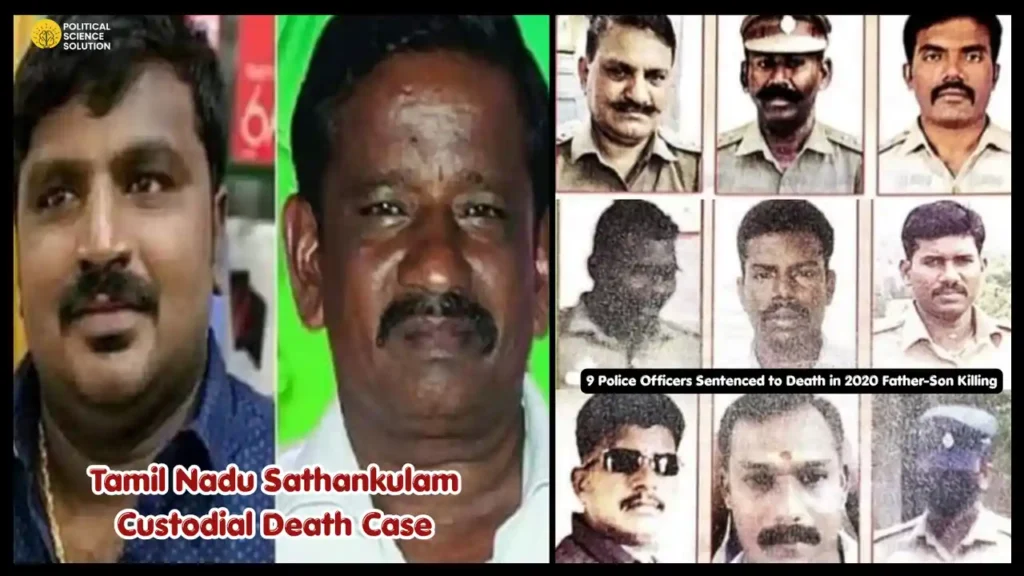
What Happened in the Sathankulam Custodial Deaths?
The tragic incident unfolded on June 19, 2020, in Sathankulam town of Thoothukudi district, Tamil Nadu. P. Jayaraj, a 58-year-old mobile phone shop owner, was detained by police from the Sathankulam police station for allegedly violating COVID-19 lockdown norms by keeping his shop open beyond permitted hours. Investigations later revealed this allegation was entirely false.
When his son, J. Benicks (aged 31), visited the station to inquire about his father’s arrest, he too was detained following a minor altercation. Both men were wrongfully confined at the police station.
According to the prosecution, the father and son were stripped naked and subjected to brutal, relentless torture throughout the night of June 19-20, 2020. They were beaten mercilessly with lathis and other weapons, often in front of each other, as an act of personal vendetta. The victims were forced to clean their own blood from the station floor. Severe injuries, including rectal bleeding, led to their deaths — Benicks on June 22 and Jayaraj on June 23, 2020.
Key evidence included blood-stained lathis, tables, and testimonies from witnesses, including a woman constable. Shockingly, CCTV footage from the station was deliberately deleted as part of a cover-up attempt.
Massive Public Outcry and Investigation by CBI
The deaths sparked widespread protests across Tamil Nadu in 2020. Activists, politicians, and citizens demanded justice, turning the case into a national symbol of police brutality. The Madurai Bench of the Madras High Court closely monitored the probe, preventing local police from suppressing evidence.
Following public pressure, the Tamil Nadu government handed over the investigation to the Central Bureau of Investigation (CBI). The CBI arrested ten police personnel and filed a charge sheet within 90 days, charging them with murder, criminal conspiracy, and destruction of evidence. One accused, Special Sub-Inspector Pauldurai, died during the trial due to COVID-19 complications.
Over five years, the trial saw 105 witnesses examined. The CBI proved that the officers tortured the victims with the clear “intention of killing” to “teach them a lesson on how to behave with the police.”
The Convicted Police Officers
The nine policemen sentenced to death are:
- Former Inspector: S. Sridhar
- Sub-Inspectors: K. Balakrishnan and P. Raghu Ganesh
- Head Constables: S. Murugan and A. Samadurai (also referred to as Saamidurai)
- Constables: M. Muthuraja, S. Chelladurai, X. Thomas Francis, and S. Vailmuthu (also spelled Veilumuthu)
Court’s Strong Observations and Rationale for Death Penalty
Delivering the verdict, First Additional District and Sessions Judge G. Muthukumaran classified the case as falling under the “rarest of the rare” category. The judge made powerful observations:
- The policemen acted with full mental soundness and clear intention to kill unarmed civilians.
- “Where there was power, there should be responsibility.”
- The father and son were “stripped and ruthlessly assaulted in front of each other as an act of vendetta.”
- “The heart shudders on reading about it.”
- Police, who are paid from public money to protect citizens, instead became perpetrators — “a case of the fence eating the crop.”
- The brutality uprooted an entire family and shook the collective conscience of society.
- No leniency should be shown based on age, education, or family background of the convicts.
The court imposed a total fine of ₹1.40 crore on the convicts as compensation to the victims’ family. If unpaid, their properties will be confiscated and auctioned.
Legal Provisions Behind the Death Sentence
Under Indian law, the convictions were primarily under Section 302 of the IPC (now Section 103 of the Bharatiya Nyaya Sanhita) for murder. Courts have consistently held that custodial murders by police officers qualify for the death penalty as they represent gross abuse of authority.
The judgment aligns with the Supreme Court’s “rarest of the rare” doctrine. It also references various safeguards:
Constitutional Safeguards
- Article 20: Protection against arbitrary punishment.
- Article 21: Right to life and personal liberty.
- Article 22: Protection against illegal arrest and detention.
Key Supreme Court Guidelines
- D.K. Basu v. State of West Bengal (1996): 11 guidelines on arrest and detention.
- Paramvir Singh Saini v. Baljit Singh (2020): Mandatory CCTV installation in police stations.
Other Provisions
- NHRC 1993 Guidelines: Custodial deaths must be reported within 24 hours.
- Section 176 CrPC (now Section 196 BNSS): Mandatory judicial magistrate inquiry into custodial deaths.
- Sections 330, 331, and 348 IPC for non-fatal custodial violence.
India has signed but not ratified the UN Convention Against Torture (UNCAT).
Broader Context: Custodial Deaths in India
Custodial death refers to any death in police or judicial custody due to torture or inhuman treatment. It violates fundamental human rights and constitutional values due to the vulnerability of detainees and unequal power dynamics. Challenges include lack of independent investigations, as the same police department often probes its own officers. This perpetuates a culture of violence and erodes public trust in the police as an institution.
Reactions to the Madurai Court Verdict
Amnesty International India’s Aakar Patel called the verdict “a rare moment of accountability” but stressed that structural reforms are essential. He urged India to ratify the UNCAT and allow the UN Special Rapporteur on Torture to visit (requests pending since 1999).
The ruling has been hailed as a strong deterrent message while renewing demands for police reforms, better training, and independent oversight mechanisms.
What Happens Next: Appeals Process and Legal Journey
A death sentence by a sessions court requires mandatory confirmation by the High Court. The nine convicts will now appeal in the Madras High Court, which will review the entire evidence and trial proceedings.
If upheld, they can approach the Supreme Court. Further remedies include review petitions and curative petitions. After exhausting judicial options, they may file mercy petitions before the Governor of Tamil Nadu (Article 161) and the President of India (Article 72).
Executions in India are rare; the last one occurred in March 2020 in the Nirbhaya case.
Historical Precedents of Death Penalty for Custodial Killings
This is not the first such case. In 2018, a CBI court in Thiruvananthapuram sentenced two Kerala police officers to death for the 2005 custodial murder of Udayakumar. However, such strict punishments remain exceptions rather than the norm.
Way Forward: Need for Systemic Police Reforms
While this verdict brings some justice to the family of Jayaraj and Benicks after six long years, experts argue it must lead to broader changes:
- Strict enforcement of CCTV guidelines.
- Independent investigation bodies for custodial deaths.
- Mandatory ratification of UNCAT.
- Regular medical examinations and transparency in custody procedures.
The Sathankulam case serves as a stark reminder that those meant to uphold the law cannot be allowed to break it with impunity.
FAQs
1. Can police officers in India be given the death penalty for custodial deaths?
Yes. If custodial torture results in death, police officers can be charged with murder under Section 302 IPC (Section 103 BNS). Courts treat such cases under the “rarest of the rare” doctrine and can impose the death penalty, as seen in the Sathankulam case.
2. What is the Sathankulam custodial death case?
It refers to the 2020 torture and killing of P. Jayaraj and his son J. Benicks in Sathankulam police station, Thoothukudi, Tamil Nadu. The father-son duo were brutally assaulted for allegedly violating COVID lockdown rules (later proven false) and died within days. Nine policemen were sentenced to death on April 7, 2026.
3. What is the next step after the Madurai court’s death sentence?
The death sentence requires mandatory confirmation by the Madras High Court. The convicted officers will file appeals there. If upheld, they can approach the Supreme Court, file review/curative petitions, and later seek mercy from the Governor or President.
4. What compensation has the court ordered for the victims’ family?
The court has imposed a total fine of ₹1.40 crore on the nine convicts, to be paid as compensation to the family of Jayaraj and Benicks. If the officers do not pay, their properties will be confiscated and sold.
5. Why is India’s custodial death problem so serious?
Custodial deaths violate Articles 20, 21, and 22 of the Constitution. In 2024 alone, the NHRC recorded 2,739 such deaths. Major issues include lack of independent investigations, deleted evidence, and weak implementation of safeguards like D.K. Basu guidelines and CCTV mandates.