

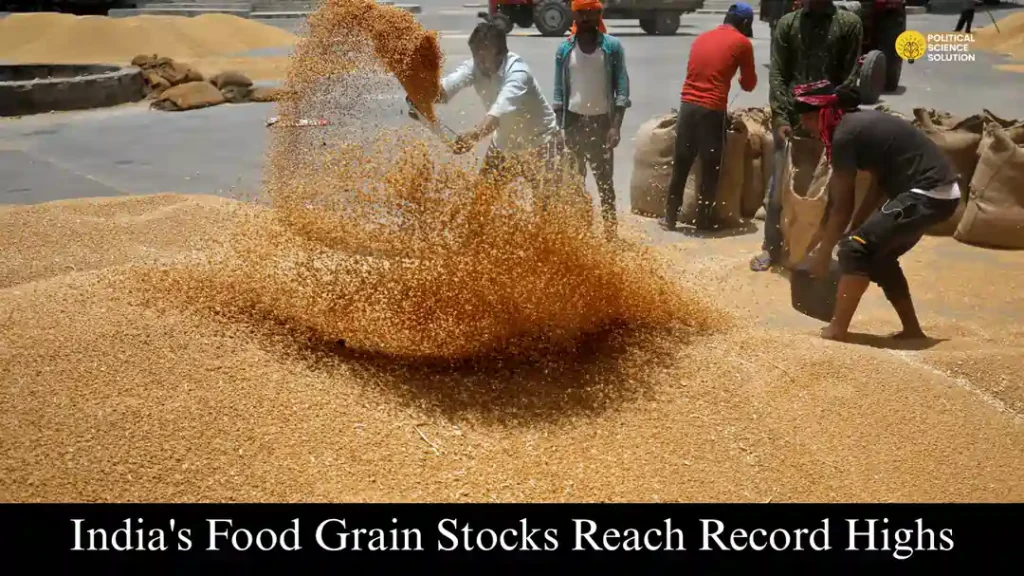
New Delhi: In a significant boost to India’s food security framework, the government has announced that the country’s central pool of food grains has swelled to approximately 602 lakh metric tonnes (LMT), nearly three times the prescribed buffer stock norms. This robust reserve position comes at a time of steady agricultural growth and global supply chain uncertainties, positioning India as one of the most resilient food-producing nations. The announcement was made during a joint inter-ministerial press briefing that also addressed maritime safety in the West Asia and Gulf region amid ongoing regional developments.
Joint Secretary C Shikha from the Department of Food and Public Distribution, under the Ministry of Consumer Affairs, Food and Public Distribution, confirmed the strong stock levels while addressing the media on Monday. “We have adequate buffer stock of both wheat and rice, three times the buffer stock norms,” she stated. India currently holds around 222 LMT of wheat and approximately 380 LMT of rice. This massive accumulation ensures uninterrupted supplies for the Public Distribution System (PDS) and provides a solid cushion for any unforeseen emergencies, such as natural calamities or production shortfalls.
The briefing highlighted how these reserves go far beyond operational requirements, reflecting successful procurement strategies and bumper harvests in recent years. Shikha emphasized that the stocks are more than sufficient to meet regular welfare scheme demands while leaving ample room for crisis response. She also noted positive developments in related sectors, including steady imports from key partners like Indonesia, Malaysia, Russia, Ukraine, Argentina, and Brazil, which have helped maintain overall supply stability. Additionally, improved mustard production has further strengthened domestic availability in the edible oil segment, reducing reliance on external sources.
Complementing the food security update, Additional Secretary Mukesh Mangal from the Ministry of Ports, Shipping and Waterways provided reassurances on maritime operations in the Gulf region. He confirmed that all Indian seafarers remain safe, with no incidents involving Indian-flag vessels reported in the past 24 hours. Two Indian-flag vessels, Green Sanghvi and Green Asha, carrying LPG, successfully transited the Strait of Hormuz in the last two days. Currently, 16 Indian-flagged vessels are operating in the Western Persian Gulf region, carrying a total of 433 Indian seafarers. Earlier assessments had placed 18 vessels and around 485 seafarers in the broader Persian Gulf area. The Ministry has repatriated over 964 seafarers so far while maintaining close coordination with the Ministry of External Affairs, Indian missions abroad, and maritime stakeholders to ensure uninterrupted operations. Ports across India continue to function normally, and about 5,98,000 passengers have returned safely to India amid the evolving security situation in West Asia and the Gulf.
India’s Thriving Foodgrain Production Landscape
The impressive stockpile is underpinned by remarkable progress in India’s agricultural sector. Agricultural exports have grown substantially from USD 34.5 billion in FY20 to USD 51.1 billion in FY25, with the share of processed food rising to 20.4 percent—an indicator of successful value addition and diversification. Horticulture production has reached an impressive 362.08 million tonnes, surpassing traditional foodgrain output and signaling a clear structural shift toward high-value crops.
India continues to dominate global rankings, emerging as the largest producer of pulses at 25.68 million tonnes and millets. The country holds the second position in rice, wheat, fruits, and vegetables production. Leadership extends to high-value segments as well, with India ranking first in spices and coconut production, and second in sugarcane, cotton, and tea.
These achievements reflect a balanced strategy that combines staple crop security with diversification into commercially viable segments, enhancing farmer incomes and export potential while building resilience against climate and market volatility.
Understanding Buffer Stock: Objectives, Policy Framework, and Operational Mechanics
Buffer stock refers to the strategic reserves of essential foodgrains that the government procures, stores, and maintains specifically to address emergencies, stabilize market prices, and support welfare initiatives. It serves as a critical tool in India’s food management architecture, ensuring availability during droughts, floods, crop failures, or sudden demand spikes.
The primary objectives of maintaining buffer stocks are multifaceted. They ensure continuous food security and regular supply even in challenging times. They help manage famines and shortages by providing a reliable backup when agricultural output dips. Buffer stocks directly support the Public Distribution System and schemes under the National Food Security Act, delivering subsidized grains to vulnerable populations. They play a pivotal role in controlling price volatility in the open market by releasing stocks during inflationary pressures. For farmers, they offer price stability through Minimum Support Price (MSP) procurement, preventing distress sales during surplus periods. The mechanism balances overall supply and demand dynamics, extends support to the poor and weaker sections, and enables swift emergency responses.
The policy governing buffer stocks traces its origins to the Fourth Five-Year Plan (1969-74), when the concept was formalized to tackle chronic shortages. The Cabinet Committee on Economic Affairs (CCEA) fixes these norms on a quarterly basis—specifically on the 1st of April, July, October, and January—based on evolving requirements. The total food stock is categorized into operational stock, meant for routine distribution under the Targeted Public Distribution System and other welfare schemes, and food security reserves (the core buffer component) reserved for contingencies.
Typically, the government maintains around four months’ requirement as operational stock, with any excess classified as buffer stock. Both are physically stored together in the central pool managed by the Food Corporation of India (FCI). When stocks exceed minimum norms, they are treated as excess and can be released through open market sales, exports, or additional allocations to states to prevent wastage. India also maintains a dedicated strategic reserve—approximately 30 LMT of wheat and 20 LMT of rice—for extreme emergencies. Since 2015, a separate buffer stock of pulses (around 1.5 LMT) has been operational to curb price fluctuations in this essential category, with agencies like NAFED, SFAC, and FCI handling procurement.
Current Buffer Stock Status: A Position of Strength
As of early 2026, India’s foodgrain stocks stand at a very comfortable level, significantly exceeding minimum requirements. The total availability hovers around 600+ LMT, with rice stocks particularly robust at around 380 LMT and wheat at approximately 220+ LMT. This positions the country with reserves that are two to three times higher than the quarterly buffer norms set by the CCEA. The central pool system ensures these grains are readily available for PDS operations and welfare schemes without interruption.
In addition to regular stocks, the strategic safety reserve remains intact. The government actively manages surplus by releasing grains into the open market or facilitating exports when necessary, demonstrating proactive stewardship of public resources.
Significance of Robust Buffer Stocks in India’s Agri-Economy
The current stock levels carry profound significance. They enable effective price control by allowing timely releases during shortages, thereby shielding consumers from inflationary spikes. Through mechanisms like the Open Market Sale Scheme, the government can directly intervene to moderate food prices. These reserves guarantee food security at the national level, mitigating risks from climate events or production dips. They form the backbone of welfare programs, ensuring subsidized access for millions under PDS. Farmers benefit from assured MSP procurement, gaining income security and protection from market gluts. The system maintains overall market equilibrium by absorbing surpluses and releasing during deficits. In crises—whether natural disasters or pandemics—buffer stocks facilitate rapid distribution. Excess reserves also open avenues for exports, generating foreign exchange while clearing storage pressures. Recent examples, such as large-scale wheat releases in 2022-23, illustrate how these interventions successfully curbed inflation.
Addressing Persistent Challenges in Buffer Stock Management
Despite the strengths, maintaining such large reserves presents notable challenges. Storage infrastructure remains a constraint, with many facilities relying on traditional godowns rather than modern silos, leading to spoilage and wastage. Procurement tends to be imbalanced, favoring wheat and rice over other crops, creating surpluses in some segments and shortages in others. The financial burden is substantial, encompassing procurement, storage, transportation, and distribution costs, which strain government budgets. Rising MSPs and FCI’s operational expenses—including handling charges, administrative overheads, and cesses—further inflate the food subsidy bill.
Other issues include leakages and corruption within the PDS, quality deterioration due to prolonged storage in suboptimal conditions, logistical bottlenecks in moving grains to remote areas, and environmental impacts from large-scale storage and transport. High maintenance costs and dependence on outdated systems add to long-term sustainability concerns.
Strategic Measures and Reforms for a Future-Ready System
To overcome these hurdles, several forward-looking measures are being emphasized. Procurement diversification beyond rice and wheat—to include pulses, oilseeds, vegetables, and even skimmed milk powder—would broaden price stabilization coverage. Scientific advancements, such as onion irradiation for extended shelf life of perishables, are being adopted. Buffer norms should be determined through data-driven analysis incorporating population trends, consumption patterns, and demand forecasts, shifting toward dynamic, real-time adjustments based on weather, production, and market data.
Technology integration—including blockchain for traceability, IoT for monitoring, and advanced weather forecasting—can enhance efficiency and transparency. Financial management improvements, such as optimized procurement and reduced inefficiencies, are essential. Encouraging private sector participation in storage, logistics, and supply chains through public-private partnerships (PPP) would bring investment and expertise. Clear separation of objectives (price control, food security, and farmer support) would streamline operations. Modernization of storage via climate-controlled silos and smart warehouse systems is a priority. Reforms in PDS, decentralized procurement, and regional storage hubs would minimize leakages and regional imbalances. Eco-friendly practices, including solar-powered facilities and sustainable packaging, are gaining traction to reduce the environmental footprint.
Institutional Pillars: Food Corporation of India and Commission for Agricultural Costs and Prices
At the heart of this system lies the Food Corporation of India (FCI), established in 1965 under the Food Corporations Act, 1964, during a period of acute shortages. As a public sector undertaking under the Department of Food and Public Distribution, FCI handles procurement at MSP, storage, transportation, and distribution. Its core objectives include ensuring fair prices for farmers, supplying subsidized grains to PDS beneficiaries, and maintaining buffer stocks for stability. FCI operates through a nationwide network of offices and continuously assesses storage capacity to bridge gaps.
Complementing FCI is the Commission for Agricultural Costs and Prices (CACP), also set up in 1965 (originally as the Agricultural Prices Commission and renamed in 1985). Working under the Ministry of Agriculture and Farmers Welfare, CACP recommends MSPs for 23 major crops based on detailed studies of production costs, market trends, demand-supply dynamics, and international prices. Through field surveys, stakeholder consultations, and data analysis, it advises on pricing, trade policies, input costs, crop insurance, and farmer welfare measures. The commission comprises a Chairman, Member Secretary, members, and technical experts, playing a vital advisory role in aligning agricultural pricing with national goals.
Looking Ahead: A Model of Food Security for the Nation
With stocks at three times the buffer norms, India stands in a position of exceptional strength. This achievement not only safeguards domestic food needs but also enhances the country’s ability to support global food security efforts through potential exports. Continued focus on modernization, diversification, and technological upgrades will ensure that buffer stock management evolves into an even more efficient, sustainable, and responsive system.
As India navigates an era of climate challenges and geopolitical uncertainties, these reserves—built through the dedication of farmers, policymakers, and institutions like FCI and CACP—underscore a commitment to self-reliance and inclusive growth. The government has affirmed it will continue close monitoring and timely interventions to maintain this stability.
This comprehensive stock position, combined with production diversification and maritime resilience, reinforces India’s status as a global agricultural powerhouse ready to meet both domestic and international responsibilities in 2026 and beyond.
FAQs
1. What is the current status of India’s food grain stocks in 2026?
India’s food grain reserves have reached about 602 lakh metric tonnes (LMT), which is nearly three times the prescribed buffer stock norms, ensuring strong food security and supply stability.
2. Why are buffer stocks important for India?
Buffer stocks help ensure food security, price stability, and emergency preparedness. They support welfare schemes like the Public Distribution System (PDS), stabilize market prices, and provide relief during natural disasters or production shortfalls.
3. What factors contributed to the rise in food grain stocks?
The increase is driven by bumper harvests, effective procurement strategies, and strong agricultural growth, along with stable imports and improved domestic production across crops like mustard and pulses.
4. What challenges does India face in managing such large buffer stocks?
Key challenges include storage limitations, high financial costs, wastage risks, imbalance in procurement (mainly wheat and rice), and inefficiencies in distribution systems like PDS.
5. What reforms are suggested to improve buffer stock management?
Proposed measures include modern storage systems (silos), technology integration (IoT, blockchain), diversification of procurement, private sector participation, and data-driven buffer norms to enhance efficiency and sustainability.