
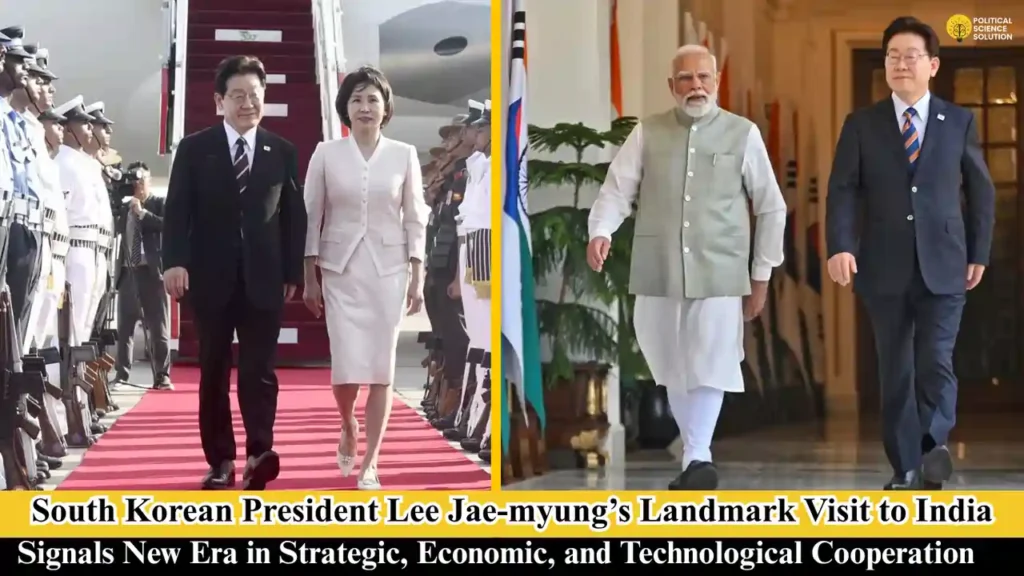
New Delhi: In a significant diplomatic development that underscores the evolving geopolitical and economic landscape of Asia, Lee Jae-myung, President of South Korea, undertook a historic three-day state visit to India beginning on April 20, 2026. The visit, marked by high-level engagements with Narendra Modi and Droupadi Murmu, is being widely viewed as a milestone moment in strengthening the India–Republic of Korea (ROK) Special Strategic Partnership.
A Strategic Visit Amid Global Uncertainty
President Lee arrived in New Delhi on Sunday, April 19, 2026, along with First Lady Kim Hea-kyung, marking the start of his first official visit to India since assuming office. The three-day visit, spanning April 19–21, 2026, comes at a time of heightened global economic instability and supply chain disruptions, exacerbated by geopolitical tensions, including developments following the Middle East conflict in February 2026.
In his remarks, Lee emphasized that India and South Korea are increasingly vital strategic partners in navigating global uncertainties. His visit reflects a shared commitment to strengthening economic resilience and regional cooperation.
Ceremonial Welcome and Diplomatic Engagements
On April 20, 2026, President Lee was accorded a ceremonial reception at Rashtrapati Bhavan, where he was welcomed by President Murmu and Prime Minister Modi. The grand reception featured cultural performances and a guard of honour, symbolizing the deepening ties between the two nations.
Later the same day, Lee held high-level talks with Prime Minister Modi, focusing on key areas such as shipbuilding, trade, artificial intelligence, semiconductors, and emerging technologies.
Tribute at Rajghat
On April 21, 2026, President Lee and the First Lady visited Rajghat to pay tribute to Mahatma Gandhi. The wreath-laying ceremony underscored the shared values of peace and mutual respect that underpin India–South Korea relations.
Joint Strategic Vision 2026–2030: A Roadmap for the Future
A major outcome of the visit was the unveiling of the Joint Strategic Vision (2026–2030), a forward-looking framework designed to guide bilateral cooperation over the next five years. This roadmap includes the institutionalization of annual leader-level meetings, ensuring sustained political engagement and strategic alignment.
Expanding Economic Cooperation and Trade Goals
Economic collaboration emerged as a central focus, with both nations setting a target to double bilateral trade to $54 billion by 2030, up from approximately $27 billion currently.
The discussions also revisited the Comprehensive Economic Partnership Agreement (2010), with India seeking an upgrade to address the existing trade deficit of over $15 billion and promote a more balanced economic relationship.
Technological Collaboration: Building the Future
The visit saw the launch of the India-Korea Digital Bridge, aimed at strengthening cooperation in artificial intelligence, semiconductors, and information technology. This initiative reflects the growing importance of technological collaboration in shaping future economic growth.
Maritime and Defence Cooperation
Both countries agreed to deepen maritime cooperation through a comprehensive partnership in shipbuilding and logistics, guided by the VOYAGES framework. Defence ties were also highlighted, building on the 2020 Roadmap to Defence Industry Cooperation, which includes joint manufacturing initiatives such as the K9 Vajra howitzers.
Climate and Sustainability Initiatives
Climate cooperation featured prominently, with South Korea joining the International Solar Alliance and India becoming a member of the Global Green Growth Institute, established during the Rio+20 Conference in 2012.
Indo-Pacific and Regional Alignment
South Korea’s participation in the Indo-Pacific Oceans Initiative marks a significant step in aligning strategic interests in the region, reinforcing a shared commitment to a free and open Indo-Pacific.
Cultural Diplomacy and Future Engagements
To strengthen people-to-people ties, both nations designated 2028–2029 as the “Year of India–ROK Friendship.” Additionally, the proposed Mumbai Korea Centre will promote cultural collaboration between K-pop and Bollywood.
Historical Context and Growth of Bilateral Relations
India and South Korea elevated their relationship to a Special Strategic Partnership in 2015, marking a turning point in bilateral ties. Trade between the two nations has grown significantly, reaching approximately $26.89 billion in the financial year 2024–25, up from $14.2 billion at the time of the CEPA’s implementation in 2010.
Conclusion
President Lee Jae-myung’s visit, spanning April 19–21, 2026, represents a defining chapter in India–South Korea relations. With the Joint Strategic Vision (2026–2030) providing a clear roadmap, both countries are poised to deepen cooperation across economic, technological, cultural, and strategic domains.
As the global landscape continues to evolve, the strengthened partnership between India and South Korea is set to play a pivotal role in shaping regional stability and economic growth in the years leading up to 2030 and beyond.
FAQs
1. When did South Korean President Lee Jae-myung visit India?
Lee Jae-myung visited India from April 19 to April 21, 2026, marking his first official state visit to the country after assuming office. The visit included key meetings and ceremonial events in New Delhi.
2. What was the main objective of Lee Jae-myung’s India visit?
The primary goal of the visit was to strengthen the India–South Korea Special Strategic Partnership through cooperation in trade, defence, technology, and regional security. Discussions with Narendra Modi focused on shipbuilding, artificial intelligence, semiconductors, and supply chain resilience.
3. What is the Joint Strategic Vision 2026–2030?
The Joint Strategic Vision (2026–2030) is a roadmap agreed upon by India and South Korea to deepen cooperation across multiple sectors. It includes initiatives such as annual leadership meetings, technological partnerships, climate collaboration, and increased economic engagement.
4. What are the trade goals between India and South Korea?
Both countries aim to double their bilateral trade to $54 billion by 2030, up from around $27 billion currently. Efforts are also underway to upgrade the Comprehensive Economic Partnership Agreement (2010) to address trade imbalances and boost mutual growth.
5. What cultural initiatives were announced during the visit?
India and South Korea announced that 2028–2029 will be celebrated as the “Year of India–ROK Friendship.” Additionally, a Mumbai Korea Centre will be established to promote cultural exchange, including collaboration between K-pop and Bollywood industries.