

New Delhi: In a significant development reinforcing the foundations of India’s constitutional democracy, the Supreme Court has unequivocally stated that majoritarianism cannot override constitutional principles. This landmark observation came during the ongoing hearing by a nine-judge Constitution Bench examining critical questions on religious freedom, particularly in the context of the Sabarimala temple entry dispute and broader issues affecting multiple faiths.
The remarks underscore a core tension in Indian jurisprudence: balancing majority sentiments in a democracy with the inviolable safeguards enshrined in the Constitution. As the apex court deliberates on seven substantial legal questions framed in the 2019 review of the 2018 Sabarimala judgment, its observations signal a firm commitment to constitutionalism over unchecked majoritarian impulses.
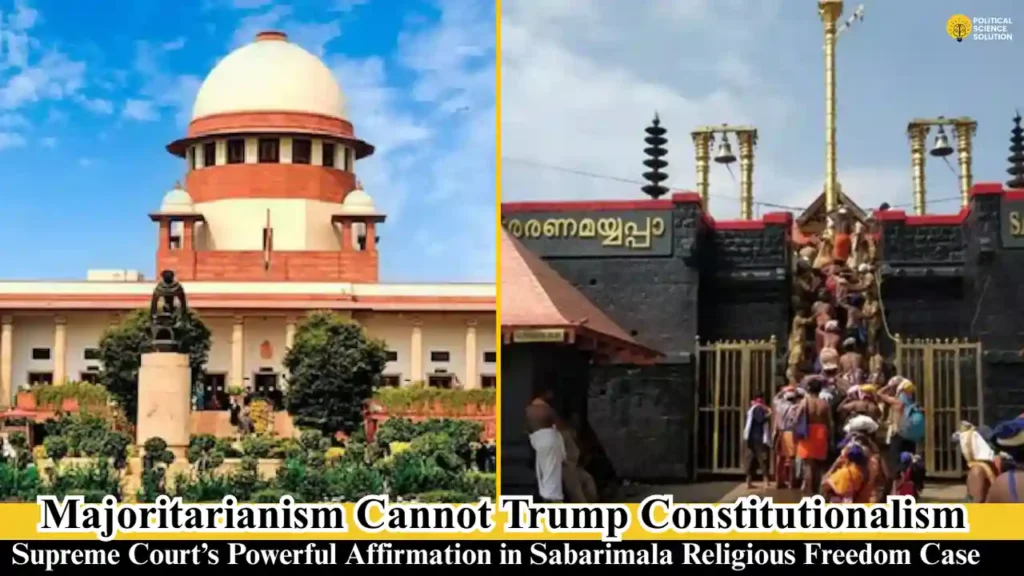
Supreme Court Bench and Context of the Hearing
The nine-judge Constitution Bench, headed by Chief Justice of India Surya Kant, includes Justices BV Nagarathna, MM Sundresh, Ahsanuddin Amanullah, Aravind Kumar, Augustine George Masih, Prasanna B Varale, R Mahadevan, and Joymalya Bagchi. The bench is hearing the Sabarimala reference matter on its 15th day, addressing the interplay between religious freedoms under Articles 25 and 26, the right to equality under Article 14, and related constitutional provisions.
The case traces back to the Supreme Court’s 2018 verdict that allowed women of all ages to enter the Sabarimala Temple in Kerala, overturning a long-standing custom restricting entry of women of menstruating age. Review petitions in 2019 led to the framing of larger questions on religious practices, which are now under scrutiny. These questions explore the scope of judicial review in religious matters, essential religious practices, and protections for various faiths, including practices among the Dawoodi Bohras.
“Majoritarianism Cannot Trump Constitutionalism”: Justice Bagchi’s Landmark Observation
During the proceedings, Justice Joymalya Bagchi delivered a clear message distinguishing democratic majoritarianism from constitutional boundaries. “It is not majoritarianism which the Court is bothered about. The Court is essentially bothered about majoritarianism trumping constitutionalism and that is the lakshman rekha,” he remarked.
Justice Bagchi elaborated that India operates as both a democracy, where decisions are tested by numbers, and a constitutional democracy. “Even if a majority feels that a particular thing is to be done, the courts have that role to test that decision from the constitutional principles,” he stated. This intervention came in response to arguments by Solicitor General Tushar Mehta, who suggested a restricted scope for judicial review in religious matters, advocating that such issues should largely be left to the legislature.
Justice Ahsanuddin Amanullah challenged this position, questioning whether decisions should be deferred purely due to majoritarian pressures. When Mehta clarified that democracy inherently means majority rule, Justice Bagchi reinforced the constitutional check, emphasizing the court’s duty to ensure adherence to fundamental principles.
Chief Justice Surya Kant intervened to contextualize the debate, noting that religious practices under Article 25 are protected equally for both majorities and minorities. “The question of religious practice has nothing to do with majoritarian principle or minority principle. Minorities can have their own religious practices, the majorities can have their own rights. All are protected under 25,” the CJI observed.
Justice Bagchi further highlighted the language of Article 25(1), stressing the phrase “equally entitled” as signifying equal rights irrespective of numerical strength. “That is precisely the significance of the phrase ‘equally entitled.’ ‘Equally’ is preceded by ‘all’ and followed by ‘freely’,” he added. The Solicitor General agreed that entitlement remains equal regardless of a religion’s size.
The CJI also pointed out the religion-neutral nature of Article 25(1) while noting that Article 25(2) includes specific conditions for Hindu practices, referencing Article 17’s prohibition on untouchability.
Constitutionalism: Limiting Governmental Power and Safeguarding Rights
The Supreme Court’s observations align with the broader concept of constitutionalism, which limits government power through a written constitution. This framework safeguards fundamental freedoms, upholds the rule of law (as seen in Article 14’s guarantee of equality before the law), protects democracy through fair elections, ensures accountability via institutions like the Comptroller and Auditor General (CAG), and enforces separation of powers.
Crucially, constitutionalism acts as a check against majoritarianism by protecting the rights of marginalized groups, including linguistic and religious minorities under Articles 29 and 30. Historical judicial precedents reinforce this:
- Kesavananda Bharati v. State of Kerala (1973): Established the Basic Structure Doctrine, preventing amendments that alter the Constitution’s core principles.
- Rameshwar Prasad v. Union of India (2006): Emphasized that constitutionalism abhors absolutism and rests on the rule of law.
- I.R. Coelho v. State of Tamil Nadu (2007): Highlighted the need for control over governmental power to preserve democratic principles.
These cases illustrate the judiciary’s role in maintaining constitutional supremacy even amid popular or legislative pressures.
Arguments Presented Before the Bench
Solicitor General Tushar Mehta, representing the Centre, argued for a very restricted scope of judicial review in religious matters. He contended that courts should ordinarily defer to the legislature, which engages in detailed consultative processes before enacting reforms. Mehta cited examples like the abolition of Sati as instances of internal reform driven by societal and legislative action, questioning whether the court should act as a reformer of religion.
Mehta emphasized that Articles 25 and 26 must be read together, with Article 26 representing the collective manifestation of individual rights under Article 25. He cautioned against treating Article 26 as a standalone provision, warning it could destabilize interpretations of other constitutional rights. While not advocating complete ouster of judicial review, he advocated a highly restrictive approach, arguing that ordinary Article 14 arbitrariness tests may not apply directly to religious beliefs, which may lack causal connections in the conventional sense.
Mehta also addressed the essentiality test applied by courts to religious practices, noting its absence in the constitutional text and questioning its permissibility. He stressed viewing issues from the perspective of a believer within the faith’s protected belief system.
Prof G Mohan Gopal, representing the Kerala-based Sree Narayana Manavadharman Trust, raised concerns about the silencing of internal reformist voices within religions. He framed the issue as “faith in God versus faith in clergy,” advocating for individual conscience and agency. Gopal argued that constitutional jurisprudence over 75 years has not adequately supported reformist forces emerging from within communities.
Justice BV Nagarathna responded by describing Hinduism as a way of life rather than a rigid set of mandatory rituals. “It is not necessary for a Hindu to mandatorily go to a temple or perform a ritual. He or she still remains a Hindu,” she observed. The CJI agreed that no formal judgment was needed for this understanding, as it is integral to the religion. Justice Nagarathna added that even simple acts like lighting a lamp suffice to express faith, and no one can interfere with personal belief.
Advocate Sneha Kalita argued that ancient customs cannot remain immune from constitutional scrutiny in a modern democracy governed by transformative constitutionalism. She drew a comparative illustration from Nepal’s Chaupadi system, where menstruating women were isolated, though the practice has since been abolished.
Senior Advocate Indira Jaising addressed the doctrine of proportionality, clarifying it has primarily operated in administrative law contexts rather than direct clashes between fundamental rights. She suggested the “substantial injury test” as a better approach: minor injuries might allow precedence to one right, while substantial injuries require determining which right prevails or yields.
Senior Advocate CS Vaidyanathan submitted that the Constitution imposes no minimum numerical requirement or formal organizational structure for a denomination. He distinguished mutts from public temples, arguing Article 25(2)(b) does not apply to private mutts even when co-located with temples.
Senior Advocate Abhishek Manu Singhvi cautioned against universalizing the social reform power under Article 25(2)(b), which specifically targets Hindu public institutions due to historical caste exclusions. He described freedom of conscience and religion as substantive rights forming part of a “golden quadrilateral” with liberty, equality, and dignity.
Singhvi outlined areas where courts should refrain: determining rationality or irrationality of practices, labeling them progressive or regressive, abstract essentiality tests, or redesigning faiths based on dissenting views or judicial preferences. The CJI echoed this, warning against the court assuming the role of a “super-spiritual authority.”
Broader Implications and Next Steps
The hearing also touched upon judicial encouragement of legislative reform, as seen in directions regarding witchcraft practices. Justice Bagchi noted the court’s supplementary role in pushing legislatures toward constitutional goals without supplanting them.
The bench is set to continue hearings, with the outcome expected to shape the future of religious freedom jurisprudence in India. By emphasizing that courts can interfere in practices violating public order, morality, or health, the Supreme Court is drawing clear boundaries while respecting the autonomy of faith where it aligns with constitutional ethos.
This case represents far more than the Sabarimala temple entry issue. It tests the judiciary’s role in navigating faith, reform, equality, and tradition in a diverse democracy. As arguments conclude, the nine-judge bench’s verdict will likely reaffirm that in India’s constitutional democracy, no majority—however strong—can override the fundamental principles that protect every citizen’s rights.
The Supreme Court’s stance serves as a timely reminder: democracy thrives not through unchecked numerical dominance but through unwavering fidelity to constitutional values. In an era where majoritarian impulses can sometimes challenge institutional safeguards, this hearing reinforces the judiciary’s critical function as the guardian of the Constitution’s basic structure and the rights of all, irrespective of faith or numbers.
FAQs
1. What did the Supreme Court mean by “Majoritarianism cannot trump constitutionalism”?
The Supreme Court, through Justice Joymalya Bagchi, clarified that while India is a democracy where majority rule prevails, courts must always test decisions against constitutional principles. Even if a majority supports a particular action or practice, it cannot override fundamental rights and constitutional values. This “lakshman rekha” ensures that majoritarian impulses do not infringe upon the rights of individuals or minorities. The observation was made during the nine-judge bench hearing on the Sabarimala reference case concerning religious freedom.
2. What is the Sabarimala reference case before the Supreme Court?
The case originates from the 2018 Supreme Court verdict that allowed women of all ages to enter the Sabarimala Temple in Kerala. After review petitions in 2019, the Court framed seven larger legal questions on the scope of religious freedom under Articles 25 and 26, their interplay with Article 14 (equality), essential religious practices, and judicial review limits. A nine-judge Constitution Bench headed by CJI Surya Kant is currently hearing the matter, which also covers practices in other faiths including Dawoodi Bohras.
3. What is Constitutionalism and why is it important in India?
Constitutionalism is a system where government power is limited by the Constitution. It safeguards fundamental rights, upholds the rule of law (Article 14), ensures separation of powers, protects minority rights (Articles 29 and 30), and prevents majoritarianism from violating individual freedoms. Key cases like Kesavananda Bharati (1973) established the Basic Structure Doctrine, reinforcing that constitutional principles cannot be altered even by amendments or majority will.
4. What were the main arguments by the Solicitor General and petitioners?
Solicitor General Tushar Mehta argued for a very restricted scope of judicial review in religious matters, stating that reforms should primarily be left to the legislature. He emphasized reading Articles 25 and 26 together and viewing issues from a believer’s perspective.
Petitioners and senior advocates like Prof G Mohan Gopal, Indira Jaising, Abhishek Manu Singhvi, and CS Vaidyanathan stressed internal reform, individual conscience, transformative constitutionalism, and argued that ancient customs cannot remain immune from scrutiny if they violate equality or cause substantial injury. The Court highlighted that Article 25 protects all religions equally.
5. What are the key observations made by the judges during the hearing?
• Justice Bagchi: Majoritarianism cannot trump constitutionalism.
• CJI Surya Kant: Religious practices under Article 25 are religion-neutral and equally protected for majorities and minorities.
• Justice Nagarathna: Hinduism is a way of life; mandatory temple visits or rituals are not required to remain a Hindu.
• The bench noted courts can interfere if practices violate public order, morality, or health, and emphasized the judiciary’s role in encouraging legislative reforms without acting as a super-religious authority.