

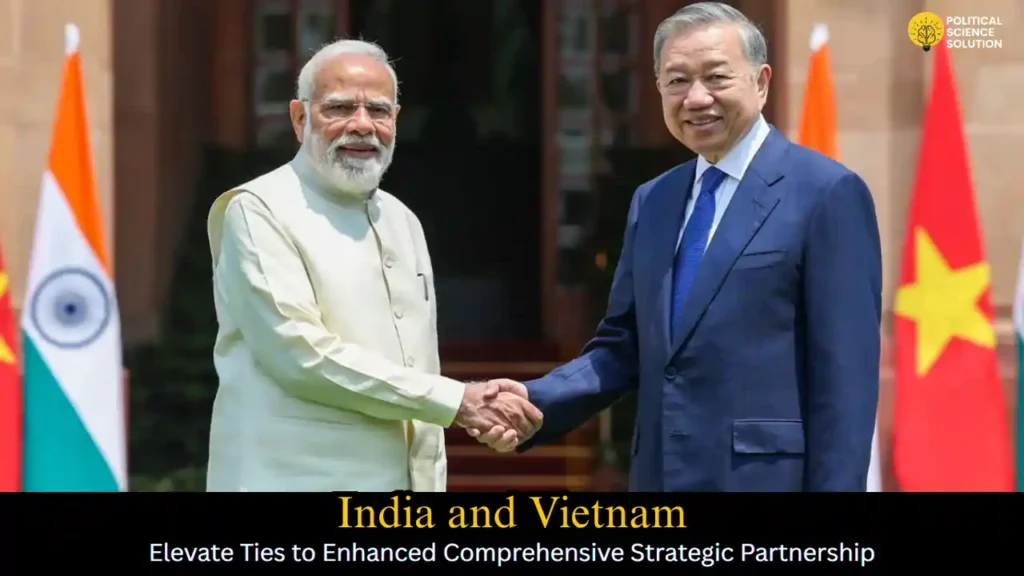
New Delhi: In a significant development underscoring deepening strategic convergence in the Indo-Pacific, India and Vietnam have upgraded their bilateral relations to an Enhanced Comprehensive Strategic Partnership. The elevation, announced during the state visit of Vietnamese President and General Secretary of the Communist Party of Vietnam, To Lam, to India from May 5 to 7, 2026, builds upon the Comprehensive Strategic Partnership established in 2016 and the foundational Strategic Partnership forged in 2007—marking India’s first such arrangement with any ASEAN nation.
Prime Minister Narendra Modi and President To Lam held extensive bilateral discussions in New Delhi on May 6-7, 2026, setting ambitious targets and signing multiple agreements aimed at fostering greater economic integration, defence collaboration, technological innovation, and regional stability. This upgrade reflects the evolving geopolitical realities and mutual interests in building resilient supply chains, ensuring maritime security, and promoting a rules-based international order.
Historical Foundations and the Road to Enhanced Partnership
India and Vietnam share deep historical and cultural bonds, with the relationship gaining momentum in the modern era through consistent diplomatic engagement. The 2007 Strategic Partnership laid the groundwork, which was further strengthened to a Comprehensive Strategic Partnership in 2016. The latest elevation to “Enhanced” status signals a commitment to more ambitious goals across multiple domains.
PM Modi, during the meeting, emphasized the trajectory: the partnership would now aim for loftier objectives spanning culture, connectivity, capacity building, security, sustainability, and supply chain resilience. He highlighted how bilateral trade had doubled over the past decade to around $16 billion, with both nations now targeting $25 billion by 2030.
Ambitious Trade Targets and Economic Cooperation
Economic ties form a cornerstone of the upgraded partnership. Leaders set a clear bilateral trade goal of $25 billion by 2030, up from approximately $16.46 billion recorded in 2025. This comes amid robust growth momentum, with two-way trade reaching $4.8 billion in the first quarter of 2026 alone—a 28% increase year-on-year.
Vietnam’s exports to India stood at $11.6 billion in FY 2025-26, while imports from India were around $6.7 billion. Both sides have committed to removing trade barriers and enhancing market access, particularly in agriculture. Vietnam will open its markets further to Indian grapes and pomegranates, while India will facilitate imports of Vietnamese durian and pomelo, with technical discussions ongoing for expanded access.
A key focus is the early review and conclusion of the ASEAN-India Trade in Goods Agreement (AITIGA) to boost regional trade facilitation. Additionally, an MoU between drug regulatory authorities aims to improve access for Indian pharmaceuticals in Vietnam, while cooperation in fisheries, aquaculture (including pangasius breeding and mussel procurement), and agricultural products is set to deepen.
The partnership emphasizes supply chain integration and diversification away from over-reliance on single sources. Vietnam has pledged to increase imports from India to support its production and exports, aligning with India’s push for resilient global value chains.
Landmark MoUs: 13 Agreements Across Key Sectors
During the visit, leaders witnessed the signing of 13 strategic MoUs covering a wide spectrum of cooperation. These pacts underscore the multifaceted nature of the enhanced partnership:
- Critical Minerals and Rare Earths: MoU between IREL (India) Ltd. and Vietnam’s Institute for Technology of Radioactive and Rare Elements (ITRRE) for cooperation in rare earth elements and emerging technologies.
- Cultural Exchanges: Five-year Cultural Exchange Program (2026–2030) between the Ministries of Culture.
- Digital Payments: MoU between Reserve Bank of India (RBI) and State Bank of Vietnam (SBV) on payment systems and digital payment innovation.
- Healthcare and Pharmaceuticals: MoU between India’s CDSCO and Vietnam’s Drug Administration for regulation of medical products, biologics, devices, and cosmetics.
- Urban Cooperation: MoU on Friendship and Cooperation between Mumbai and Ho Chi Minh City for urban management and economic development.
- India Studies Chair: ICCR MoU with University of Science and Education, Da Nang University.
- Capacity Building: MoU between Nalanda University and Ho Chi Minh National Academy of Politics.
- Digital Technologies: Collaboration between India’s Ministry of Electronics and IT and Vietnam’s Ministry of Science and Technology.
- QR Code Payments: MoU between NPCI International Payments Ltd. (NIPL) and NAPAS for cross-border QR code interoperability.
- Auditing Cooperation: Renewed MoU between Comptroller and Auditor General of India and Vietnam’s State Audit Office.
- Tourism: MoU between tourism ministries to promote sustainable two-way tourism, including cultural, medical, and wellness segments.
- Another India Studies Chair: ICCR agreement with University of Social Sciences and Humanities.
- Cham Manuscripts Digitization: MoU between Gyan Bharatam and USSH, VNUHCM, for conservation and online dissemination of ancient Cham manuscripts of Indian origin.
These agreements span critical minerals, digital connectivity, FinTech, healthcare, culture, education, and more, providing a robust framework for practical implementation.
Defence, Security, and Maritime Collaboration
Defence and security remain a key pillar. Both nations agreed to establish a Strategic Diplomacy-Defence Dialogue (2+2 format). Defence Minister Rajnath Singh met Vietnam’s Deputy Prime Minister and Defence Minister General Phan Van Giang, reviewing ongoing cooperation and planning deeper engagement. Singh is expected to visit Vietnam in the second half of May 2026.
Cooperation will expand in traditional and emerging areas including policy dialogues, joint exercises, staff talks, joint research, co-production of defence technologies, port calls, peacekeeping, information sharing, hydrography, capacity building, defence industrial cooperation, maritime security, and search and rescue.
Vietnam formally joined India’s Indo-Pacific Oceans Initiative (IPOI), a voluntary, non-treaty framework launched by India in 2019 to promote a free, open, and rules-based Indo-Pacific. This move strengthens maritime integration.
On the South China Sea, the joint statement reaffirmed commitment to freedom of navigation and overflight, peaceful resolution of disputes per the 1982 UNCLOS, non-militarization, self-restraint, full implementation of the Declaration on the Conduct of Parties (DOC), and early conclusion of a Code of Conduct (COC). This stance aligns both countries’ positions on maintaining peace and stability without threat or use of force.
Strategic Significance for India’s Act East Policy and Beyond
Vietnam holds immense importance for India as a core ASEAN partner under the Act East Policy, Vision MAHASAGAR, and broader Indo-Pacific vision. Its geostrategic location enhances secure trade routes. Cooperation supports supply chain diversification, particularly in critical minerals and rare earths, reducing dependence on single suppliers.
Energy security is another vital area, with Indian companies already invested in oil and gas exploration in Vietnamese waters of the South China Sea. Joint projects will continue in accordance with international law.
Vietnamese President To Lam outlined five key directions for the future:
- Strengthening strategic trust in defence, security, and multilateral forums.
- Enhancing connectivity via infrastructure, logistics, digitalization, and value chains, plus business and pharma ties.
- Boosting science, innovation, and strategic technologies like semiconductors, AI, and digital transformation.
- Expanding cultural, educational, tourism, and youth exchanges.
- Promoting regional peace, stability, and prosperity through institutional cooperation.
Investment Flows and Business Opportunities
As of March 2026, Indian investors had 503 active projects in Vietnam worth about $1.117 billion, ranking 26th among investors. Focus areas include manufacturing (62 projects, $643 million), electricity/gas, and mining. Notable projects feature Son Hoa Sugar Factory, Ngon Coffee, and Infra 1 Solar Power Plant.
Conversely, Vietnamese investments in India total nearly $150.5 million across 30 projects. Vingroup’s planned electric vehicle manufacturing facility in Tamil Nadu, with ambitions to scale investment to $6.5 billion, highlights growing momentum.
The upgraded partnership opens doors in manufacturing, infrastructure, renewable energy, pharmaceuticals (Indian firms in Vietnamese public tenders from 2027), AI, 6G, biotechnology, space, nuclear technology, tourism, and digital payments. Expanded air connectivity, QR code interoperability, and people-to-people ties will further catalyze business exchanges.
Outlook: A Model for Regional Resilience
The Enhanced Comprehensive Strategic Partnership between India and Vietnam represents more than a bilateral upgrade—it is a strategic response to global uncertainties, emphasizing trust, mutual benefit, and shared values of sovereignty and rules-based order. By integrating supply chains, advancing defence ties, harnessing technology, and safeguarding maritime commons, both nations are positioning themselves as key pillars of stability and prosperity in the Indo-Pacific.
As implementation of the 13 MoUs and the 2024-2028 Action Program progresses, businesses, policymakers, and citizens on both sides stand to gain from deeper integration. This partnership not only strengthens bilateral bonds but also contributes meaningfully to ASEAN-India relations and the broader vision of a free and open Indo-Pacific.
FAQs
1. What is the Enhanced Comprehensive Strategic Partnership between India and Vietnam?
The Enhanced Comprehensive Strategic Partnership is the upgraded bilateral relationship between India and Vietnam, announced during Vietnamese President To Lam’s visit to India on May 6-7, 2026. It elevates the Comprehensive Strategic Partnership established in 2016 (and the original Strategic Partnership of 2007). The new framework aims for deeper cooperation in trade, defence, security, technology, supply chains, healthcare, digital connectivity, and maritime security, with an ambitious target of increasing bilateral trade to $25 billion by 2030.
2. What are the key outcomes and agreements from the India-Vietnam summit 2026?
Major outcomes include:
◦ Bilateral trade target raised to $25 billion by 2030 (from ~$16.46 billion in 2025).
◦ Signing of 13 strategic MoUs covering critical minerals & rare earths, digital payments (QR code interoperability), pharmaceuticals, digital technology, tourism, culture, Cham manuscripts digitization, urban cooperation, and education.
◦ Establishment of a Strategic Diplomacy-Defence Dialogue (2+2).
◦ Vietnam joining India’s Indo-Pacific Oceans Initiative (IPOI).
◦ Enhanced defence and maritime cooperation, including joint exercises, co-production, and port calls.
◦ Greater market access for agricultural products (Indian grapes/pomegranates to Vietnam and Vietnamese durian/pomelo to India).
3. Why is the India-Vietnam partnership important for both countries?
Vietnam is a key pillar of India’s Act East Policy and Indo-Pacific strategy. The partnership helps both nations diversify supply chains, reduce dependence on single-country sources (especially for critical minerals and rare earths), boost energy security through oil & gas exploration in the South China Sea, and strengthen maritime security. It also supports a rules-based order, freedom of navigation, and peace in the South China Sea as per UNCLOS. For businesses, it opens opportunities in manufacturing, renewable energy, pharmaceuticals, AI, semiconductors, and tourism.
4. How will the Enhanced Partnership benefit businesses and investors?
The upgrade signals strong opportunities in:
- Trade & Supply Chains: Easier market access and AITIGA review.
- Investment: Indian firms can participate in Vietnam’s public pharmaceutical tenders from 2027; expanded cooperation in renewable energy, infrastructure, and high-tech manufacturing.
- Digital Economy: QR code payment connectivity and digital transformation initiatives.
- Tourism & Connectivity: More direct flights and people-to-people exchanges.
- Technology: Collaboration in AI, 6G, biotechnology, space, and nuclear technology.
As of early 2026, Indian investment in Vietnam already stands at over $1.1 billion across 503 projects, while Vietnamese investment (including Vingroup’s EV plans) in India is growing rapidly.
5. What is the significance of the South China Sea and defence cooperation in India-Vietnam relations?
Both countries reaffirmed their commitment to freedom of navigation, overflight, and peaceful resolution of disputes as per the 1982 UNCLOS. They called for non-militarization, self-restraint, full implementation of the DOC, and early conclusion of the Code of Conduct (COC) in the South China Sea. On the defence front, the two sides agreed to expand joint exercises, defence industrial cooperation, co-production of technologies, maritime security, and information sharing. Vietnam’s joining of the IPOI further strengthens maritime collaboration in the Indo-Pacific.