

New Delhi: The National Crime Records Bureau (NCRB) has released its much-awaited Crime in India 2024 report, painting a complex picture of law and order in the country. While traditional cognisable crimes registered a notable decline, emerging threats like cybercrime, economic frauds, and drug overdoses have surged, highlighting new vulnerabilities in a rapidly digitising society. The report, along with the Accidental Deaths & Suicides in India (ADSI) 2024, offers critical insights for policymakers, law enforcement agencies, and citizens alike.
Overall Crime Trends Show Improvement in Traditional Metrics
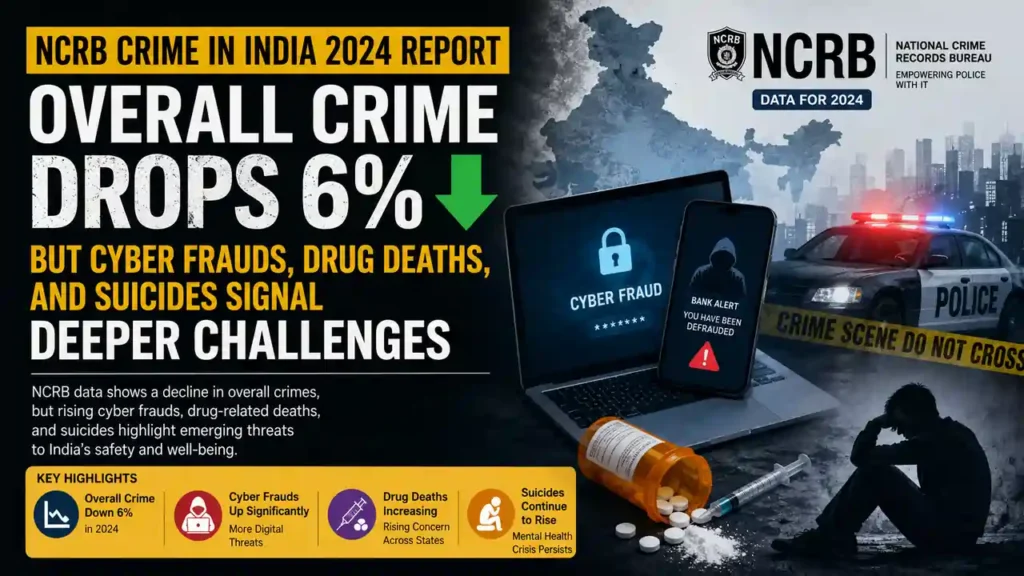
According to the NCRB data, India recorded 58.86 lakh cognisable crimes in 2024, marking a 6% decrease from 62.41 lakh cases in 2023. The crime rate per lakh population dropped significantly from 448.3 to 418.9, indicating better policing outcomes or shifts in reporting patterns in several categories.
Out of the total cases, 35.44 lakh were registered under the Indian Penal Code (IPC) / Bharatiya Nyaya Sanhita (BNS), while 23.41 lakh fell under Special and Local Laws (SLL). This decline comes amid ongoing criminal justice reforms, including the implementation of new criminal laws. However, experts caution that reduced numbers in some areas may also reflect underreporting or improved preventive measures rather than a complete eradication of issues.
Cybercrime Emerges as the Fastest Growing Threat
One of the most alarming revelations in the Crime in India 2024 report is the sharp 17.9% rise in cybercrime cases. The total jumped from 86,420 in 2023 to 1,01,928 in 2024, pushing the cybercrime rate from 6.2 to 7.3 per lakh population.
Fraud continues to dominate the landscape, accounting for a staggering 72.6% of all cybercrime incidents — equating to 73,987 cases. Other significant motives include sexual exploitation (3,190 cases), extortion (2,536 cases), causing disrepute (2,231 cases), and personal revenge (1,850 cases).
State-wise, Telangana led with 27,230 cases, registering nearly a 50% increase from the previous year. Karnataka followed closely with 21,003 cases. Metropolitan cities bore a heavy burden, with nearly 35,000 cybercrime cases reported across major urban centres. Investigation pendency remains a critical issue, with over 1.2 lakh cases still under probe and around 75,000 pending trial.
This surge underscores India’s growing digital vulnerability. As more citizens engage in online banking, e-commerce, and digital services, sophisticated scams targeting financial data have proliferated. The report emphasises the urgent need for enhanced cyber policing, digital literacy drives, and robust fintech regulations to safeguard citizens in the digital age.
Economic Offences Continue Upward Trajectory
Closely linked to cyber trends, economic offences rose by 4.6%, climbing from 2,04,973 cases in 2023 to 2,14,379 in 2024. Forgery, Cheating, and Fraud (FCF) dominated this category, making up nearly 90% with 1,92,382 cases. Criminal breach of trust accounted for another 21,251 cases.
The increase points to expanding online scams, weak consumer protection mechanisms, and the rapid evolution of financial fraud tactics. As digital transactions grow, the gap in regulatory oversight and enforcement capacity has become more apparent, necessitating stronger coordination between banking institutions, cyber cells, and law enforcement.
Crimes Against Women Record Marginal Decline
Cases of crimes against women decreased by 1.5% to approximately 4.41 lakh in 2024 from 4.48 lakh in 2023. The crime rate against women per lakh female population fell from 66.2 to 64.6. ‘Cruelty by husband or relatives’ remained the largest share at around 42%.
A notable development is the introduction of a new category — ‘Offences against Women and Child’ — under the Bharatiya Nyaya Sanhita (BNS). Despite the slight drop, structural challenges such as patriarchal norms, low conviction rates, and underreporting continue to persist. Domestic violence and crimes against minors within this bracket remain areas of serious concern requiring sustained intervention through women helplines, legal aid, and community awareness programmes.
Rising Concerns for Children and Juveniles
In contrast to women, crimes against children increased by 5.9% to around 1.8 lakh cases. Missing children cases rose by 7.8% to 98,375, with girls constituting the majority (75,603), followed by boys (22,768) and a small number of transgender children (4).
Juveniles in conflict with the law saw an 11.2% increase, with Delhi recording the highest number of cases (2,306) among metro cities. Alarmingly, 77.7% of these juveniles fell in the 16-18 age bracket. These trends highlight urban vulnerabilities, potential trafficking networks, and the pressing need for robust child protection systems, better tracking mechanisms, and rehabilitation-focused juvenile justice reforms.
Senior Citizens and Marginalised Communities
Crimes against senior citizens increased by 16.9% compared to 2023, with theft and fraud emerging as the most common offences. This rise reflects the vulnerability of elderly populations to both physical and financial exploitation.
On the social justice front, crimes against Scheduled Castes (SCs) declined by 3.6% to 55,698 cases, while those against Scheduled Tribes (STs) dropped more sharply by 23.1% to 9,966 cases. Uttar Pradesh, Madhya Pradesh, and Bihar reported high numbers for SCs, while Madhya Pradesh, Rajasthan, and Maharashtra led for STs.
Analysts note that declining registered cases do not automatically translate to reduced discrimination. Underreporting, limited access to justice, and fear of backlash may influence these statistics, calling for greater trust-building measures and improved grievance redressal mechanisms.
Suicides and Socio-Economic Distress
The companion ADSI 2024 report reveals 1,70,746 suicides in 2024, spotlighting deep-rooted socio-economic pressures. Daily wage workers accounted for around 31% of cases, followed by homemakers (22,113), unemployed persons (14,778), and students (14,488).
The agriculture sector remained particularly affected, with 10,546 suicides — 4,633 among farmers/cultivators and 5,913 among agricultural labourers. These numbers point to persistent agrarian distress, unemployment, mental health challenges, financial instability, and social isolation. Comprehensive mental health support systems and livelihood security programmes are essential to address these underlying causes.
Sharp Rise in Drug Overdose Deaths
Drug overdose deaths surged by nearly 50%, rising from 650 in 2023 to 978 in 2024. Tamil Nadu reported the highest fatalities (313), followed by Punjab (106), Madhya Pradesh (90), Rajasthan (69), and Mizoram (65).
This alarming trend signals expanding drug abuse networks and gaps in rehabilitation infrastructure. Coordinated efforts involving public health authorities, narcotics control agencies, and community-level interventions are critical to curb this public health emergency, especially among youth.
Offences Against the State on the Rise
Cases under offences against the state increased by 6.6% from 4,873 to 5,194. The Prevention of Damage to Public Property Act accounted for 84.6% of these, while 649 cases were registered under the Unlawful Activities (Prevention) Act (UAPA). This uptick reflects ongoing challenges related to public order, internal security, and anti-state activities.
About NCRB: India’s Premier Crime Data Repository
Established in 1986 on the recommendations of the Tandon Committee, National Police Commission (1977-81), and MHA’s Task Force (1985), the NCRB operates under the Ministry of Home Affairs. Its core mandate is to serve as a central repository of crime and criminal information, assisting investigators in linking crimes and identifying repeat offenders.
Key initiatives include the Crime and Criminal Tracking Network & Systems (CCTNS) launched in 2009, which has connected over 15,000 police stations. The National Digital Police Portal (2017) enables searches on CCTNS and facilitates citizen services like online complaints and tenant verification.
NCRB maintains vital databases such as the National Database of Sexual Offenders (NDSO) and supports tools like CyTrain for cybercrime training and Cri-MAC for multi-agency coordination. It also manages the National Automated Fingerprint Identification System (NAFIS) and publishes reports like Prison Statistics India.
Key Challenges and the Road Ahead
The Crime in India 2024 report highlights several institutional, social, and governance challenges: massive pendency in investigations and trials, forensic and cyber policing gaps, low conviction rates, coordination issues between agencies, and insufficient mental health and rehabilitation infrastructure.
Recommended Way Forward:
- Strengthen cyber security architecture through dedicated cybercrime stations, advanced digital forensics, and interstate coordination.
- Promote widespread cyber awareness and digital literacy campaigns.
- Fast-track cases related to cybercrime and economic offences.
- Enhance child and women safety through better tracking systems and community policing.
- Expand farmer welfare schemes, employment generation, and mental health support.
- Bolster drug abuse prevention with improved intelligence sharing and rehabilitation centres.
Conclusion: A Mixed Picture Demands Proactive Response
The NCRB Crime in India 2024 report presents a mixed yet insightful narrative. The overall decline in crime rate and traditional offences is encouraging and reflects incremental improvements in law enforcement. However, the rapid escalation in cybercrime, economic frauds, drug-related deaths, suicides, and persistent vulnerabilities among women, children, and marginalised groups signal deeper systemic and socio-economic challenges.
As India embraces greater digital transformation, bridging the gap between technological progress and security infrastructure is paramount. Effective implementation of recommendations — from modernising policing to addressing root causes of social distress — will determine whether the country can translate statistical improvements into genuine safety and justice for all citizens.
The data serves as both a report card on current governance and a roadmap for future action. Stakeholders across government, civil society, and technology sectors must collaborate to build a more secure, equitable, and resilient India.
FAQs
1. What are the major highlights of the NCRB Crime in India 2024 report?
The NCRB Crime in India 2024 report shows an overall 6% decline in cognisable crimes to 58.86 lakh cases, with the crime rate dropping from 448.3 to 418.9 per lakh population. However, cybercrime surged 17.9% to 1,01,928 cases, economic offences rose 4.6%, crimes against children increased 5.9%, and drug overdose deaths jumped nearly 50% to 978. Crimes against women saw a marginal 1.5% decline, while crimes against SCs and STs also decreased.
2. Which state recorded the highest number of cybercrime cases in 2024?
Telangana topped the list with 27,230 cybercrime cases in 2024 — a nearly 50% increase from 2023. Karnataka followed with 21,003 cases. Fraud accounted for 72.6% of all cybercrime incidents nationwide (73,987 cases). Metro cities together reported nearly 35,000 cybercrime cases.
3. Did crimes against women increase or decrease in 2024 according to NCRB?
Crimes against women decreased by 1.5% from 4.48 lakh in 2023 to approximately 4.41 lakh in 2024. The crime rate per lakh women population fell from 66.2 to 64.6. ‘Cruelty by husband or relatives’ continued to be the largest category, comprising around 42% of cases. A new ‘Offences against Women and Child’ category was introduced under BNS.
4. How many suicides were reported in India in 2024 and which groups were most affected?
India recorded 1,70,746 suicides in 2024 as per the ADSI 2024 report. Daily wage workers accounted for around 31% of suicides. Other highly affected groups include homemakers (22,113), unemployed persons (14,778), students (14,488), and the agriculture sector (10,546 suicides). The data highlights serious concerns over agrarian distress, unemployment, and mental health.
5. What is the role of NCRB and when was it established?
The National Crime Records Bureau (NCRB) was established in 1986 under the Ministry of Home Affairs based on recommendations of the Tandon Committee, National Police Commission, and MHA Task Force. It serves as India’s central repository for crime data and criminal records. Key initiatives include CCTNS (connecting 15,000+ police stations), National Digital Police Portal, NAFIS, CyTrain, and Cri-MAC. NCRB publishes annual reports like Crime in India, ADSI, and Prison Statistics India.