

New Delhi: In a significant development that underscores shifting geopolitical alignments in South Asia, Bangladesh has formalized a major pact with China to develop an economic zone adjacent to the strategic Mongla Port. The agreement, signed during Bangladesh Prime Minister Tarique Rahman’s visit to Beijing, effectively replaces a long-stalled India-backed project and marks a deeper integration of Chinese influence in Bangladesh’s infrastructure and river management initiatives. This move not only highlights Dhaka’s pivot toward Beijing but also raises profound questions about India’s strategic posture in the Bay of Bengal and its immediate neighborhood.
The deal centers on 110 acres of land in Bagerhat district near Mongla Port, Bangladesh’s second-largest and second-busiest seaport after Chittagong. Located just 188 kilometers from Kolkata and in close proximity to the ecologically sensitive Sunderbans, Mongla holds immense commercial and strategic value. Under the new agreement, a Chinese state-owned enterprise will establish manufacturing units for telecom and electronic goods, alongside warehouses and storage facilities. This replaces land previously allotted to Indian developers, which was delisted amid deteriorating India-Bangladesh ties following political changes in Dhaka.
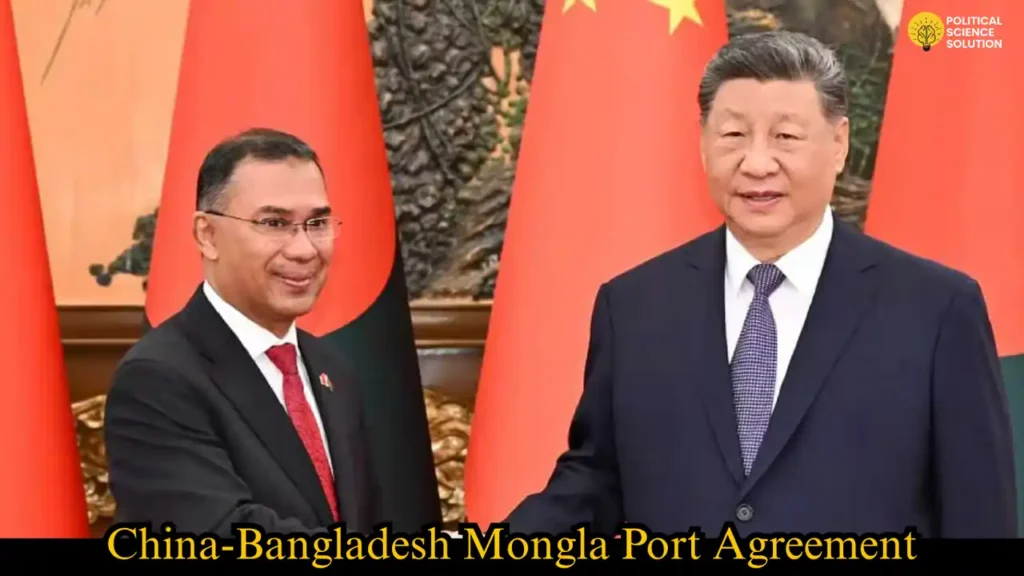
From Indian Economic Zone to Chinese Foothold: The Timeline of the Mongla Project
The origins of the Mongla development trace back to 2015, when Bangladesh and India signed a Memorandum of Understanding (MoU) during Sheikh Hasina’s tenure to jointly develop two economic zones—one at Mongla and another in Chattogram’s Mirsarai. India committed a line of credit, and both nations collaborated on modernizing Mongla Port while constructing a new railway line connecting it to Khulna to boost bilateral trade.
In 2018, the Narendra Modi government selected the Hiranandani Group for the Mongla project. By March 2022, Bangladesh Economic Zones Authority (BEZA) signed an MoU with Avita Constructions Private Limited, the Hiranandani-linked entity. Progress, however, stalled after the 2024 student-led uprising that ousted Hasina, who sought refuge in India. Under the interim administration of Muhammad Yunus, anti-India sentiments surged, leading to the project’s cancellation in 2025. Bangladeshi officials cited the Indian developer’s failure to commence work within the stipulated two-year period.
China quickly capitalized on the vacuum. In June 2025, the Chinese embassy in Dhaka proposed developing a Chinese economic zone on the same 110-acre site. By October 2025, the allotment to India was formally revoked. The pact was sealed on June 25, 2026, during Tarique Rahman’s maiden foreign visit as Prime Minister, with China Civil Engineering Construction Corporation (CCECC) as the implementing partner. A separate $370 million agreement for port modernization, signed earlier in March 2025 between Mongla Port Authority and CCECC, further cements Chinese involvement.
Chinese plans are ambitious. They include constructing two new container jetties, multiple container yards, and installing four cranes along with Bangladesh’s first automated operator crane system—technology that enables human-intervention-free cargo handling, mirroring efficiencies at major Chinese ports. These upgrades are projected to nearly triple Mongla Port’s annual capacity to approximately 394,000 TEUs (Twenty-foot Equivalent Units).
Beyond port infrastructure, the economic zone will feature telecom and electronics manufacturing hubs. BEZA member Mohammad Nazrul Islam noted that Bangladesh will provide the land, while the Chinese firm handles investment and development, with equity-sharing details to be finalized later. The joint statement from Rahman’s China visit also references advancing the Chinese Economic and Industrial Zone in Chattogram, where India’s previous land allotment had been cancelled under Yunus.
Teesta River Cooperation: A Sensitive Flashpoint Near India’s Siliguri Corridor
Compounding Indian concerns is Bangladesh’s agreement to deepen collaboration with China on the Teesta River Comprehensive Management and Restoration Project (TRCMRP). The joint statement emphasizes cooperation in integrated water resources management, planning, hydrological forecasting, flood prevention, disaster reduction, river dredging, and technology sharing. China has committed support for feasibility studies and related work.
The Teesta River, originating in Sikkim and flowing through West Bengal before entering Bangladesh, has long been a bone of contention over water-sharing. Under Hasina, Dhaka preferred Indian involvement in conservation efforts. The river’s management sites lie less than 100 km from India’s Siliguri Corridor—commonly known as the Chicken’s Neck—a narrow 22-km-wide stretch connecting India’s northeastern states to the mainland. This vulnerability is further heightened by reports of Chinese interest in developing an old airport in Lalmonirhat, Bangladesh.
India’s Strategic Concerns: Encirclement, Surveillance, and Economic Setbacks
For New Delhi, the developments represent a multifaceted challenge. Analysts point to heightened risks of strategic encirclement through China’s “String of Pearls” framework—a network of commercial and dual-use ports across the Indian Ocean Region (IOR), intertwined with the Belt and Road Initiative (BRI). Notable examples include Gwadar in Pakistan and Hambantota in Sri Lanka. Chinese firms are involved in 17 IOR port projects, driven largely by Beijing’s energy security needs, as 80% of its crude oil imports transit the Indian Ocean.
Key implications for India include:
- Maritime and Geopolitical Encirclement: Chinese presence at Mongla, just 80-188 km from Indian shores, expands Beijing’s footprint in the Bay of Bengal, traditionally viewed as India’s sphere of influence.
- Two-Front Security Dilemma: Enhanced China-Pakistan ties on the western frontier combined with deepening China-Bangladesh cooperation on the east could stretch Indian defenses.
- Intelligence and Surveillance Risks: Dual-use infrastructure raises fears of intelligence gathering and monitoring of Indian naval and military activities, similar to patterns observed elsewhere.
- Trade and Energy Vulnerabilities: Potential disruptions to India’s maritime trade routes and energy supplies through chokepoints controlled or influenced by China.
- Constraints on Strategic Autonomy: A greater Chinese military or logistical presence in the IOR and near the Northeast could limit India’s maneuverability.
Former Indian High Commissioner to Bangladesh, Ambassador Veena Sikri, described the shift as a “big change” and “big disappointment.” Comparing the latest Bangladesh-China joint statement with the 2024 India-Bangladesh one under Hasina, she noted that Mongla modernization and Teesta projects were previously assigned to India. Sikri emphasized that India had secured operational rights to a Mongla terminal as a counter to Chinese influence, a gain now reversed.
The joint statement also elevates bilateral ties to a “comprehensive strategic cooperative partnership” and envisions a “China-Bangladesh community with a shared future.” It outlines high-level exchanges, governance cooperation, a foreign ministers’ strategic dialogue, and exploration of a “2+2” diplomacy-defense mechanism. While cooperation in healthcare and education is mentioned—areas where India retains strong ties—the overarching trajectory signals Bangladesh’s balancing act between its largest neighbor, India, and its top trading partner, China.
Broader Context: Bangladesh’s Political Transition and China’s Port Empire
Tarique Rahman’s choice of China for his first overseas trip as Prime Minister, succeeding the Yunus interim period, reflects the BNP-led government’s priorities following the 2024 upheaval. Despite geographical realities—Bangladesh shares its longest border with India—economic imperatives and political shifts have facilitated Beijing’s entry.
China’s strategy leverages loans, investments, and technical expertise. In Bangladesh, this includes submarine base developments in Cox’s Bazar capable of hosting multiple vessels, with Chinese warships regularly visiting Chittagong and Mongla. The Hambantota precedent—where debt led to a 99-year lease—serves as a cautionary tale of potential debt-trap dynamics.
India’s Counter-Strategy: The Necklace of Diamonds and Beyond
India is not passive. In response to the String of Pearls, it advances the “Necklace of Diamonds” through partnerships with Singapore, Indonesia, Seychelles, Oman, Iran, Mongolia, Japan, and Vietnam, including naval facility developments. Key assets include INS Varsha, a nuclear submarine base at Rambilli in Andhra Pradesh; a tri-services command on the Andaman and Nicobar Islands for monitoring the Bay of Bengal and Malacca Strait; and infrastructure on Mauritius’ Agalega Island.
Enhanced connectivity to Northeast India remains critical. Access to Chittagong and Mongla ports had been granted to India in 2018 for transit. Had the economic zone remained Indian-led, it could have slashed logistics costs for goods to Agartala and other northeastern hubs—reducing road distances dramatically compared to the 1,600 km via Kolkata.
Balancing Act for Bangladesh and the Road Ahead for India
While the Mongla and Teesta pacts deepen Sino-Bangladeshi bonds, Dhaka must navigate its geographic and economic interdependence with India. Bangladesh Foreign Minister Khalilur Rahman has previously framed ties with major powers as non-zero-sum, hoping for reciprocal understanding.
For India, the situation demands careful diplomacy, robust monitoring, and accelerated infrastructure push in the Northeast alongside maritime domain awareness. The developments at Mongla—positioned to potentially alleviate China’s Malacca Strait dependency—could alter regional naval dynamics in any contingency.
As Beijing extends its maritime silk ambitions and Dhaka recalibrates its foreign policy, the Bay of Bengal emerges as a critical theater. India’s response will define not just bilateral relations with Bangladesh but its broader ability to safeguard interests in a contested Indo-Pacific. The coming months will test whether economic pragmatism in Dhaka can coexist with strategic sensitivities in New Delhi, or if further realignments loom on the horizon.
FAQs
Q1: What exactly is the China-Bangladesh agreement on Mongla Port?
The agreement, signed in June 2026 during Bangladesh Prime Minister Tarique Rahman’s visit to China, grants a Chinese state-owned company (CCECC) rights to develop an economic zone on 110 acres of land near Mongla Port in Bagerhat district. It includes modernizing the port with new container jetties, automated cranes, and expanding capacity to nearly 394,000 TEUs. This replaces a previously India-allotted project that was cancelled under the interim Yunus regime. The deal also covers broader cooperation on the Teesta River management.
Q2: Why is India concerned about the Mongla Port deal with China?
India views the development as a strategic setback because Mongla Port lies just 188 km from Kolkata and near the Sunderbans. Chinese control raises risks of dual-use infrastructure for surveillance, potential military access, and encirclement in the Bay of Bengal. It compounds the two-front security challenge alongside Pakistan and threatens India’s trade routes, energy security, and influence in its traditional neighborhood. The proximity to the Siliguri Corridor via the linked Teesta project heightens vulnerabilities to the Chicken’s Neck.
Q3: How did India lose the Mongla economic zone project?
In 2015, India and Bangladesh signed an MoU for economic zones at Mongla and Mirsarai. The Hiranandani Group was selected in 2018, with a formal agreement in 2022. Political upheaval after Sheikh Hasina’s ouster in 2024 led to stalled progress. The Yunus administration delisted the Indian project in 2025 citing delays, paving the way for China’s proposal and eventual takeover in 2026 under the new BNP-led government.
Q4: What is the connection between the Mongla deal and China’s String of Pearls strategy?
The Mongla project is seen as an extension of China’s “String of Pearls” — a network of strategic ports and infrastructure across the Indian Ocean Region linked to the Belt and Road Initiative. Similar to investments in Gwadar (Pakistan) and Hambantota (Sri Lanka), it helps secure China’s energy import routes (80% of its oil passes through the Indian Ocean) and provides potential commercial-military footholds, reducing dependence on chokepoints like the Malacca Strait.
Q5: How is India responding to growing Chinese influence in Bangladesh?
India is strengthening its “Necklace of Diamonds” strategy through port and naval partnerships with countries like Singapore, Indonesia, Seychelles, Oman, Japan, and Vietnam. Key assets include the INS Varsha submarine base, the tri-services command in Andaman & Nicobar Islands, and infrastructure on Agalega Island. Diplomatically, New Delhi is closely monitoring developments while maintaining robust people-to-people and economic ties with Bangladesh in areas like healthcare and education.