
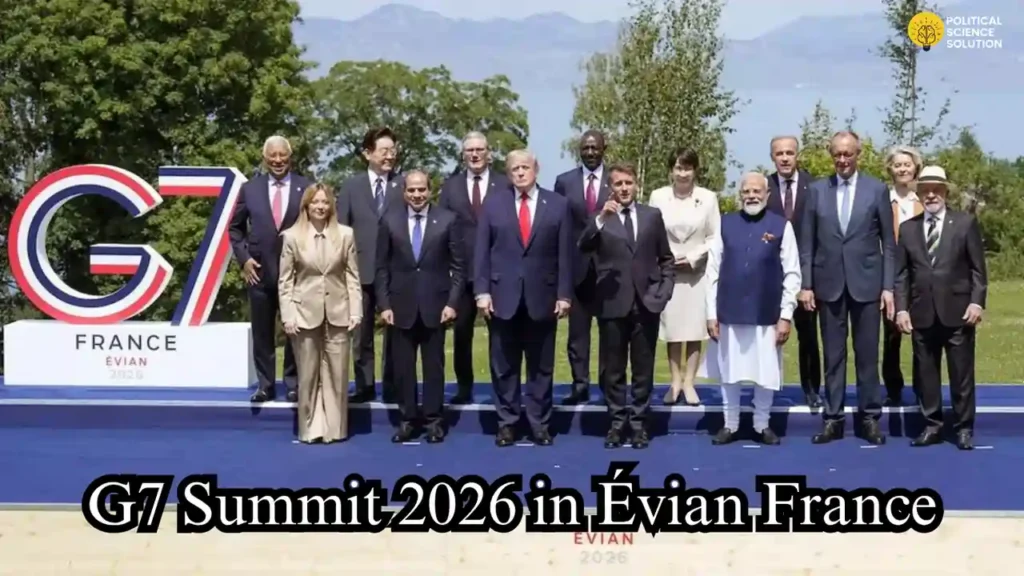
New Delhi: The picturesque lakeside town of Évian-les-Bains in France hosted the 52nd G7 Leaders’ Summit from June 15 to 17, 2026, bringing together the world’s advanced democracies to address pressing global challenges. India, invited as a key partner country, played a prominent role, with Prime Minister Narendra Modi using the platform to advocate for a shift from traditional donor-recipient dynamics to equitable partnerships grounded in mutual trust and shared prosperity. This year’s summit, chaired by French President Emmanuel Macron, focused on forging new alliances, rebuilding international solidarity, advancing AI governance, supporting Ukraine, and managing the aftermath of a landmark US-Iran agreement.
Prime Minister Modi’s participation marked India’s 13th engagement at the G7 outreach and his seventh consecutive appearance. Upon arrival in Évian for the two-day visit, Modi expressed optimism about collaborative efforts for a sustainable and prosperous future. He shared moments from the summit on social media, including a group photograph following Macron’s warm welcome, underscoring the commitment of India and G7 nations to global well-being, sustainability, and prosperity.
PM Modi’s Core Message: Addressing the “Shortage of Trust” and Embracing ‘Vasudhaiva Kutumbakam’
In his address during the high-level working session themed “Forging New Partnerships and Rebuilding International Solidarity,” PM Modi highlighted that the world does not face a shortage of resources but rather a “shortage of trust,” exacerbated by the misuse of trade and technology for narrow interests. He called for moving beyond outdated donor-recipient paradigms toward partnerships based on solidarity, equality, and transparency. Modi rooted India’s vision in the ancient Indian philosophy of Vasudhaiva Kutumbakam — the world is one family — and a ‘humanity first’ approach, positioning India as a bridge between the Global North and South.
The Prime Minister also raised concerns over disruptions in maritime trade through the Strait of Hormuz amid West Asia tensions, noting the loss of Indian civilian lives and the critical need to ensure the safety of Indian seafarers, who constitute a significant portion of the global maritime workforce. He emphasized freedom of navigation and urged collective responsibility for secure sea routes.
Key Declarations and Outcomes from the G7 Summit
Leaders adopted several significant declarations covering development finance, health crises, cancer research, geopolitics, and security threats:
- Development Finance and Debt Management: The summit called for reforms in global development finance, strengthening the IMF-World Bank 3-Pillar Approach. This framework assists vulnerable countries through structural reforms, external financial support, and debt burden reduction. Emphasis was placed on mobilizing private capital to address escalating debt vulnerabilities, particularly for middle-income nations.
- Health and Humanitarian Responses: Coordinated international action was urged to contain the Bundibugyo Ebola outbreak affecting the Democratic Republic of Congo (DRC) and Uganda. Commitments were made to advance cancer research, reduce lung cancer mortality, and improve access to paediatric cancer data globally.
- Geopolitical Developments: The G7 welcomed the US-Iran nuclear agreement aimed at ending conflict in West Asia, promoting a free and open Indo-Pacific, and expressed concerns over North Korea’s nuclear program. Leaders pledged stronger measures against human trafficking and migrant smuggling networks, including collaboration with online platforms. A new G7+ Ports Network was announced to combat maritime drug trafficking and disrupt associated illicit financial flows.
Additional statements reaffirmed commitments to diversifying supply chains, reducing dependence on critical minerals from single sources (targeting under 60% reliance on China by 2030, aiming for 50%), enhancing energy security, and supporting Ukraine with air defenses, energy supplies, and increased sanctions on Russia’s war economy. G7 nations also addressed exchange rate stability amid oil price volatility and oil reserve systems aligned with International Energy Agency standards.
Bilateral Engagements: Strengthening India’s Global Footprint
PM Modi held several high-impact bilateral meetings on the sidelines, reinforcing India’s strategic partnerships:
- With US President Donald Trump: In their first in-person meeting in 16 months, Modi and Trump discussed trade, defence, energy, critical minerals, and regional security. Modi highlighted seafarers’ safety in the context of the US-Iran deal and the Strait of Hormuz. Trump praised Modi as a “very tough negotiator,” “calm, cool, and a total killer” in a positive sense, and stated that the US would defend India if attacked. He expressed plans to visit India and noted strong bilateral ties.
- With UK Prime Minister Keir Starmer: The leaders announced that the India-UK Comprehensive Economic and Trade Agreement would enter into force on July 15, 2026. Modi described the past year as outstanding for bilateral relations, with the deal opening new avenues for economic cooperation.
- With Canadian Prime Minister Mark Carney: Discussions focused on economic growth, relations, AI, Ukraine, and Iran. Modi described the meeting as delightful.
- With UAE President Sheikh Mohamed bin Zayed Al Nahyan: The third interaction in 2026 reviewed progress in technology, trade, investment, energy, defence, and regional security.
- With Ukrainian President Volodymyr Zelenskyy: Modi reiterated India’s commitment to peace and humanity, agreeing to restore pre-war trade ties and reviewing cooperation across sectors.
- With German Chancellor Friedrich Merz: Both sides noted satisfaction with the renewed momentum in the India-Germany Strategic Partnership, celebrating 75 years of diplomatic ties.
Modi also engaged with EU leaders, including Ursula von der Leyen, who indicated that the India-EU free trade deal could be inked by the end of 2026, with enhanced security and defence cooperation.
Day 2 Focus: AI Governance, Digital Safety, and Geopolitical Updates
On June 17, the digital sphere dominated discussions, with leaders addressing AI security risks, social media threats, and protections for minors. PM Modi warned against the misuse of AI, stressing safeguards to protect children from misinformation, deepfakes, and exploitation, while highlighting AI’s potential for education and creativity in native languages. He called for global cooperation against cyber fraud and deepfakes.
Tech executives, including OpenAI’s Sam Altman and Anthropic’s Dario Amodei, joined sessions. Altman urged governments not to cede responsibilities to AI companies, while Macron advocated preventing frontier AI models from reaching authoritarian regimes and progress on “trusted partners” access to advanced US models. G7 leaders called on tech firms to ensure safe, age-appropriate online experiences for minors.
Trump made several notable remarks: defending the Iran deal to avoid economic catastrophe, stating the US might return Iranian funds eventually, praising the potential game-changing nature of the agreement, and commenting on various international issues including Brazil, Netanyahu, and North Korea. He declared “I’m the boss” during a session, drawing laughter, and discussed trade, the Grand Ethiopian Renaissance Dam with Egypt’s President Sisi, and peace efforts with Ukraine and Russia.
The India-UK trade deal announcement, critical minerals diversification, support for Ukraine’s air defences and energy needs, and commitments against organized crime, asset seizures (including virtual assets), and drug networks featured prominently.
Significance for India and the Global South
India’s active role at the G7 Summit 2026 reflects its growing influence in shaping global agendas on peace, security, sustainable development, and economic growth. By articulating the priorities of the Global South, Modi positioned India as a constructive partner advocating for inclusive frameworks like the proposed International Mobilisation Partnership for Accelerating Connectivity and Trade (IMPACT), inspired by the India-Middle East-Europe Economic Corridor (IMEC). This could extend connectivity projects to Africa, Latin America, and Pacific Islands, leveraging G7 capital, Indian expertise, and Global South ownership.
The summit concluded with renewed commitments to multilateralism amid complex challenges, including the US-Iran accord, Ukraine support, and AI governance. For India, outcomes like the operationalization of the UK trade deal, progress toward an EU pact, and strengthened bilateral ties with the US, UAE, Canada, and others signal expanding economic and strategic opportunities.
As global interdependence grows, events like the G7 Summit in Évian underscore the need for trust-based collaboration. India’s consistent participation and proactive diplomacy continue to amplify its voice on the world stage, promoting humanity-centric solutions to shared problems ranging from health crises and debt sustainability to technological risks and geopolitical stability.
FAQs
1. What were the key highlights of PM Narendra Modi’s participation at the G7 Summit 2026?
Prime Minister Narendra Modi attended the G7 Summit as a partner country and emphasized the global “shortage of trust” rather than resources. He advocated shifting from donor-recipient models to equal partnerships based on solidarity, rooted in Vasudhaiva Kutumbakam and a ‘humanity first’ approach. Modi raised concerns over Strait of Hormuz disruptions and Indian seafarers’ safety, proposed the IMPACT connectivity framework, and held bilateral meetings with leaders including US President Donald Trump, UK PM Keir Starmer, and others. Key outcomes included the India-UK trade deal coming into effect on July 15, 2026.
2. What major agreements and declarations were adopted at the 2026 G7 Summit?
Leaders adopted declarations on development finance reforms (strengthening the IMF-World Bank 3-Pillar Approach), coordinated Ebola response in DRC and Uganda, cancer research and paediatric data access, action against migrant smuggling and drug trafficking (including a new G7+ Ports Network), support for Ukraine with air defences and sanctions on Russia, and critical minerals supply chain diversification to reduce dependence on China. They also welcomed the US-Iran agreement and addressed AI risks, online safety for minors, and geopolitical issues in the Indo-Pacific and North Korea.
3. What happened in the bilateral meeting between PM Modi and US President Donald Trump at the G7 Summit?
During their first in-person meeting in 16 months, PM Modi and President Trump discussed trade, defence, energy, critical minerals, and regional security. Modi highlighted Indian seafarers’ safety in the context of the Iran deal. Trump praised Modi as a “tough negotiator,” “calm, cool and a total killer,” affirmed US defence support for India if attacked, and expressed plans to visit India. The meeting aimed to expedite a bilateral trade deal and strengthen cooperation.
4. What were the main AI and technology-related discussions at the G7 Summit 2026?
Day 2 focused on AI security risks, misinformation, deepfakes, and child protection online. PM Modi warned against AI misuse while highlighting its educational potential. Leaders engaged with tech CEOs like OpenAI’s Sam Altman and Anthropic’s Dario Amodei. Discussions covered “trusted partners” access to advanced US AI models, preventing frontier models from reaching authoritarian regimes, and calls for governments to retain responsibility over AI governance. G7 urged tech firms to build safer tools for minors.
5. When does the India-UK trade deal come into effect and what other trade developments occurred at the G7 2026?
The India-UK Comprehensive Economic and Trade Agreement will enter into force on July 15, 2026, as announced by PM Modi and UK PM Keir Starmer. Additionally, EU Commission President Ursula von der Leyen indicated that the India-EU free trade deal could be signed by the end of 2026. PM Modi also pitched the International Mobilisation Partnership for Accelerating Connectivity and Trade (IMPACT) to boost global trade and connectivity involving G7, India, and Global South countries.