

New Delhi: Japanese Prime Minister Sanae Takaichi’s landmark three-day official visit to India has ushered in a new era of bilateral cooperation, culminating in the highly anticipated 16th India-Japan Annual Summit. This pivotal diplomatic engagement underscores the strengthening of the Special Strategic and Global Partnership between the world’s largest democracies in Asia, focusing on economic security, defense, emerging technologies, and Indo-Pacific stability.
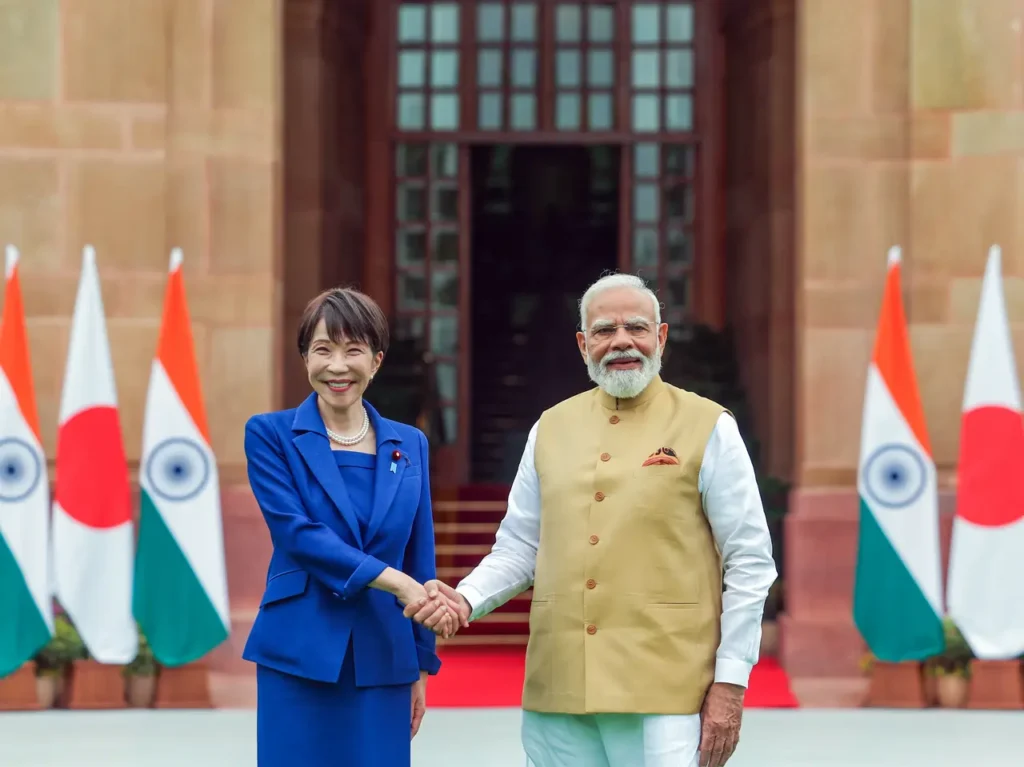
Arrival and Warm Welcome in New Delhi
Japanese Prime Minister Sanae Takaichi arrived in New Delhi on Wednesday evening, marking her first official visit to India since assuming office. The visit, held from July 1 to July 3 at the invitation of Prime Minister Narendra Modi, was received with high-level hospitality. Prime Minister Modi personally welcomed Takaichi, highlighting the warmth of India-Japan relations through a heartfelt post on X (formerly Twitter): “Prime Minister Sanae Takaichi, welcome to India. We sincerely welcome your first visit to India. I look forward to exchanging views across a wide range of fields tomorrow to further deepen the Japan-India Special Strategic and Global Partnership. The two countries will continue to cooperate to contribute to peace, stability and prosperity in the Indo-Pacific region and beyond.”
Minister of State for Science and Technology Jitendra Singh and Ministry of External Affairs (MEA) spokesperson Randhir Jaiswal were among the dignitaries who received the Japanese PM upon arrival. Jaiswal described the visit as “another important milestone in advancing the India-Japan Special Strategic and Global Partnership.”
Agenda: Deepening Cooperation Across Key Sectors
The summit provided a comprehensive platform for leaders to review bilateral ties and address regional and global issues. Discussions centered on expanding economic engagement, strengthening strategic coordination, and enhancing collaboration in critical technologies such as semiconductors, artificial intelligence (AI), critical minerals, pharmaceuticals, batteries, and energy resilience. Both nations emphasized building resilient supply chains and industrial cooperation to counter global volatility.
Defence and maritime security featured prominently, alongside Indo-Pacific cooperation. Key topics included the proposed Industrial Value Chain linking the Bay of Bengal with India’s Northeast for enhanced regional connectivity and manufacturing. The summit concluded with a Joint Statement reaffirming the partnership, alongside multiple agreements and Memoranda of Understanding (MoUs).
Major Outcomes of the 16th India-Japan Annual Summit
The summit yielded a robust list of concrete deliverables, demonstrating tangible progress:
- India-Japan Joint Declaration on Economic Security: Promotes project-based collaboration for resilience in semiconductors, critical minerals, ICT including AI, clean energy, and pharmaceuticals. The India-Japan Fact Sheet 2.0 highlights growing government-to-government (G2G) and business-to-business (B2B) engagement.
- India-Japan Joint Statement on Cooperation in Artificial Intelligence: Elevates ties to a strategic R&D partnership, building on existing initiatives with a roadmap for the full AI technology stack, emphasizing safe, secure, trusted, inclusive, and human-centric AI.
- Joint Statement on Energy Resilience (MoPNG and METI, Japan): Focuses on strategic stockpiling, reserves for crude oil and petroleum products, and joint investments in maritime energy transport.
- Celebrating the 75th Anniversary of Diplomatic Relations: Plans for commemorative events in 2027 as the “India-Japan Year of Shared Horizons.”
- Memorandum of Cooperation for India-Japan Cooperative Biogas for Growth (CBG) Initiative: Aims to establish 1,000 biogas and organic fertilizer plants across India using dairy cooperatives.
- Memorandum on Batteries: Builds a trusted, resilient, and sustainable battery supply chain.
- Memorandum on Pharmaceuticals and Medical Devices: Strengthens supply chains for APIs and KSMs through investment, technical collaboration, and industry-academia partnerships.
- Memorandum on Geology and Mineral Exploration: Enhances upstream critical minerals exploration via technical expertise exchange.
- MoC between IndiaAI Mission and METI’s GENIAC: Supports B2B matchmaking, AI policy webinars, and joint projects with computing resources.
- Next Generation Mobility Partnership (NGMP): Operationalizes cooperation in rail, automotive, aviation, shipbuilding, ports, logistics, and urban development, positioning India as a “Make in India for the World” hub.
Additional MoUs cover life sciences research between C-CAMP/RIKEN, biological sciences between NCBS-TIFR and RIKEN, LLMs via IIT Bombay/BharatGen and National Institute of Informatics, SarvamAI with Preferred Networks, internet governance (NIXI-JPNIC), and financial services (IFSCA-JFSA).
Strategic Context and Broader Framework
The 16th Summit aligns Japan’s Free and Open Indo-Pacific (FOIP) strategy with India’s Indo-Pacific Oceans’ Initiative (IPOI) and MAHASAGAR doctrine, fostering a rules-based maritime order. It builds on the 15th Summit in Tokyo (August 2025), which introduced a Joint Vision for the Next Decade, the Economic Security Initiative, Security Cooperation Declaration, and a Human Resource Exchange Action Plan targeting over 500,000 people movements in five years.
Defence and Maritime Security Advancements
Leaders advanced defence ties through the UNICORN Antenna Agreement—the first defence technology co-development project. They scheduled the 4th 2+2 Ministerial Dialogue in Tokyo by end-2026 and expanded naval cooperation via JAIMEX exercises and Make in India MRO initiatives.
Economic Security and Supply Chains
Agreements target semiconductors, critical minerals, clean energy, ICT, and pharmaceuticals. High-tech trade facilitation includes eased export controls, secure technology trade, and local currency transactions. The summit aims to accelerate a $1 trillion investment pipeline supporting Viksit Bharat.
Energy initiatives include the CBG Initiative, Odisha green hydrogen/ammonia project, and strategic petroleum reserves cooperation, with Japan backing India’s IEA membership. Technology highlights feature an AI Strategic Dialogue, continued support for Mumbai-Ahmedabad Bullet Train, and JICA projects in metro, healthcare, and education.
Strategic Opportunities and Challenges
Opportunities include modernizing the CEPA, developing India’s Northeast via BIMSTEC linkages, democratizing hardware ecosystems through Sakura Science and LUPEX missions, and integrating MSMEs via the new India-Japan SME Forum.
Challenges addressed: economic coercion, maritime disruptions (e.g., vessels near Strait of Hormuz), regional militarization in South/East China Seas, cyber/terror threats, and technical-labor harmonization.
Way Forward and Media Reception
Priorities include executing the UNICORN project, expanding petroleum reserves, meeting 2027 high-speed rail deadlines, digital payment integration, and launching a trilateral dialogue with the Philippines.
Japanese media, including The Japan Times, Kyodo News, and The Japan News, hailed the summit positively, noting tightened ties amid supply chain concerns, energy security, and regional dynamics.
Conclusion: A Milestone in Bilateral Relations
The 16th India-Japan Annual Summit under PM Modi and PM Takaichi has transformed standard ties into deep technological co-development. By addressing supply chain vulnerabilities, critical minerals, energy security, and defence innovation, both nations are poised to safeguard economic interests and promote Indo-Pacific peace and prosperity. This partnership exemplifies visionary diplomacy for a stable, resilient future.
FAQs
1. What was the main purpose of Japanese PM Sanae Takaichi’s visit to India?
The three-day official visit (July 1-3, 2026) focused on the 16th India-Japan Annual Summit. It aimed to deepen the Special Strategic and Global Partnership through enhanced cooperation in economic security, resilient supply chains, emerging technologies (AI, semiconductors), defence, maritime security, clean energy, and critical minerals. PM Takaichi’s first official trip to India since taking office also included the India-Japan Business Forum with over 150 Japanese business leaders.
2. What were the major outcomes and agreements signed during the summit?
Key deliverables include the Joint Declaration on Economic Security, Joint Statement on AI Cooperation, Energy Resilience Statement, CBG Biogas Initiative (targeting 1,000 plants), MoUs on batteries, pharmaceuticals, critical minerals exploration, Next Generation Mobility Partnership (NGMP), multiple research collaborations (RIKEN, IIT Bombay, SarvamAI, etc.), and frameworks for financial services and internet governance. Defence advancements featured the UNICORN Antenna co-development project.
3. How does this summit build on previous India-Japan engagements?
It advances the 2014 Special Strategic and Global Partnership and outcomes from the 15th Summit in Tokyo (August 2025), including the Joint Vision for the Next Decade, Economic Security Initiative, Security Cooperation Declaration, and Human Resource Exchange Plan (aiming for 5 lakh people movements). It aligns FOIP with India’s IPOI and MAHASAGAR for a rules-based Indo-Pacific order.
4. What are the strategic opportunities and challenges addressed?
Opportunities: $1 trillion investment pipeline, CEPA modernization, Northeast India development, high-speed rail (Mumbai-Ahmedabad by 2027), MSME integration, and tech R&D (LUPEX, Sakura Science). Challenges include supply chain vulnerabilities, maritime disruptions (e.g., Strait of Hormuz), regional militarization, cyber threats, and harmonizing technical standards with labor frameworks.
5. Why is this summit significant for regional stability and bilateral trade?
It strengthens defence co-development, energy resilience, and trusted supply chains amid geopolitical tensions. By promoting local currency trade, critical minerals security, and people-to-people ties, it positions India and Japan as anchors for peace, prosperity, and a free Indo-Pacific, with positive coverage in Japanese media highlighting the expanding partnership.