

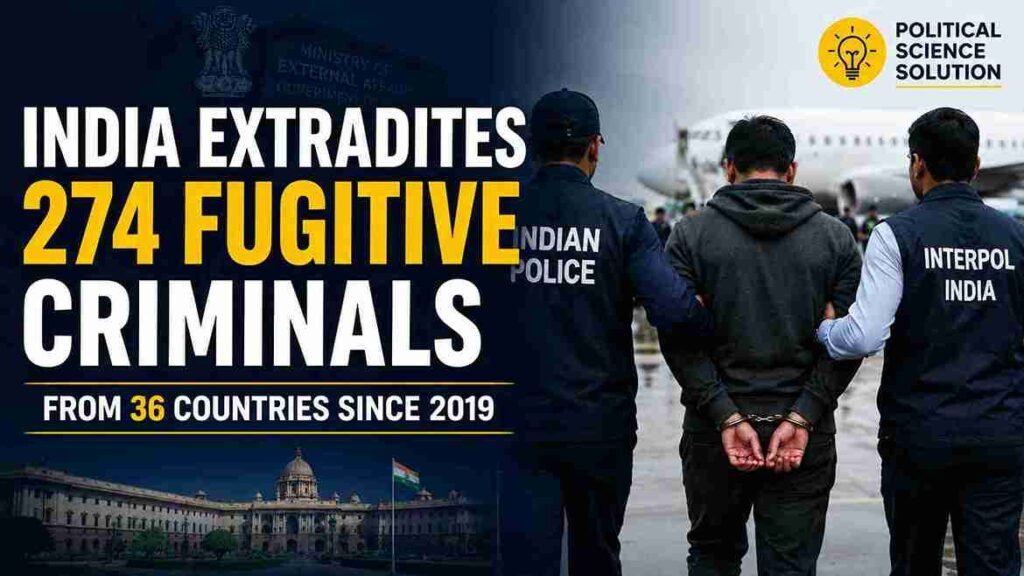
New Delhi: In a sustained campaign that has reshaped India’s approach to transnational crime, authorities have successfully returned 274 fugitive criminals to Indian soil from 36 countries between 2019 and July 2026. The Ministry of Home Affairs has framed the effort as the direct outcome of political resolve, legal overhaul, technological integration and whole-of-government coordination under Prime Minister Narendra Modi and Union Home Minister Amit Shah.
The figures mark a sharp departure from earlier patterns. Between 2004 and 2013 the average number of successful extraditions stood at only four per year, while 110 requests remained pending. Before 2014 India maintained extradition treaties with just 37 countries and lacked a dedicated statute for economic offenders or systematic asset confiscation. Incomplete dossiers, slow processing and frequent judicial rejections on grounds of double jeopardy or dual criminality compounded the problem. Coordination among ministries was weak and the issuance of Interpol Red Corner Notices moved at a glacial pace. Officials now describe that earlier phase as one marked by insufficient political will; the current administration has elevated the return of fugitives to a national priority linked explicitly to sovereignty, economic stability, law and order and national security.
Three Pillars of the Strategy
Home Minister Amit Shah has repeatedly outlined a three-pronged approach: global operations, robust inter-agency coordination and smart diplomacy. This framework underpins an integrated, intelligence-led and technology-driven model designed to locate, track and repatriate offenders who had fled after changing identities or names.
Legal foundations were strengthened early. The Fugitive Economic Offenders Act of 2018 provided a specialised tool against economic runaways. In 2019 the National Investigation Agency (Amendment) Act and the Unlawful Activities (Prevention) Amendment Act expanded the reach of enforcement beyond proscribed organisations to individual terrorists, overseas handlers, funding networks and support systems. The three new criminal laws of 2024 introduced, for the first time, Sections 355 and 356 of the Bharatiya Nagarik Suraksha Sanhita that permit trials in absentia, allowing the judicial process to proceed even when the accused remains abroad.
Institutional and Technological Advances
In January 2025 the Central Bureau of Investigation launched BHARATPOL, a digital platform that now links more than 1,400 State and Central agencies, including State Police Headquarters through Interpol Liaison Officers and District Police units. Response times for information requests that once stretched for weeks have been compressed to 10–20 days in most cases and 3–10 days in many others. The CBI has also established a Special Global Operations Centre for real-time liaison with foreign police forces via Interpol and has designated Interpol Contact Officers in every State and Central investigating agency.
Operation Trishul has added a technological edge. Using satellite imagery, digital footprint analysis, surveillance data and profile mapping, investigators have geo-located fugitives who altered their identities while living overseas. Video-conferencing has accelerated court proceedings in extradition matters. Over the past three years alone, 401 Red Corner Notices have been issued. Annual figures show a steep rise: 40 in 2022, 100 in 2023, 107 in 2024, 112 in 2025 and 182 already in 2026.
Asset recovery has run parallel to physical returns. Between 2019 and 2026 the Enforcement Directorate attached property worth ₹17,874 crore belonging to fugitive criminals under the Prevention of Money Laundering Act. Successful restitution of ₹18,762 crore has been recorded, including funds recovered from economic offenders who had left the country.
Year-wise and Category-wise Breakdown
The 274 returnees break down as follows across crime categories and years (2019–July 2026):
- Fraud and financial crimes: 9
- Terrorist, anti-national or narco-terror activity: 17
- Organised crime, gangsters and extortion: 42
- Murder, robbery and violent crime: 62
- Sexual offences, rape and POCSO cases: 53
- Narcotics, NDPS and drug trafficking: 16
- Smuggling, fake currency, cyber and contraband: 12
- Human trafficking and kidnapping: 18
- Other offences: 45
Annual totals rose from single digits in 2019 (9) and 2020 (7) to 23 in 2021, 40 in 2022, 37 in 2023, 43 in 2024, 70 in 2025 and 45 in the first seven months of 2026. The list includes individuals wanted in terrorism, pro-Khalistan extremism, the gangster-terror nexus, narcotics trafficking, cyber fraud and counterfeit currency operations. One high-profile illustration is the extradition of Tahawwur Hussain Rana from the United States, a case that required prolonged legal and diplomatic engagement.
Coordination Architecture
Success rests on continuous collaboration among the Intelligence Bureau, Central Bureau of Investigation, Research and Analysis Wing, National Investigation Agency, Enforcement Directorate, Ministry of External Affairs, Narcotics Control Bureau, Directorate General of GST Intelligence and State police forces. In January 2026 a Standing Focus Group was constituted under the Multi-Agency Centre of the Intelligence Bureau. Its mandate covers prioritisation of cases, standardisation of dossiers, closure of information gaps, sustained follow-up with foreign partners and national-level support for investigations begun by State agencies.
Extradition requests are now prepared to professional standards. Written assurances are tailored to the documentary and legal requirements of the requested country, addressing earlier causes of rejection. India hosted the 90th Interpol General Assembly in 2022, an occasion used by the Home Minister to emphasise the three Cs of global policing—communication, collaboration and cooperation. Five important meetings convened by the Home Minister have reinforced this institutional momentum.
Broader Implications
Officials stress that fugitives operating from abroad are not static files but active threats capable of sustaining terrorism, narco-terrorism and cross-border support networks, particularly in the context of Jammu and Kashmir. The campaign therefore extends beyond individual returns to the dismantling of overseas ecosystems. Technology has narrowed the space for identity concealment, while legal reforms have closed procedural loopholes that previously frustrated prosecution.
The Ministry notes that the results flow from credibility built through thorough legal preparation, persistent diplomacy and relentless follow-up rather than isolated strokes of luck. By converting extradition into a mission-mode national priority, the government has transformed what was once a cumbersome, low-yield process into a systematic, multi-layered effort that treats every corner of the world as within reach of Indian justice.
As of August 2026 the cumulative tally of 274 returns, the surge in Red Notices, the attachment of thousands of crores in assets and the creation of digital and institutional bridges such as BHARATPOL and the Standing Focus Group together signal a durable shift. The framework continues to evolve, with real-time coordination, satellite-enabled location and in-absentia trial provisions now standard tools in India’s pursuit of those who once believed distance offered impunity.
FAQs
1. How many fugitive criminals has India brought back since 2019, and from how many countries?
India has successfully returned 274 fugitive criminals from 36 countries between 2019 and July 2026. This averages roughly 40 extraditions per year—nearly ten times higher than the average of just four per year recorded between 2004 and 2013.
2. What major legal and institutional changes enabled the higher success rate in extraditions?
Key reforms include the Fugitive Economic Offenders Act (2018), amendments to the NIA Act and UAPA in 2019, and the introduction of Sections 355 and 356 in the Bharatiya Nagarik Suraksha Sanhita (2024) that allow trials in absentia. BHARATPOL, launched in January 2025, now connects more than 1,400 agencies with Interpol, cutting information-sharing time to as little as 3–10 days. A Standing Focus Group under the Intelligence Bureau’s Multi-Agency Centre was also set up in January 2026 to prioritise cases and standardise dossiers.
3. How has technology been used to locate and track fugitives hiding abroad?
Under Operation Trishul, agencies employ satellite imagery, digital footprint analysis, surveillance data and profile mapping to geo-locate offenders who changed names or identities. Video-conferencing has also been used to speed up court hearings in extradition proceedings. These tools, combined with a sharp rise in Interpol Red Corner Notices (401 issued in the last three years, including 182 already in 2026), have significantly improved tracking capabilities.
4. What has been the scale of asset recovery linked to these fugitives?
Through rigorous enforcement of the Prevention of Money Laundering Act, authorities attached assets worth ₹17,874 crore belonging to fugitive criminals between 2019 and 2026. In the same period, successful restitution of ₹18,762 crore was achieved, including funds recovered from economic offenders who had fled the country.
5. Which types of crimes were most common among the 274 returned fugitives?
The largest categories were murder, robbery and violent crime (62 cases), sexual offences including POCSO (53), organised crime/gangsters/extortion (42), and “other” offences (45). Smaller but significant numbers involved terrorism/anti-national activity (17), human trafficking/kidnapping (18), narcotics (16), smuggling/fake currency/cyber crimes (12) and financial fraud (9).