

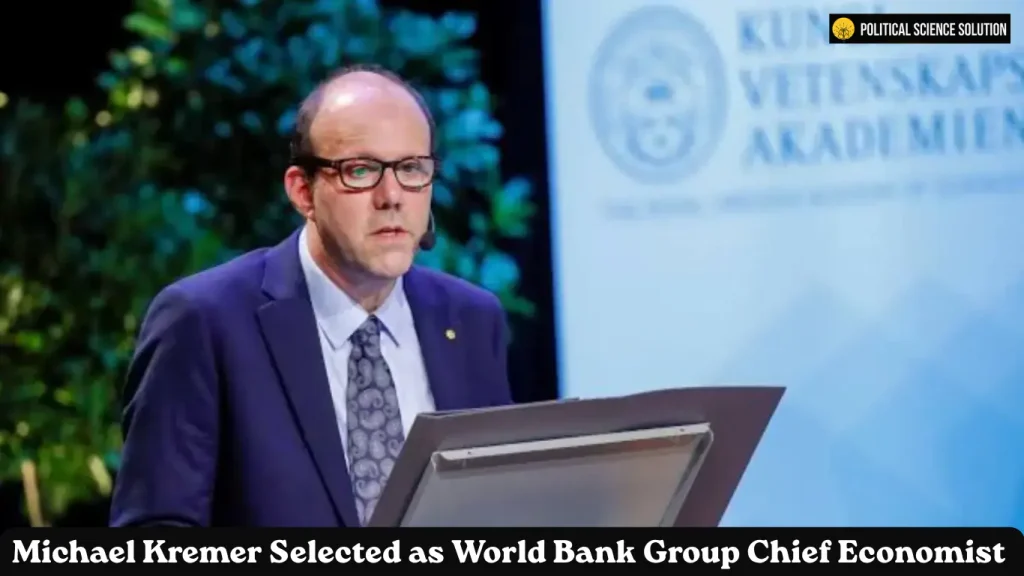
New Delhi: The World Bank Group revealed on September 16, 2026, that Nobel laureate Michael Kremer will become its Chief Economist and Senior Vice President for Development Economics. The 61-year-old University of Chicago professor steps into the post left vacant by Indermit Gill’s retirement the previous month. Kremer begins duties on October 1, 2026, shortly before the joint annual meetings of the World Bank and International Monetary Fund take place in Bangkok, Thailand.
This selection marks a historic first: Kremer arrives already holding the Nobel Prize in Economic Sciences. Earlier occupants of the same office, among them Joseph Stiglitz and Paul Romer, earned the distinction only after their terms concluded.
Appointment Timeline and Institutional Context
Kremer currently directs the Development Innovation Lab at the University of Chicago, where he holds the rank of University Professor. He previously served as the Gates Professor of Developing Societies in the Department of Economics at Harvard University after completing his doctoral studies there. World Bank Group President Ajay Banga framed the choice around the need for practical, scalable answers to pressing global problems. Banga specifically cited the challenge of generating employment opportunities that match the expectations of more than 1.2 billion young people entering the working-age population over the next decade.
The new chief economist joins an institution that has deliberately sought tighter connections between research findings and on-the-ground results. The goal is to ensure that high-quality data and analysis guide policy recommendations, public- and private-sector solutions, investments, partnerships, and operational programs worldwide.
Academic Foundations and Recognition
Kremer shared the 2019 Sveriges Riksbank Prize in Economic Sciences in Memory of Alfred Nobel with Esther Duflo and Abhijit Banerjee. The award recognized their experimental methods for reducing global poverty. The trio employed randomized controlled trials to produce trustworthy evidence, pinpoint workable interventions, test those interventions carefully, and expand the ones that delivered measurable benefits.
Additional honors include a MacArthur Fellowship awarded in 1997, membership in the National Academy of Sciences, fellowship in the American Academy of Arts and Sciences, and designation as a Presidential Faculty Fellow. Kremer co-founded the Bureau for Research and Economic Analysis of Development and maintains a research associateship with the National Bureau of Economic Research. His scholarly interests cover economic growth, technological progress, and development economics, with sustained attention to innovation across education, health, water, finance, and agriculture in lower-income settings.
Transformative Research Turned into Large-Scale Programs
Several lines of Kremer’s work have moved beyond academic journals into programs reaching hundreds of millions of people. Studies on school-based deworming revealed substantial drops in student absenteeism. Those findings helped prompt governments in Africa and South Asia to distribute roughly two billion deworming treatments to children since 2014.
Together with Rachel Glennerster, Kremer advanced the concept of Advance Market Commitments—contractual pledges by donors that create incentives for pharmaceutical firms to invent, manufacture, and supply vaccines and medicines needed in low-income countries. This approach underpinned a $1.5 billion Advance Market Commitment for a pneumococcal vaccine developed in partnership with Gavi and the World Bank Group. Vaccines obtained through the mechanism have been delivered to 60 developing countries, targeting a major driver of infant mortality.
Kremer co-founded Development Innovation Ventures, a funding vehicle housed within the U.S. Agency for International Development. The initiative backed more than 300 innovations that collectively reached over 200 million individuals before it was discontinued following a change in U.S. presidential administration. He also co-founded Precision Development, an organization that deploys digital tools to raise productivity and earnings for smallholder farmers. Parallel research on artificial-intelligence-supported agricultural weather forecasting has shaped government initiatives serving more than 50 million people across Africa and South Asia.
In the early 2000s Kremer outlined a conceptual framework aimed at limiting the ability of authoritarian leaders to extract resources and leave subsequent generations burdened with illegitimate or “odious” debt. In 2024 he delivered a keynote address at a World Bank gathering under the title “The Great Incoherence: Growth and Human Development in an Era of Stagnation.” In that presentation he advocated reforms that would finance experimental pilot projects and strengthen incentives for research into new technologies—priorities that have featured prominently in Banga’s agenda since 2023.
Statements from Leadership
Banga underscored Kremer’s distinctive record: “Michael has spent his career not just identifying what works in development, but proving it at scale—and that is exactly the kind of thinking we need.” He positioned the appointment as timely given the scale of current development obstacles.
Kremer reciprocated by emphasizing the World Bank Group’s combined research capacity and operational reach. “The World Bank Group has tremendous research capacity to develop and test innovative solutions to development problems—and the operational reach to scale them up and improve people’s lives,” he observed. He listed the foremost tasks ahead as creating jobs at volume, mobilizing private capital for development finance, and securing access to health, education, and related services that enable people to prosper. Simultaneously, he noted that emerging technologies open substantial pathways for faster growth and higher living standards. Reliable data, rigorous evidence, and applied research, he argued, can equip firms and governments to manage both the difficulties and the openings. Kremer conveyed readiness to collaborate with colleagues throughout the institution and with partners across the globe.
Economic Pressures Confronting Developing Countries
Kremer assumes the role against a backdrop of elevated borrowing costs and increased energy prices that followed the United States’ military engagement with Iran. These pressures arrive on top of a 23 percent reduction in official development assistance recorded in 2025—the steepest annual contraction on record—driven largely by cuts originating in the United States. The combined environment intensifies the urgency of identifying cost-effective, scalable approaches that can stretch limited public resources and attract private investment.
Personal and Collaborative Dimensions
Kremer is married to Rachel Glennerster, a British economist whose career has included service with the United Kingdom government and the International Monetary Fund. Glennerster assumed the presidency of the Center for Global Development in Washington in September 2024. The couple both became early members of Giving What We Can when the organization launched in 2009; its participants commit to directing at least ten percent of their income toward highly effective charitable causes.
Outlook Toward the Bangkok Meetings and Beyond
With the October 1 start date, Kremer will be in place as the World Bank Group and International Monetary Fund convene their annual gatherings in Bangkok. The meetings provide an early platform for articulating research priorities and operational strategies under new intellectual leadership. The appointment signals continued institutional emphasis on converting experimental evidence into policies and programs capable of raising living standards at scale, even amid tighter aid budgets and heightened macroeconomic uncertainty.
Kremer’s body of work—from vaccine financing mechanisms and school health interventions to digital agriculture tools—illustrates a consistent pattern of moving from controlled trials to widespread implementation. That pattern now becomes central to the World Bank Group’s research, data, and analytical agenda at a moment when developing economies confront simultaneous constraints on traditional financing and rising demographic pressures. The coming months will test how effectively the institution can leverage this combination of scholarly rigor and proven delivery experience to address job creation, technology adoption, and service provision across its client countries.
Frequently Asked Questions
1. Who is Michael Kremer and why was he chosen as the World Bank Group’s next chief economist?
Michael Kremer is a 61-year-old University of Chicago professor and director of its Development Innovation Lab. He previously taught at Harvard University as the Gates Professor of Developing Societies. The World Bank selected him because of his long record of turning rigorous research into practical programs that have reached hundreds of millions of people in areas such as health, education, and agriculture. World Bank Group President Ajay Banga highlighted Kremer’s ability not only to identify effective development approaches but also to prove them at scale—exactly the mindset needed for current global challenges.
2. When does Michael Kremer start the role and whom is he replacing?
Kremer assumes the position of Chief Economist and Senior Vice President for Development Economics on October 1, 2026. He succeeds Indermit Gill, who retired the previous month. The start date places him in the role just before the annual meetings of the World Bank and International Monetary Fund in Bangkok, Thailand.
3. What is the significance of Kremer already holding a Nobel Prize?
Kremer is the first person to become World Bank chief economist while already holding the Nobel Prize in Economic Sciences. He shared the 2019 award with Esther Duflo and Abhijit Banerjee for their experimental approach to reducing global poverty, which relied heavily on randomized controlled trials. Earlier chief economists such as Joseph Stiglitz and Paul Romer received the Nobel only after leaving the position.
4. What are some of Kremer’s most notable real-world contributions?
His research on deworming schoolchildren showed clear reductions in absenteeism and helped governments in Africa and South Asia deliver about two billion treatments since 2014. Together with Rachel Glennerster he pioneered Advance Market Commitments that supported a $1.5 billion program for a pneumococcal vaccine, reaching 60 developing countries. He co-founded Development Innovation Ventures (which backed more than 300 innovations reaching over 200 million people) and Precision Development, which uses digital tools to raise smallholder farmers’ productivity. Additional work on AI-based agricultural weather forecasting has informed programs serving more than 50 million people.
5. What major challenges will Kremer face in his new role?
Developing countries are dealing with higher interest rates and elevated energy prices following the U.S. conflict with Iran. These pressures come on top of a 23 percent drop in official development assistance in 2025—the largest annual decline on record, driven largely by reductions from the United States. At the same time, the World Bank must help create jobs for more than 1.2 billion young people entering the working-age population in the coming decade while unlocking private capital and expanding access to health, education, and other essential services.