

New Delhi: India’s position on international measures of democratic quality has slipped to a point not seen in five decades. The latest Varieties of Democracy Institute assessment places the country’s Electoral Democracy Index score at its weakest mark since 1975, ranking it 106th out of 179 nations. The findings have drawn sharp political comment and sit alongside fresh international scrutiny of electoral inclusion.
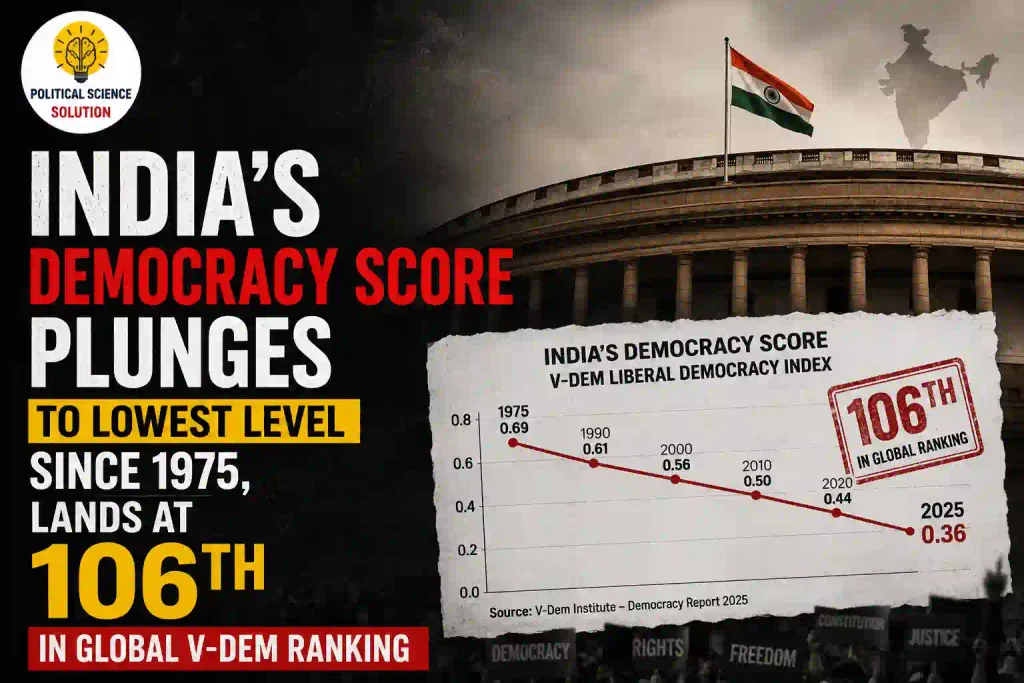
Historic Low on the Electoral Democracy Index
The Varieties of Democracy project, based at the University of Gothenburg in Sweden, released data covering 2025 that gives India a score of 0.38 on its Electoral Democracy Index. That figure ranks the nation 106th among 179 countries evaluated. On the related Liberal Democracy Index the score stands at 0.26, corresponding to a rank of 105th. Both readings represent the lowest Electoral Democracy Index level recorded for India since the Emergency year of 1975.
V-Dem classifies India as an electoral autocracy, placing it in the same category as Kazakhstan and Pakistan. Afghanistan and Turkmenistan fall into the stricter closed autocracy group. The institute’s director is Associate Professor Steven Wilson, who leads the project from the Department of Political Science at the University of Gothenburg.
Regional Picture Across South and Central Asia
Within South and Central Asia the report shows that only two percent of the population lives under electoral democracy. Those citizens are concentrated in Nepal and Sri Lanka. A very small share resides in three countries described as grey-zone democracies: Bhutan, Mongolia and the Maldives. India appears alongside Kazakhstan and Pakistan in the electoral autocracy column, while Afghanistan and Turkmenistan are listed as closed autocracies.
V-Dem uses population-weighted measures to show how much democracy the average person worldwide statistically experiences. Under this system, democratic changes in small countries such as the Seychelles or Timor-Leste receive equal weight with those in large nations including India or the United States.
Slow Autocratization and Institutional Indicators
The institute identifies a gradual process of autocratization in India that began around 2009. It characterises the trend as a systematic weakening of democratic institutions. Key areas of decline include freedom of expression, media independence, harassment of journalists critical of the government, and pressure on civil society groups and opposition parties.
Several institutional indicators now sit at their lowest points in fifty years. These cover judicial accountability, corruption levels, the autonomy of election management bodies, and the impartiality of public administration. Academic freedom measures—freedom to research and teach, academic expression, and institutional autonomy—have also fallen.
United Nations Committee Voices Matching Concerns
Last week the UN Committee on the Elimination of Racial Discrimination completed its first review of India since 2007. The committee stated it was “gravely concerned” about reports of large-scale violations by law-enforcement officials. Among the issues raised was the exclusion of large numbers of voters, particularly Muslims, during the Special Intensive Revision of electoral rolls. Observers have noted that these UN remarks align closely with patterns recorded in the V-Dem data.
Political Reactions to the Ranking
Senior Congress leader and Rajya Sabha MP P. Chidambaram highlighted the figures in a post on X. He wrote: “Without comment: India ranks 106th among 179 countries on the Electoral Democracy Index. V-Dem’s democracy index score for India is at its lowest since 1975.” The Congress party has regularly questioned electoral processes. Leader of the Opposition in the Lok Sabha Rahul Gandhi has repeatedly alleged “vote chori” in recent months.
How V-Dem Measures Democracy
V-Dem does not treat democracy as simply the holding of elections. Its multidimensional approach evaluates electoral integrity, civil liberties, institutional autonomy, judicial accountability, freedom of expression and the quality of public administration. The goal is to track democratization and autocratization over time and to allow consistent cross-country comparison.
The current report continues a series of annual assessments that have previously documented downward movement in several Indian institutional scores. Detailed indicator data show declines in free and fair elections, media and academic expression, and the absence of barriers to opposition participation. These components combine to produce the overall Electoral Democracy Index score of 0.38.
Implications for Public Confidence and Institutions
Falling institutional autonomy can reduce public trust in electoral bodies, the judiciary and administrative agencies. Concerns about voter exclusion and election-management independence raise questions about whether elections remain free, fair and inclusive. The documented pressures on media, academic life and civil society underline the importance of constitutional checks and balances, institutional independence, electoral inclusion and freedom of expression.
Supporters of the present government have previously challenged the methods and conclusions of international democracy indices, arguing that India’s large-scale elections, multiparty competition and independent election commission demonstrate strong democratic practice. Critics respond that the cumulative shift in indicators since 2009 points to structural changes that deserve serious attention. The V-Dem data themselves offer comparative measurements rather than policy prescriptions.
Methodology and Global Context
Population-weighted global averages used by the institute give India’s numbers extra significance. Because the country accounts for a large share of the world’s population, movements in its democratic indicators influence the statistical experience of the average global citizen. At the same time the weighting system prevents large countries from overshadowing progress or setbacks in smaller democracies.
Other measurement projects, including those produced by Freedom House and the Economist Intelligence Unit, have also recorded downward trends for India over the past decade and a half. The consistent direction across different systems has increased attention on the latest V-Dem release.
Looking Ahead
Future movement in these indicators will depend on developments in institutional independence, electoral administration, media freedom and the climate for political opposition and civil society. The present snapshot establishes a clear reference point: India’s Electoral Democracy Index stands at its lowest recorded level since 1975, with a global rank of 106 and a classification as an electoral autocracy. Parallel concerns from the UN Committee on the Elimination of Racial Discrimination about voter exclusion keep questions of inclusion and fairness at the centre of public discussion.
The full report and underlying datasets are publicly available through the V-Dem Institute portal. Researchers, journalists and citizens can examine the coded expert assessments, confidence intervals and coding rules for themselves. In the Indian case the combination of a historic low score, an electoral-autocracy classification and supporting detail on media, judicial and electoral indicators has ensured sustained political and public attention.
Frequently Asked Questions
1. What is India’s current ranking and score on the V-Dem Electoral Democracy Index?
India ranks 106th out of 179 countries with a score of 0.38 on the Electoral Democracy Index for 2025. On the Liberal Democracy Index it ranks 105th with a score of 0.26. These figures mark the lowest Electoral Democracy Index level recorded for India since 1975.
2. Why has V-Dem classified India as an electoral autocracy?
V-Dem places India in the electoral autocracy category alongside countries such as Kazakhstan and Pakistan. The classification reflects a gradual decline in key indicators since around 2009, including freedom of expression, media independence, election management body autonomy, judicial accountability, and pressures on civil society and opposition groups. Afghanistan and Turkmenistan are listed separately as closed autocracies.
3. How does the 2025 score compare with India’s past performance?
The 0.38 Electoral Democracy Index score is the lowest since 1975, the year the Emergency was imposed. V-Dem describes a slow process of autocratization beginning around 2009, with several institutional measures now at their weakest points in fifty years.
4. What connection exists between the V-Dem findings and the recent UN CERD review?
The UN Committee on the Elimination of Racial Discrimination, in its first review of India since 2007, expressed grave concern over reports of large-scale violations by law-enforcement officials and the exclusion of large numbers of voters, particularly Muslims, during the Special Intensive Revision of electoral rolls. These observations align with the patterns of institutional weakening and electoral concerns highlighted in the V-Dem data.
5. What does the Varieties of Democracy (V-Dem) Institute measure and how is it produced?
V-Dem, based at the University of Gothenburg in Sweden and directed by Associate Professor Steven Wilson, uses a multidimensional approach that assesses electoral integrity, civil liberties, institutional autonomy, judicial accountability, freedom of expression, academic freedom, and public administration quality. It employs population-weighted measures so that changes in both large and small countries receive equal statistical weight, and it tracks long-term trends in democratization and autocratization across nearly 180 countries.