

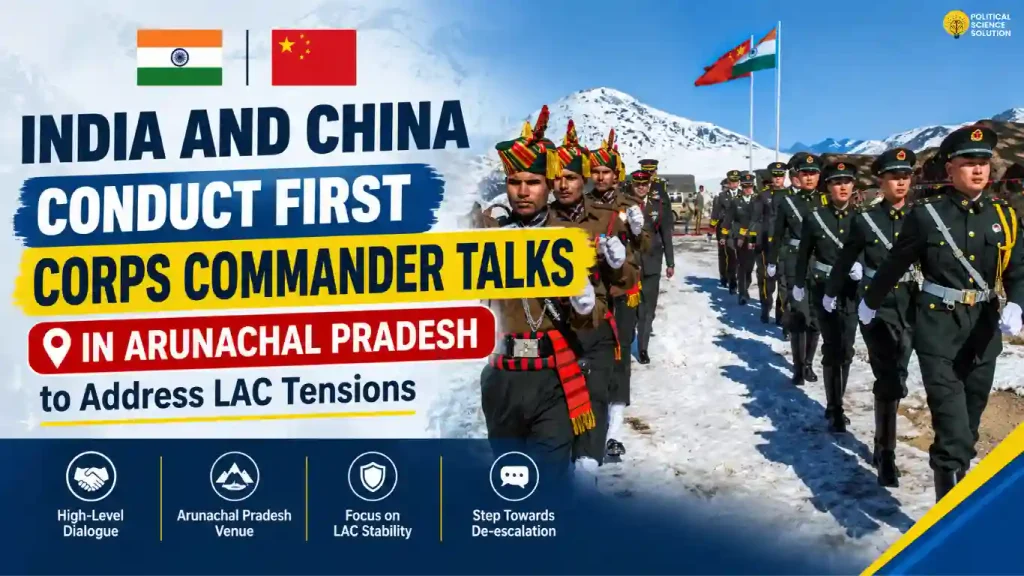
New Delhi: India and China held their first Corps Commander-level military talks in the Eastern Sector of the Line of Actual Control on September 6, 2026. The meeting took place at the Wacha-Damai border personnel meeting point on the Indian side of the LAC in Arunachal Pradesh. Lieutenant General Girish Kalia, commander of the Indian Army’s III Corps, also called the Spear Corps, led the Indian delegation in discussions with his Chinese counterpart and other officers. The engagement occurred amid reports of recent tensions and alleged Chinese activity in the Taksing area of Upper Subansiri district. Indian troops continue to remain deployed in large numbers in the region to prevent any escalation. This was the first senior military commander-level dialogue between the two sides in recent months focused specifically on Arunachal Pradesh, expanding a mechanism that had until now been used mainly for the western sector in Ladakh.
The talks followed multiple meetings between local commanders of both armies in the preceding weeks. Wacha, described as India’s easternmost border personnel meeting point, is located in the Kibithoo sector. There are five designated meeting points along the full India-China LAC, including two in Arunachal Pradesh, of which Wacha is one. The 12-member Indian side also included an Inspector General of the Indo-Tibetan Border Police. The III Corps is headquartered at Rangapahar near Dimapur in Nagaland and carries operational responsibility for stretches of the LAC in Arunachal Pradesh. The Indian Army maintains two corps formations for the Arunachal frontier: III Corps at Rangapahar and IV Corps headquartered at Tezpur in Assam.
Significance of Expanding Military Dialogue to the Eastern Sector
What makes these talks particularly notable is that the Corps Commander-level format has traditionally been applied to manage tensions along the LAC in eastern Ladakh. India and China have already held 23 rounds of such meetings at the Chushul-Moldo border meeting point in Ladakh. The 23rd round took place in October 2025, roughly a year after both sides formally agreed on patrolling arrangements in the Depsang Plains and Demchok, the final two major friction points left from the 2020 military standoff. Those earlier understandings followed the informal meeting between Prime Minister Narendra Modi and President Xi Jinping on the sidelines of the BRICS Summit in Kazan, Russia, in October 2024, which helped produce disengagement at the remaining points.
The Galwan Valley clash of June 2020 had resulted in casualties on both sides and sharply deteriorated bilateral ties. Since then, both countries have pursued military and diplomatic channels to restore peace and tranquillity. Differing perceptions of the LAC alignment have historically generated ground-level friction, especially where infrastructure construction and force multipliers are involved. Former Chief of Defence Staff Lieutenant General Anil Chauhan (retd) commented on the latest Corps Commander talks and the decision to set up two additional military hotlines, describing the developments as positive. He observed that the boundary issue remains unsettled and that differing perceptions, infrastructure activity and force multipliers create the possibility of friction and escalation. This, he said, requires continued vigilance, credible capabilities, clear agreements and consistent adherence.
The India-China border dispute centres on the approximately 3,488-kilometre LAC, divided into three sectors. The Western Sector covers Ladakh and has been the main arena of military tensions since 2020. The Middle Sector, covering Himachal Pradesh and Uttarakhand, has seen comparatively fewer disputes. The Eastern Sector includes Arunachal Pradesh and Sikkim. China claims a large part of Arunachal Pradesh as “South Tibet,” while India considers the entire state an integral part of the country. China has particularly objected to Indian administrative control over areas such as Tawang. The decision to hold Corps Commander-level talks in Arunachal therefore extends a proven communication mechanism into a sector where strategic sensitivity remains high.
Diplomatic Backdrop and New Confidence-Building Measures
The military meeting in Arunachal came shortly after National Security Advisor Ajit Doval and Chinese Foreign Minister Wang Yi, serving as the Special Representatives for boundary talks, held discussions in Beijing on August 25-26, 2026. Those talks produced an eight-point agreement that included advancing negotiations toward an early and substantial harvest on boundary questions, establishing two new Border Personnel Meeting Points—one in the Eastern Sector and another in the Central Sector—and creating new military hotlines. The proposed hotlines will connect the Indian Army’s Eastern and Central Commands with their Chinese counterparts to improve direct communication and help address situations along the LAC more rapidly.
The Arunachal Corps Commander talks also followed the 36th meeting of the Working Mechanism for Consultation and Coordination on India-China Border Affairs held on August 6, 2026. Together these steps form part of a broader effort by New Delhi and Beijing to stabilise relations that had plummeted after the eastern Ladakh standoff began in 2020. Parallel to the diplomatic track, the Indian Army has been reviewing operational preparedness. Army Chief General Dhiraj Seth recently visited the headquarters of III Corps, where formation commanders briefed him on readiness levels and measures being taken to strengthen combat capabilities along the frontier.
The timing of the military engagement carries added weight because it precedes the 18th BRICS Summit, which India is hosting in New Delhi from September 11 to 13, 2026. Chinese President Xi Jinping is expected to attend. Xi’s previous visit to India took place in October 2019 when he travelled to Mamallapuram near Chennai for the second informal bilateral summit with Prime Minister Modi. The sequence of Special Representative talks, new meeting points, planned hotlines and the first Corps Commander engagement in Arunachal reflects a carefully calibrated attempt to manage border issues while keeping higher-level diplomatic channels open.
Focus on Stability and Ongoing Challenges
Discussions at Wacha-Damai focused on maintaining peace and stability along the LAC in the eastern sector and on strengthening mechanisms that prevent localised incidents from escalating into larger confrontations. Sources indicated that Indian forces remain deployed in strength in the Taksing area of Upper Subansiri district specifically to deter any change in the status quo. The meeting therefore built directly on recent lower-level contacts between local commanders while elevating the conversation to a more senior military plane.
Arunachal Pradesh holds strategic importance because of its location along the LAC and because of the unresolved sovereignty claims. Extending the Corps Commander format into this sector signals recognition by both sides that communication channels need to match the geographic spread of potential friction points rather than remaining confined to Ladakh. At the same time, the fundamental territorial disagreement remains unresolved. China continues to assert claims over portions of Arunachal Pradesh, and both armies maintain substantial deployments and infrastructure programmes near the LAC.
The September 6 meeting does not by itself settle these larger questions. Yet it demonstrates a practical willingness to expand the toolkit of military dialogue. The addition of new Border Personnel Meeting Points and hotlines, combined with the first senior-level engagement in the Eastern Sector, creates additional instruments for managing day-to-day issues. Whether these channels deliver lasting stability will depend on consistent implementation and mutual restraint on the ground. For now, the fact that Corps Commander-level talks have been successfully convened in Arunachal Pradesh marks a measurable widening of the communication architecture between the two armies at a moment when both capitals are also preparing for high-level political engagement at the BRICS Summit.
FAQs
1. When and where did the first India-China Corps Commander-level talks in Arunachal Pradesh take place?
The talks were held on September 6, 2026, at the Wacha-Damai (also called Vacha-Damai) Border Personnel Meeting Point on the Indian side of the LAC in the Kibithoo sector of Arunachal Pradesh.
2. Who led the Indian delegation and which formation does he command?
Lieutenant General Girish Kalia, commander of the Indian Army’s III Corps (Spear Corps), led the 12-member Indian side. The corps is headquartered at Rangapahar near Dimapur in Nagaland and is responsible for operational areas along the LAC in Arunachal Pradesh.
3. Why were the talks considered significant?
This was the first senior military commander-level engagement in the Eastern Sector in recent months. Until now the Corps Commander format had been used mainly for the Ladakh sector, where 23 rounds have already been held. The meeting expands military communication channels beyond the Western Sector.
4. What recent diplomatic developments preceded the military talks?
The meeting followed the August 25-26, 2026 discussions in Beijing between National Security Advisor Ajit Doval and Chinese Foreign Minister Wang Yi. Those talks produced an eight-point understanding that included two new Border Personnel Meeting Points and new military hotlines linking the Eastern and Central Commands.
5. How does the timing relate to the BRICS Summit and ongoing border issues?
The talks occurred just days before the 18th BRICS Summit in New Delhi (September 11-13, 2026), which Chinese President Xi Jinping is expected to attend. They also addressed reports of tensions in the Taksing area of Upper Subansiri district while Indian troops remained deployed in strength to prevent escalation.