

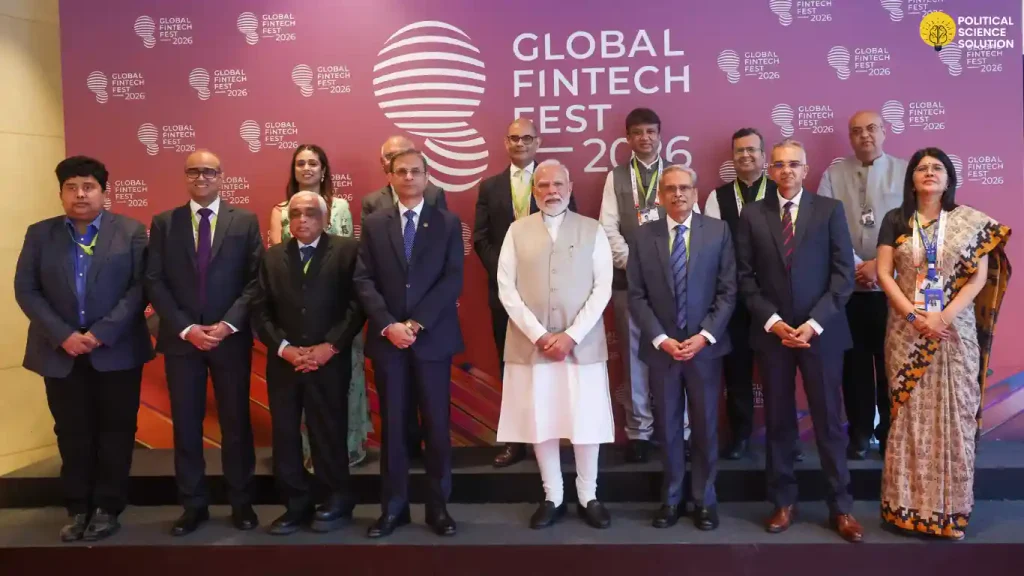
New Delhi: The seventh Global Fintech Fest opened in Mumbai on 8 September 2026 and runs through 11 September, drawing policymakers, technologists and market participants from around the world. This year’s programme centres on three technologies expected to redefine how individuals manage portfolios, gain exposure to assets and evaluate risk over the next decade: agentic artificial intelligence, tokenisation and quantum computing. The official theme—“Potential to Impact: Agentic AI | Tokenisation | Quantum: Trusted, Connected, Global Systems for Inclusive Finance”—frames these tools as the foundation for more autonomous, programmable and secure financial systems.
Event Scale and Institutional Backing
Organised by the Payments Council of India, the National Payments Corporation of India and the Fintech Convergence Council, the gathering receives formal support from the Ministry of Electronics and Information Technology, the Department of Financial Services under the Ministry of Finance, the New Emerging and Strategic Technology Division of the Ministry of External Affairs, NITI Aayog, the Reserve Bank of India, the Securities and Exchange Board of India, the International Financial Services Centres Authority and the Pension Fund Regulatory and Development Authority. Since its first edition in 2020 the festival has expanded into one of the largest global platforms for financial technology dialogue, reflecting rising international interest in India’s digital finance model.
Agentic AI Moves Beyond Answers to Action
Organisers describe agentic AI as the autonomous coordination of complex financial processes, the delivery of highly personalised services across large user bases, and ongoing risk oversight that requires little continuous human input. Practitioners at the event expand on this definition with clear examples of how the technology could alter everyday investing. Devyani Gupta, founder and chief executive of Arrowhead AI, characterises the shift as artificial intelligence progressing from responding to queries to performing complete multi-step tasks. Eshaan Lazarus, founder and chief executive of 021 Trade, illustrates the point with an agent that evaluates tax-saving investment options, completes the necessary paperwork and seeks only final confirmation from the user. The same systems, he notes, can function like a dedicated relationship manager already familiar with an individual’s cash flows, objectives and tax circumstances, while also maintaining constant watch over portfolio positions rather than activating only when an application is opened.
Himanshu Sahu, head of engineering at Share.Market by PhonePe, projects that within five to ten years these agents will track personal life goals, carry out trades and oversee wealth management quietly in the background. Bruce Keith, chief executive and co-founder of Investor Ai, observes that conventional algorithmic trading already follows fixed instructions; agentic systems simply extend that capability across far larger volumes of data. Rishabh Nahar, partner and fund manager at Qode Advisors, anticipates a transition from mere notifications about portfolio shifts to actual execution inside predetermined safety parameters, covering rebalancing, additional investments and tax-loss harvesting. Sougata Basu, founder and chief executive of CashRich, highlights a practical Indian constraint: meaningful human advisory attention often becomes available only after an investor reaches roughly ₹50 lakh in assets. Agentic platforms, he argues, can close that gap for far smaller portfolios.
Tokenisation Opens Fractional Access to Previously Illiquid Assets
Tokenisation, according to festival materials, converts every form of asset—public or private, physical or digital—into programmable units that can be divided and transferred instantly across shared global infrastructure. Gupta defines the process as creating a digital version of an asset that supports division, transfer and digital management. Sahu looks further ahead, suggesting that within a decade ordinary investors may purchase and settle tiny fractions of commercial property or private equity funds directly through familiar brokerage applications. Lazarus points to concrete regulatory progress already under way: the Securities and Exchange Board of India’s 2026 annual report confirmed a pilot programme for tokenising corporate bonds. He also notes that mutual funds already permit holdings to four decimal places and that systematic investment plans can begin with as little as ₹100, demonstrating that fractional ownership is no longer purely theoretical.
Quantum Computing Strengthens the Invisible Backbone
Quantum technology receives a different emphasis. Festival organisers present it as a fundamental upgrade to security, optimisation and computational power. Gupta stresses that its primary effects will occur behind the scenes at financial institutions rather than on retail interfaces. Although still experimental, Sahu outlines potential retail benefits: platforms capable of running millions of risk scenarios in fractions of a second, more precise portfolio construction, improved modelling of severe market downturns, and enhanced cybersecurity across the wider financial network.
How the Three Technologies Work Together for Investors
Gupta describes a seamless chain of interaction. An agentic system first understands an investor’s objectives and continuously reviews holdings. When an attractive opportunity appears in a tokenised form, the agent can engage with that asset digitally. Quantum-level processing supplies the heavy computational support required for sophisticated optimisation and risk assessment. Lazarus supplies a concrete walk-through. An investor indicates a desire for greater real-estate exposure. The agent examines current positions, identifies indirect exposure already present through bank stocks, and presents alternatives that include a tokenised infrastructure trust requiring only a ₹5,000 minimum commitment instead of the ₹25 lakh threshold typical in 2026. After approval, funds and the asset transfer simultaneously, removing the conventional T+1 settlement delay. Post-quantum cryptographic methods protect the entire transaction.
India’s Digital Public Infrastructure Supplies the Essential Foundation
The festival places these emerging tools in the context of India’s existing digital architecture. The Jan Dhan–Aadhaar–Mobile combination has created a broad base for formal financial access. By 26 August 2026 more than 59.15 crore Jan Dhan accounts had been opened, while Aadhaar enrolments exceeded 144 crore by March 2026. Unified Payments Interface volumes reached 2,365.8 crore transactions valued at ₹29.88 lakh crore in July 2026 across 741 participating banks—growth of nearly 12,000 times since financial year 2016-17. August 2026 alone recorded 24,509 million transactions, representing close to half of global real-time digital payment volume and operating in eleven countries. The Financial Inclusion Index advanced from 43.4 in March 2017 to 70.0 in March 2026. Aadhaar e-KYC processed more than 2,458 crore transactions by 29 June 2026. DigiLocker counted 73.53 crore registered users and 936.03 crore issued documents. Cumulative Direct Benefit Transfer disbursements stood at ₹53.26 lakh crore by September 2026. The Open Network for Digital Commerce had linked more than 20 crore buyers and five lakh sellers across over a thousand cities by June 2026, with its financial-services category creating additional distribution channels.
Supporting technologies already embedded in the ecosystem include application programming interfaces, cloud computing, biometrics, distributed-ledger systems, large-scale data analytics, artificial intelligence and machine learning. These tools have improved efficiency, expanded inclusion and diversified credit sources beyond a narrow set of traditional banks, thereby reducing certain concentration risks.
Regulatory Architecture Built for Scale and Trust
As the sector has grown, authorities have strengthened the framework that underpins public confidence. The Reserve Bank of India’s May 2024 Framework for Self-Regulatory Organisations in the FinTech Sector promotes ethical standards and dispute resolution. Master Directions on Digital Payment Security Controls issued in 2021 establish common minimum protections across channels. NPCI deploys artificial-intelligence and machine-learning systems to monitor UPI fraud. The Digital Personal Data Protection Act of 2023 and the Rules notified in 2025 set the data-protection baseline. The Regulatory Sandbox launched in August 2019 continues to allow controlled testing of new products. Consumer safeguards for digital lending include a public directory of applications, the National Cybercrime Reporting Portal, helpline 1930 and the SACHET portal for complaints about unauthorised deposit collection.
Looking Ahead: Sovereignty, Inclusion and Responsible Innovation
Official statements emphasise the next phase of development: deepening digital sovereignty, technological self-reliance and innovation that remains accountable. Strong cybersecurity, data protection and consumer protections are described as non-negotiable as digital finance expands. Open platforms are expected to continue widening access for citizens, start-ups and enterprises. Collaboration with emerging economies and the Global South is presented as a route for India to share both technical capability and institutional experience. The overarching objective remains a sovereign, secure and inclusive digital financial system grounded in people-centred governance and public value.
For investors the message from Mumbai is practical. Agentic systems promise continuous oversight and disciplined execution inside clear boundaries. Tokenisation points toward fractional ownership of assets once reserved for large institutions and near-instant settlement. Quantum capabilities, once mature, are expected to fortify the computational and security layers that support the entire ecosystem. The Global Fintech Fest 2026 does not present these outcomes as immediate; it presents them as the logical extension of the digital public infrastructure already operating at national scale. The design choices made now—technical, regulatory and commercial—will determine how quickly and how safely these capabilities reach everyday portfolios.
Frequently Asked Questions
1. What exactly is agentic AI and how is it different from the AI tools investors already use?
Agentic AI goes beyond answering questions or generating reports. It autonomously handles multi-step financial tasks—comparing investment options, preparing forms, monitoring portfolios continuously, and even executing trades within pre-approved limits. Current AI tools mostly assist with screening or send alerts that still need human approval. Agentic systems aim to act like a full-time relationship manager that understands cash flows, goals and tax situations while operating in the background.
2. How could tokenisation change the way ordinary investors buy assets?
Tokenization converts real-world or digital assets into programmable, divisible units that can be bought, sold and settled almost instantly on digital infrastructure. This could allow retail investors to purchase tiny fractions of commercial real estate, private equity or infrastructure projects through a regular brokerage app, potentially with minimum tickets as low as a few thousand rupees instead of the much higher thresholds common today. Regulators in India have already begun pilot work on tokenising corporate bonds.
3. Is quantum technology ready for everyday investing, or is it still experimental?
Quantum technology remains largely experimental. Its near-term impact will be felt more inside financial institutions than on investor screens—enabling far faster risk simulations, better portfolio optimisation and stronger cybersecurity through post-quantum cryptography. Over time it could support the complex calculations that power agentic systems and tokenised markets, but widespread retail applications are still several years away.
4. How do these three technologies work together for an investor?
An agentic AI system can analyse an investor’s goals and existing holdings, identify a suitable opportunity, and present options. If the asset is tokenised, the agent can execute the purchase with near-instant settlement. Quantum computing in the background can handle the heavy risk modelling and security requirements. One example discussed at the festival involves an investor seeking more real-estate exposure and receiving a low-minimum tokenised infrastructure option that settles immediately under advanced cryptographic protection.
5. What role does India’s existing digital infrastructure play in making these technologies practical?
India’s digital public infrastructure—Aadhaar, UPI, DigiLocker, Jan Dhan accounts and open networks—has already delivered large-scale identity, payments and data-sharing systems. This foundation makes it easier to layer agentic AI, tokenisation and quantum-safe security on top of trusted, interoperable platforms that already serve hundreds of millions of users. Strong regulatory frameworks around data protection, digital payments and fintech self-regulation further support responsible adoption.