

New Delhi: Navi Mumbai has been declared the cleanest city in India under the latest edition of Swachh Survekshan, the flagship urban cleanliness survey conducted by the Union Ministry of Housing and Urban Affairs. The announcement marks a significant shift in the national rankings, as Indore, which held the top position for eight consecutive years, did not feature among the primary winners this cycle. Surat from Gujarat secured the second position, while Vijayawada in Andhra Pradesh claimed third place in the overall standings for larger urban centres.
President Droupadi Murmu presented the awards at a formal ceremony held in New Delhi. The survey evaluated performance across thousands of urban local bodies, with more than 4,700 cities and towns participating in the 2025-26 assessment. Officials highlighted that the process involved extensive on-ground evaluation by over 3,000 trained assessors, supported by real-time GPS monitoring and a fully digital system covering evidence submission, verification, and quality checks at every stage.
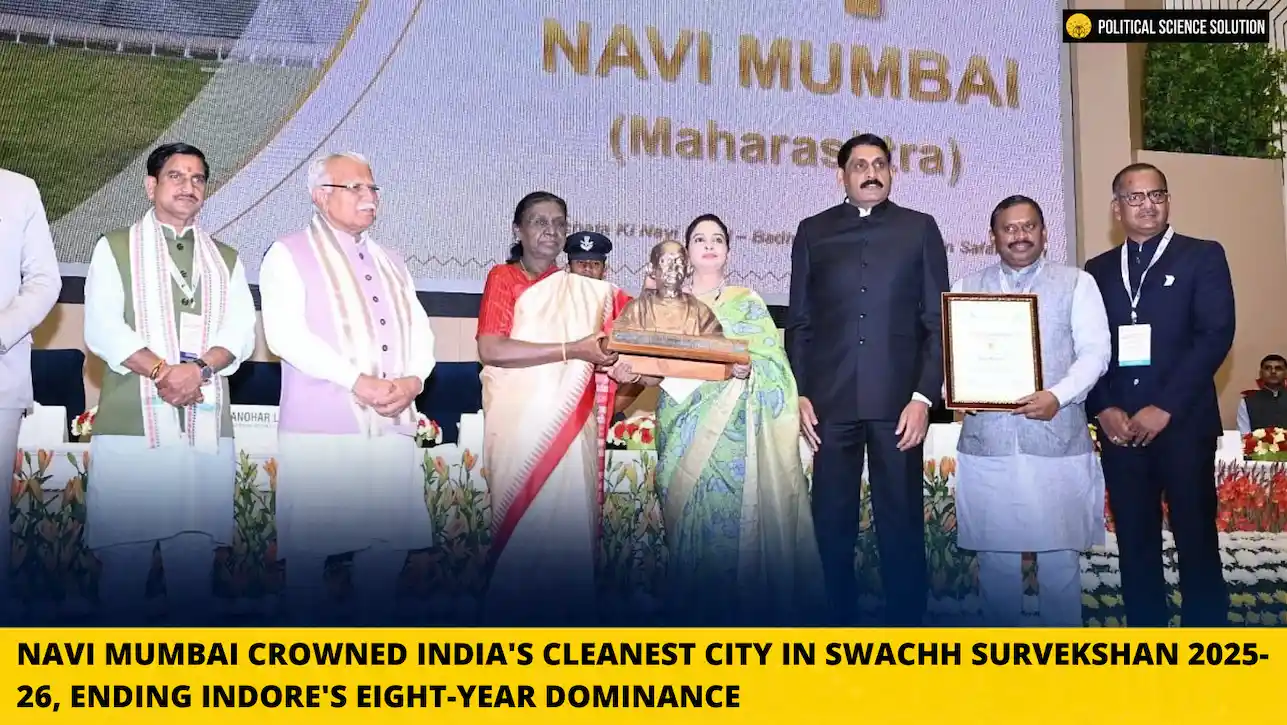
Overall Rankings and Category Leaders
In the main category for major cities, Navi Mumbai’s top ranking reflects sustained improvements in waste management, sanitation infrastructure, and public participation. Surat and Vijayawada followed closely. For cities with populations between three lakh and ten lakh, Ujjain in Madhya Pradesh emerged as the cleanest, with Chandigarh taking second place and Guntur in Andhra Pradesh finishing third.
Among cities with populations exceeding ten lakh, Greater Visakhapatnam ranked first, followed by Jabalpur and Lucknow. These results underscore regional variations in performance while pointing to consistent progress in several southern and central Indian urban centres.
Specialized Categories Highlight Regional Strengths
The survey expanded its focus this year to include specialized assessments. In the cleanest riverfront town category, Rewa in Madhya Pradesh took the top spot, with Bilaspur in Chhattisgarh in second place and Varanasi in Uttar Pradesh in third. For coastal towns, Puri in Odisha ranked first, followed by Alappuzha in Kerala and Ratnagiri in Maharashtra.
In the Himalayan cities category, Rudrapur in Uttarakhand was declared the cleanest, with Jammu in second position and Shopian in third. These category-specific awards aim to recognize efforts tailored to geographic and environmental challenges, such as managing waste near water bodies or in mountainous terrain.
Indore’s Shift to Mentor City Role
Indore’s absence from the primary top ranks this year has drawn attention. The city, long regarded as a benchmark for urban cleanliness, was assessed under the newly introduced Swachh Shehar Jodi initiative in the Mentor City category. There, Indore paired with Depalpur secured the second position. Ahmedabad, paired with Sanand, claimed the top spot in this category, while Tirupati with Kuppam finished third.
The ministry noted measurable improvements among mentee cities between the previous survey and the current one. Visible cleanliness scores rose from 48 percent to 70 percent. Door-to-door collection improved from 52 percent to 74 percent. Source segregation increased from 16 percent to 30 percent, access to sanitation from 11 percent to 38 percent, used water management from 32 percent to 53 percent, and advocacy for cleanliness from 48 percent to 66 percent. These gains illustrate the impact of structured mentorship from higher-performing cities.
Smaller City Categories and Additional Details
In the population band of 50,000 to three lakh, Dewas in Madhya Pradesh ranked first, the New Delhi Municipal Council second, and Sagar third. For towns with populations between 20,000 and 50,000, Vita in Maharashtra took first place, followed by Aska in Odisha and Panaji in Goa.
Last year’s top three overall were Indore, Surat, and Navi Mumbai. Jaipur had been recognized as the cleanest city in Rajasthan, and Gwalior held a similar distinction within Madhya Pradesh in the prior cycle. The continuity of strong performers alongside new entrants reflects both sustained efforts and the competitive nature of the annual assessment.
Survey Enhancements and Methodology
Swachh Survekshan 2025-26 carried the theme “Swachhata Ki Nayi Pehel – Badhayein Haath, Karein Safai Saath.” Key enhancements included greater weight to citizen feedback, expanded coverage of urban riverfronts, coastlines, and water bodies, and focused indicators on preventing open defecation and open urination. Additional attention was given to the cleanliness of tourist and heritage sites and to behaviour-change initiatives in schools.
The survey forms a core component of the Swachh Bharat Mission-Urban, which seeks to strengthen sanitation, hygiene, and solid waste management systems across Indian cities. Participation exceeded 4,751 urban local bodies in the latest round, making it one of the most extensive cleanliness evaluations conducted globally.
Context and Broader Implications
The results arrive at a time when urban India continues to grapple with the twin challenges of rapid population growth and the need for sustainable waste and sanitation infrastructure. Navi Mumbai’s recognition highlights the outcomes of coordinated municipal efforts, public engagement, and infrastructure investment. Surat’s consistent high ranking and Vijayawada’s strong showing further demonstrate that multiple cities across different states are achieving measurable gains.
For Indore, the transition into a mentor role under the Swachh Shehar Jodi framework positions the city to transfer its accumulated expertise to smaller or developing urban centres. The reported percentage improvements in mentee cities suggest that this approach is already yielding tangible results in service delivery and community practices.
Officials emphasized the digital and transparent nature of the assessment process. From initial evidence collection to final verification, every stage remained subject to rigorous checks, reducing subjectivity and enhancing credibility. The inclusion of real-time GPS tracking for assessors added another layer of accountability.
Looking Ahead
The annual Swachh Survekshan rankings serve both as a competitive benchmark and as a diagnostic tool for urban local bodies. Cities that perform well gain national visibility and opportunities to share best practices, while those lower in the rankings receive clearer indicators of areas requiring attention. The expanded focus on riverfronts, coastal zones, Himalayan towns, and smaller population categories ensures that recognition is not limited to the largest metropolitan areas.
Citizen feedback has been given greater prominence this year, reflecting an understanding that sustained cleanliness depends on public participation as much as on municipal systems. Behaviour-change programmes in schools aim to build long-term habits among younger generations. Indicators targeting open defecation and open urination continue to address foundational sanitation gaps that affect public health and dignity.
As urban centres across India absorb the findings of the 2025-26 survey, the emphasis is likely to remain on scalable solutions for waste segregation, collection efficiency, treatment of used water, and maintenance of public spaces. The mentor-mentee model offers one pathway for accelerating progress in cities that have lagged behind.
Navi Mumbai’s achievement as the cleanest city, Surat’s second-place finish, and the strong performances of Vijayawada, Ujjain, Greater Visakhapatnam, Rewa, Puri, Rudrapur, and other category leaders collectively illustrate a broadening base of urban excellence in sanitation. The survey’s comprehensive methodology and the recorded gains among mentee cities indicate that the national cleanliness mission continues to evolve and deliver measurable outcomes across diverse urban settings.
The full set of rankings and detailed performance data released by the Union Ministry of Housing and Urban Affairs provide city administrations with concrete benchmarks against which to measure future progress. With over four thousand urban local bodies already engaged in the process, the scale of participation itself underscores the widespread institutional commitment to improving urban living conditions through better sanitation and waste management practices.
FAQs
1. Which city was declared the cleanest in India under Swachh Survekshan 2025-26?
Navi Mumbai was adjudged the cleanest city in India. Surat ranked second and Vijayawada third in the overall category for major urban centres.
2. Why did Indore not top the rankings this year after eight consecutive wins?
Indore was assessed under the newly introduced Mentor City category as part of the Swachh Shehar Jodi initiative. It secured second place along with its partner town Depalpur. Ahmedabad (with Sanand) took first and Tirupati (with Kuppam) finished third in that category.
3. What were the top performers in the specialised categories?
- Cleanest riverfront town: Rewa (first), Bilaspur (second), Varanasi (third)
- Cleanest coastal town: Puri (first), Alappuzha (second), Ratnagiri (third)
- Cleanest Himalayan city: Rudrapur (first), Jammu (second), Shopian (third)
- Cities with 10 lakh+ population: Greater Visakhapatnam (first), followed by Jabalpur and Lucknow
- Cities with 3–10 lakh population: Ujjain (first), Chandigarh (second), Guntur (third)
4. How many cities participated and what improvements were recorded among mentee cities?
Over 4,700 urban local bodies took part. Mentee cities showed clear gains: visible cleanliness rose from 48% to 70%, door-to-door collection from 52% to 74%, source segregation from 16% to 30%, access to sanitation from 11% to 38%, used water management from 32% to 53%, and advocacy for cleanliness from 48% to 66%.
5. Who presented the awards and what was the theme of this year’s survey?
President Droupadi Murmu presented the awards in New Delhi. The theme was “Swachhata Ki Nayi Pehel – Badhayein Haath, Karein Safai Saath.” The assessment included stronger citizen feedback, expanded coverage of riverfronts, coastlines and water bodies, and focused indicators on open defecation prevention, tourist-site cleanliness and school behaviour-change programmes.