

New Delhi: The six member states of the Gulf Cooperation Council have approved the creation of an advanced headquarters for their Unified Military Command in Kuwait and agreed to assign appropriate military forces to the facility. The decision was taken on Tuesday during the 23rd session of the GCC Joint Defence Council in Manama, Bahrain. Defence ministers from Bahrain, Kuwait, Oman, Qatar, Saudi Arabia and the United Arab Emirates attended the meeting, which was chaired by Bahrain’s Minister of Defence Affairs, Lieutenant General Abdullah bin Hassan Al Nuaimi. GCC Secretary-General Jasem Mohamed Albudaiwi announced the outcome, stating that the new headquarters would enhance joint military cooperation, operational coordination and collective security across the bloc.
The move follows explicit directives issued by GCC leaders at an extraordinary summit held in Jeddah in April 2026. Those directives called for accelerated progress on stronger defence coordination and the completion of a joint missile warning system. The Kuwait facility is described as a forward headquarters, positioned closer to potential areas of tension at the northern end of the Gulf. Specific details on its exact location, the number of personnel, the composition of assigned units and the timeline for full operational readiness have not been released. The headquarters will operate under the existing Unified Military Command structure, which maintains its primary base in Riyadh.
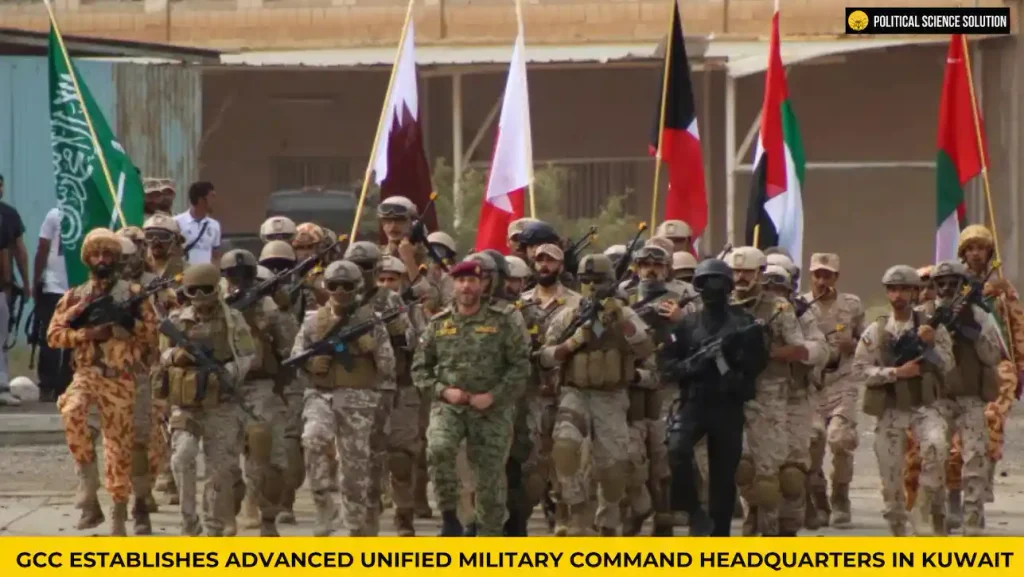
What the GCC Announced and How the Command Structure Will Function
The Unified Military Command was established in December 2013 with the purpose of coordinating joint operations and reinforcing collective defence among the six states. Its permanent headquarters in the Saudi capital opened in 2021. The decision to add an advanced command post in Kuwait therefore builds on more than a decade of institutional development rather than creating an entirely new organisation. Officials emphasised that the facility will receive “appropriate” forces drawn from the member states, though the precise mix of capabilities remains undisclosed.
This arrangement sits alongside the long-standing Peninsula Shield Force. That force draws infantry, armour, artillery and combat-support elements from each GCC country. A standing rule requires that any operational intervention by the Peninsula Shield Force must include participation from every member state, underscoring the consensus-based character of Gulf military cooperation. Analysts note that the new Kuwait headquarters is intended to provide a more agile command-and-control node while remaining firmly within the same collective framework.
Muhanad Seloom, a nonresident fellow at the Middle East Council on Global Affairs, described the decision as establishing a permanent unified presence at the northern tip of the Gulf. Kuwait, he observed, has generally sought to maintain a moderate posture toward Iran even while facing direct threats. The country also contends with risks originating from across its border with Iraq, where Iran-aligned armed groups have previously launched drones toward Gulf targets. According to Seloom, the presence of a forward command structure sends a clear message to both Iran and Iraq and reassures GCC capitals that contingency planning is under way for a range of scenarios.
Regional Security Pressures Behind the Decision
The timing of the announcement is closely linked to the security environment that has unfolded since the United States and Israel launched military operations against Iran on 28 February. Gulf states that host major American military installations came under Iranian missile and drone attacks in the ensuing conflict. Those strikes disrupted commercial aviation and maritime traffic, exposing the vulnerability of the region’s critical energy export infrastructure. Although further large-scale military action against Iran was later characterised as unnecessary for the immediate term, a United States naval blockade remains in effect and shipping volumes through the Strait of Hormuz have yet to return to normal levels.
Parallel pressure has come from Yemen. After several years of relative calm following a United Nations-brokered truce in 2022, fighting between Iran-aligned Houthi forces, also known as Ansar Allah, and Saudi-backed government forces intensified. The GCC statement that accompanied the Kuwait headquarters decision specifically condemned Houthi attacks on Saudi Arabia. Officials described the assaults as a flagrant violation of the sanctity of sites revered by Muslims and a direct challenge to the Kingdom’s security and sovereignty. One of the most serious incidents occurred on 10 October, when a Houthi strike on Riyadh’s King Khalid International Airport killed 14 people and wounded more than 300.
Seloom argued that the headquarters should be understood as part of a longer-term deterrent strategy rather than a reaction to any single imminent threat. Regional capitals, he said, have increasingly voiced the view that they must develop independent capabilities to protect their interests. The combination of Iranian missile and drone operations, persistent Houthi targeting of Saudi infrastructure, and the residual disruption to energy trade has reinforced the case for tighter operational coordination among the six GCC states.
How the New Headquarters Fits with Broader Alliances and United States Partnerships
The Kuwait facility adds a dedicated GCC layer to an expanding network of overlapping security arrangements. In August, Saudi Arabia, Pakistan and Türkiye signed the Mecca Joint Defence Agreement, under which an armed attack on any one of the three parties is to be treated as an attack on all. Pakistan and Saudi Arabia had already formalised a bilateral mutual defence treaty in 2025. The GCC command structure operates as a separate framework focused exclusively on coordination among Bahrain, Kuwait, Oman, Qatar, Saudi Arabia and the United Arab Emirates. Seloom characterised the new headquarters as complementary to these newer pacts, signalling that the Gulf states are actively constructing their own institutional capacity.
At the same time, analysts caution against interpreting the decision as a move away from longstanding security partnerships with the United States. Albert Vidal, a Gulf and Middle East analyst at the International Institute for Strategic Studies, stated that the announcement itself does not suggest any shift in the region’s relationship with Washington. On the contrary, he argued, the United States would welcome closer direct cooperation and information-sharing among GCC members because such integration improves overall military effectiveness. Seloom similarly rejected the notion that the headquarters represents a response to any perceived shortcoming in American policy. He described it instead as a wake-up call that prompted the GCC states to assume greater responsibility for their own defence planning.
The practical impact of the Kuwait headquarters will depend on the scale of forces eventually assigned to it and on the speed with which command systems, communications links and joint planning procedures are put in place. Until those details are released, the facility’s primary significance remains political and institutional. By establishing a forward command node in Kuwait, the six member states have demonstrated a concrete commitment to reducing response times, improving real-time coordination and strengthening collective deterrence against missile, drone and cross-border threats.
Gulf leaders have repeatedly stressed the need for tighter defence coordination to address both current challenges and those that may arise in the future. The 10 November decision implements part of that agenda. It builds on the 2013 creation of the Unified Military Command and the 2021 opening of its Riyadh headquarters, responds directly to the April 2026 Jeddah directives, and sits alongside newer bilateral and trilateral defence agreements. While many operational questions remain unanswered, the strategic intent is clear: the GCC intends to enhance its capacity for independent collective action in a more contested regional security environment.
FAQs
1. What exactly did the GCC announce regarding the military command base in Kuwait?
On 10 November 2026, the six GCC member states approved the establishment of an advanced (forward) headquarters for the Unified Military Command in Kuwait and agreed to allocate “appropriate” military forces to it. The decision was taken at the 23rd session of the GCC Joint Defence Council in Manama, Bahrain, chaired by Bahrain’s Minister of Defence Affairs. Exact details on location, troop numbers, force composition and deployment timeline have not been released. The facility will operate under the existing Unified Military Command, which has its main headquarters in Riyadh.
2. Why was Kuwait chosen for the advanced headquarters?
Kuwait sits at the northern end of the Gulf, closer to potential threat areas involving Iran and Iraq. Analysts note that placing a permanent unified command presence there strengthens operational reach and sends a deterrent message. Kuwait has maintained a relatively moderate stance toward Iran while still facing risks from Iran-aligned groups operating across its border with Iraq. The move creates a forward command node without relocating the primary headquarters from Riyadh.
3. How is this decision linked to the Iran conflict and Houthi attacks?
The approval follows Iranian missile and drone attacks on Gulf states after the US-Israel military campaign against Iran began on 28 February 2026. Those strikes disrupted flights, shipping and energy exports. At the same time, Houthi forces intensified attacks on Saudi Arabia, including a 10 October strike on Riyadh’s King Khalid International Airport that killed 14 people and wounded more than 300. The GCC statement accompanying the announcement explicitly condemned the Houthi assaults. Officials and experts describe the headquarters as part of a longer-term strategy to build independent deterrents rather than a response to any single imminent threat.
4. Does the new headquarters signal reduced reliance on the United States?
No. Analysts emphasise that the facility complements rather than replaces existing security partnerships with the United States. The US has long served as the primary external security provider to the Gulf. Experts note that Washington would likely welcome closer direct coordination and information-sharing among GCC states because it improves overall military effectiveness. The decision is widely viewed as a wake-up call for the GCC to strengthen its own capabilities alongside, not instead of, current alliances.
5. What is the background of the Unified Military Command and how does it relate to the Peninsula Shield Force?
The Unified Military Command was established in December 2013 to coordinate joint operations and collective defence; its Riyadh headquarters opened in 2021. The new Kuwait facility adds a forward layer to this structure. It operates alongside the older Peninsula Shield Force, which draws infantry, armour, artillery and combat-support units from all six member states. A core rule of the Peninsula Shield Force requires participation from every GCC country in any intervention. The Kuwait headquarters is intended to improve command agility and real-time coordination within this established collective framework.