

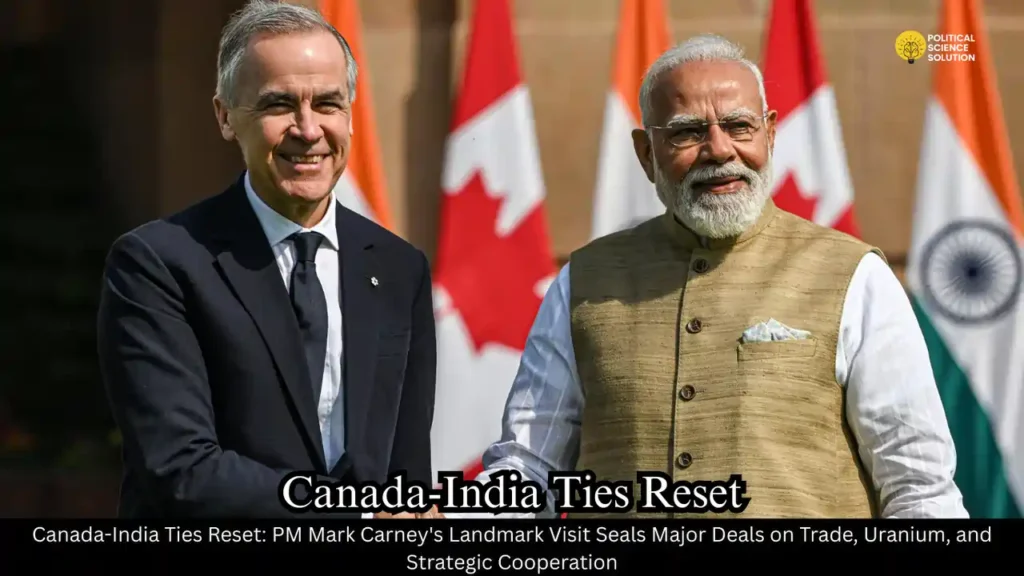
New Delhi: Canadian Prime Minister Mark Carney’s official visit to India from February 27 to March 2, 2026, has delivered a series of high-impact agreements, signaling a decisive reset and expansion of bilateral relations. This marked Carney’s inaugural bilateral trip to India since assuming office in March 2025 as Canada’s 24th Prime Minister, following his leadership of the Liberal Party and a subsequent federal election victory. It was also the first such visit by a Canadian leader since 2018, underscoring efforts to move beyond past diplomatic strains and capitalize on shared economic and strategic priorities in an era of global uncertainty.
A Carefully Choreographed Reset Amid Global Pressures
The visit unfolded against a backdrop of evolving international dynamics, including U.S. tariff policies under President Donald Trump, ongoing geopolitical conflicts, and the need for diversified partnerships. Both nations, as vibrant democracies and middle powers, emphasized building resilience through deeper cooperation. Carney arrived accompanied by a high-level delegation, including ministers, provincial representatives, and business leaders, engaging with Indian counterparts in Mumbai and New Delhi.
Prime Minister Narendra Modi welcomed the visit as laying a “strong foundation for a truly renewed partnership.” In a post on X responding to Carney’s highlights of the trip as an “expansion with new ambition and focus,” Modi expressed eagerness to collaborate on a future rooted in trust, growth, innovation, and shared prosperity.
Carney described the relationship as one between “two confident, ambitious nations charting their course,” noting unprecedented governmental engagement in the preceding year—more than in the prior two decades combined. The joint statement issued by the leaders affirmed that a robust India-Canada partnership advances mutual prosperity and global priorities.
Landmark Uranium Supply Agreement Powers Clean Energy Goals
A standout outcome was the finalization of a long-term commercial uranium supply contract between Canada’s Cameco Corporation and India’s Department of Atomic Energy. Valued at approximately US$1.9 billion (CA$2.6 billion), the deal secures uranium ore concentrates to fuel India’s civilian nuclear program, support its clean energy transition, and bolster long-term energy security.
The agreement opens doors for joint work on small and modular nuclear reactors, as well as advanced reactor technologies. Modi highlighted this as a “landmark deal” for civil nuclear energy, aligning with India’s ambitions for reliable, low-carbon base-load power.
Trade Acceleration: CEPA Negotiations and $50 Billion Target
Bilateral merchandise trade currently stands at US$8–10 billion annually—well below potential given the scale of both economies. To unlock greater opportunities, the leaders signed the Terms of Reference for negotiations on a Comprehensive Economic Partnership Agreement (CEPA) encompassing goods and services.
Both sides pledged to conclude the ambitious, balanced CEPA by the end of 2026. Upon completion, it would anchor economic ties, boost investment, and drive progress toward a bilateral trade goal of US$50 billion by 2030 (equivalent to CAD 70 billion or INR 4.65 lakh crore).
A reconstituted Canada-India CEOs Forum will identify prospects in trade, investment, innovation, and supply chain resilience, offering actionable input for CEPA talks. The Finance Ministers’ Economic and Financial Dialogue was also greenlit to tackle instant payments, cross-border remittances, and merchant payments, benefiting trade, tourism, education, remittances, and small and medium enterprises.
Critical Minerals, Energy, and Agriculture Advancements
Cooperation in critical minerals advanced with a signed Memorandum of Understanding to build secure, resilient supply and value chains essential for strategic sectors.
A new Strategic Energy Partnership was announced, focusing on clean energy collaboration. Canada will supply India with LPG and LNG, providing reliable alternatives amid shifting global energy markets.
In agriculture, a Declaration of Intent established a Joint Pulse Protein Centre of Excellence. As a leading pulse exporter, Canada stands to gain from strengthened value chains supporting food security.
Defense, Security, and Technology Deepening
Defense ties received institutional momentum through the establishment of an India-Canada Defence Dialogue, expanded military cooperation via joint training and exchanges, a new Maritime Security Partnership emphasizing supply chain resilience, and the appointment of defense attaches.
Progress in national security advisers’ dialogues and an agreement on national security and law enforcement cooperation were noted. Both nations committed to intensified efforts against violent extremism, terrorism, organized crime, extortion, financial fraud, and associated threats.
Canada announced joining the Global Biofuels Alliance and International Solar Alliance, reinforcing renewable energy alignment. The Canada-India Talent and Innovation Strategy launched, incorporating 13 new university partnerships to boost education links.
Additional pledges covered critical technologies, space collaboration, higher education, AI integration into space and aerospace, and clean energy initiatives.
Navigating Past Challenges Toward Future Ambition
Relations had cooled significantly since 2023 over allegations related to the killing of a Sikh separatist leader in Canada, leading to diplomatic expulsions and stalled engagements. Carney’s administration has prioritized rebuilding, including inviting Modi to the G-7 Summit in Alberta and meetings on G-20 sidelines, alongside ministerial dialogues in foreign affairs, trade, and energy.
The visit was meticulously planned—focused on Mumbai’s business ecosystem and New Delhi’s political center, avoiding sensitive areas—to emphasize forward momentum. While security concerns linger and demand careful management, the emphasis remained on economic, technological, and strategic alignment.
The eight agreements and multiple pacts across trade, energy, agriculture, space, and more represent preliminary yet meaningful progress toward normalization. In a world marked by trade disruptions and supply vulnerabilities, India and Canada are positioning their partnership as a model of democratic cooperation for resilience and prosperity.
With ambitious targets set and negotiations underway, the momentum from Carney’s visit promises sustained advancement in this revitalized strategic relationship.
FAQs
1. Why did Canadian Prime Minister Mark Carney visit India in early 2026?
Mark Carney’s visit to India from February 27 to March 2, 2026, was his first official bilateral trip to the country since becoming Canada’s 24th Prime Minister in March 2025. It aimed to reset and expand the Canada-India Strategic Partnership (designated in 2018), which had faced strains since 2023 over diplomatic tensions. The visit focused on rebuilding trust through business-oriented engagements in Mumbai and New Delhi, diversifying trade amid U.S. tariff pressures under President Donald Trump, and advancing cooperation in energy, trade, defense, critical minerals, and clean technologies. Both leaders described it as building a foundation for a “truly renewed partnership” based on shared democratic values, innovation, and mutual prosperity.
2. What were the major agreements signed during the visit?
Several key pacts were concluded, including:
• A long-term commercial uranium supply contract worth approximately US$1.9 billion (CA$2.6 billion) between Canada’s Cameco and India’s Department of Atomic Energy to support India’s civilian nuclear energy program and clean energy goals.
• The Terms of Reference for negotiations on a Comprehensive Economic Partnership Agreement (CEPA) covering goods and services, with a target to conclude it by the end of 2026.
• A Memorandum of Understanding (MoU) on critical minerals to develop secure and resilient supply chains.
• A Declaration of Intent for a Joint Pulse Protein Centre of Excellence in agriculture.
• Canada’s joining the Global Biofuels Alliance and International Solar Alliance. Additional commitments included launching the Canada-India Talent and Innovation Strategy (with 13 new university partnerships), establishing an India-Canada Defence Dialogue, and pledging deeper cooperation in defense, small modular reactors, AI, space, renewable energy, and law enforcement against terrorism and organized crime.
3. What is the new bilateral trade target, and why is it significant?
The leaders set an ambitious goal to increase bilateral merchandise trade to US$50 billion by 2030 (from the current US$8–10 billion annually). This target is significant because current trade levels are considered well below potential given the economic sizes of both nations. The forthcoming CEPA is expected to serve as a durable economic anchor, boost investment, supply chain resilience, and accelerate progress toward this goal. A reconstituted Canada-India CEOs Forum will provide recommendations to support negotiations and identify opportunities in trade, innovation, and related areas.
4. How did the visit address past strains in Canada-India relations?
Relations had deteriorated significantly since 2023 following allegations by then-Prime Minister Justin Trudeau linking Indian agents to the killing of a Sikh separatist leader in Canada, leading to diplomatic expulsions and frozen high-level ties. Carney’s visit was carefully choreographed—limited to Mumbai (business focus) and New Delhi (political talks), avoiding Punjab or other sensitive regions—to emphasize forward-looking business and strategic cooperation over past controversies. While security concerns (including terrorism, extremism, and transnational crime) were discussed constructively, both sides prioritized economic reset. Carney noted more bilateral governmental engagement in the past year than in the previous two decades, following earlier meetings at the G7 and G20.
5. What areas of future cooperation were highlighted beyond trade and energy?
The visit expanded cooperation into defense and security (e.g., joint training, maritime security partnership, defense attaches, and national security/law enforcement dialogues), education and talent (via new university partnerships and the Talent and Innovation Strategy), critical technologies, space and AI integration, clean energy (including LPG/LNG supplies and renewables), and financial systems (instant payments, remittances, and merchant payments through a Finance Ministers’ Economic and Financial Dialogue). Both leaders pledged to ramp up ties in small and modular nuclear reactors, higher education, and addressing global challenges like terrorism and organized crime, positioning the partnership as resilient amid geopolitical uncertainties and supply chain disruptions.