

New Delhi: The Economic Survey 2025-26, presented in Parliament on January 29, 2026, by Finance Minister Nirmala Sitharaman, has identified the explosive growth of digital addiction among children, adolescents, and young adults as one of the most urgent emerging public health challenges facing the nation.
With smartphone ownership and internet connectivity now approaching saturation levels across demographic groups, the Survey stresses that the primary concern has evolved from expanding digital access to managing its compulsive and harmful overuse.
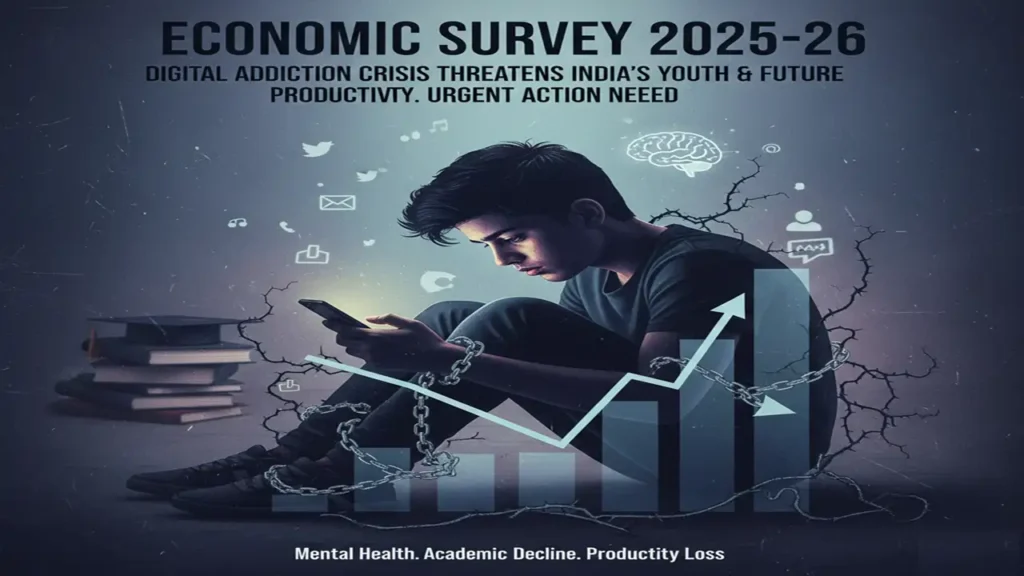
Understanding Digital Addiction in the Indian Context
Digital addiction involves repeated, uncontrolled engagement with online platforms, applications, and devices that leads to significant emotional discomfort and interference in daily responsibilities. The document highlights behaviors such as endless social media browsing, immersive online gaming sessions, and habitual scrolling as primary drivers.
Young people between 15 and 24 years old show particularly high vulnerability, displaying elevated patterns of dependency that correlate with emotional instability, diminished confidence, and increased exposure to hostile online interactions.
Far-Reaching Effects on Mental, Cognitive, and Social Well-Being
Prolonged and intense screen engagement disrupts natural sleep cycles, creating cumulative fatigue that impairs concentration and information processing. These disruptions translate into measurable declines in educational results and occupational output.
Beyond individual performance, excessive virtual involvement reduces participation in physical community activities, weakens interpersonal bonds formed in person, and limits opportunities to practice essential face-to-face relational abilities.
On the physical side, extended periods of inactivity contribute to rising incidence of weight gain, metabolic imbalances, and early-onset heart conditions. Economically, individuals fall prey to fraudulent schemes, unregulated betting environments, and other exploitative digital mechanisms that generate substantial personal debt and broader societal strain.
Expert Perspectives on the Accelerating Trend
Commentators note that the COVID-19 period dramatically intensified reliance on screens as people sought connection and diversion amid restrictions and routine upheaval. Roma Kumar, a clinical psychologist at Sir Ganga Ram Hospital, observes that sustained high usage amplifies risks for various chronic lifestyle conditions and advocates incorporating regular physical activity and relaxation techniques from childhood onward.
Vinay Agarwal, former national president of the Indian Medical Association, attributes heightened susceptibility to inherited metabolic traits combined with modern dietary habits and chronic stress. He prescribes a regimen of consistent seven-hour nightly rest, meals rich in whole foods including produce and fish, and at least thirty minutes of daily movement to counteract escalating threats of obesity, diabetes, hypertension, and cardiovascular events.
Multi-Layered Recommendations for Educational Institutions
Schools emerge as central arenas for prevention. The Survey advocates launching targeted curricula focused on recognizing safe digital practices, establishing reasonable usage boundaries, and understanding psychological ramifications of overuse. It further recommends prioritizing in-person instructional methods over virtual alternatives whenever practical and embedding compulsory daily exercise to balance sedentary tendencies.
Existing policy tools—including CBSE directives on internet safety within school premises and transport, the Ministry of Education’s Pragyata framework for thoughtful digital integration, and NCPCR stipulations on permissible screen durations—offer ready foundations for broader implementation.
Empowering Families to Set Healthy Boundaries
Guardians play an indispensable frontline role. Households should introduce deliberate technology moderation routines, carving out protected intervals free from devices (particularly around meals and sleep preparation), defining explicit family guidelines, and deploying supervisory applications to guide and constrain access.
Demanding Greater Responsibility from Technology Providers
The Survey places substantial onus on platform operators and service providers. It calls for stringent verification processes to confirm user ages, automatic activation of child-oriented configurations, removal or restriction of features engineered to maximize prolonged engagement (such as seamless video looping and algorithmic feeds), and prohibitions on precision-targeted promotions directed toward minors.
Additional network-based measures include creating separate data pricing structures that differentiate instructional from entertainment traffic, along with preset restrictions on hazardous material types adjustable by responsible adults.
Building Robust Monitoring Systems and Offline Alternatives
Progress depends on systematic observation. Standardized tracking protocols should capture metrics related to leisure-oriented screen duration, rest adequacy, instances of online mistreatment, and linked emotional indicators to guide interventions and assess efficacy.
To foster genuine social engagement, the proposal includes developing purpose-built gathering spaces for youth in both densely populated low-income neighborhoods and remote rural locales. Implementation of screen-prohibited zones within professional environments, higher education facilities, and communal areas would stimulate authentic exchanges and skill cultivation. Carefully moderated virtual gathering points administered by credible organizations could serve as supplementary secure channels.
Expanding Mental Health Resources to Confront Addiction Directly
A key proposal involves enhancing the Tele-MANAS national tele-mental health network—active since October 2022 and having managed more than 32 lakh inquiries—by extending its scope from immediate crisis response to sustained support for technology-related compulsions. Embedding connections with educational settings and preparing dedicated specialists would promote early recognition and diminish barriers to assistance.
The specialized SHUT Clinic operated by NIMHANS in Bengaluru already offers tailored therapeutic services addressing problematic device behaviors among teenage and young adult populations. Complementing these efforts, the Online Gaming (Regulation) Act, 2025 constitutes important regulatory progress in mitigating economic exploitation and addictive patterns tied to gaming.
Positioning Digital Wellness Within Broader Preventive Health Strategy
The concerns around digital overuse align with the Survey’s overarching push toward a healthcare model centered on anticipation, promotion, and community-level action rather than predominantly curative responses. Persistent challenges from both infectious pathogens and surging non-communicable ailments—including psychological disorders—affecting economically active age brackets underscore the necessity for sustained emphasis on nutrition, emotional care, balanced technology interaction, and grassroots delivery mechanisms.
Notable historical achievements, such as an 86 percent reduction in maternal mortality since 1990 (surpassing the global 48 percent improvement), a 78 percent drop in under-five mortality (against a worldwide 61 percent), and steady infant mortality decline from 40 to 25 per thousand live births over the recent decade, illustrate the effectiveness of preventive priorities.
By embedding principles of mindful digital engagement, proactive safeguards, and holistic lifestyle balance, India stands positioned to protect its young population and harness its demographic potential for enduring economic strength and societal resilience. The Survey’s detailed blueprint urges immediate, collaborative efforts across governmental bodies, educational systems, families, technology firms, and local communities to address this pervasive modern challenge effectively.
FAQs
1. What exactly is digital addiction according to the Economic Survey 2025-26?
Digital addiction refers to persistent, excessive, or compulsive use of digital devices, smartphones, social media, online gaming, and internet platforms. It causes psychological distress, loss of control, and significant impairment in daily functioning, academic performance, work productivity, sleep quality, and social relationships. It is treated as a behavioral addiction rather than substance-based.
2. Who is most affected by digital addiction, and what are the main negative impacts?
Children, adolescents, and youth (especially ages 15–24) face the highest risk due to near-universal smartphone and internet access. Impacts include: mental health issues like anxiety, depression, low self-esteem, aggression, and cyberbullying stress; cognitive/academic decline from “sleep debt,” distractions, and poor focus; weakened real-world social connections and community participation; physical health problems (obesity, diabetes risks from inactivity); and financial harms from online fraud or gambling.
3. What solutions does the Economic Survey recommend to tackle digital addiction?
Key recommendations include: introducing a “Digital Wellness Curriculum” in schools covering cyber safety and screen-time literacy, plus mandatory physical activity; families adopting “digital diets” with device-free hours and parental controls; tech platforms enforcing age verification, age-appropriate defaults, restrictions on auto-play and targeted ads for minors; network-level safeguards like differentiated data plans and content blocking; developing metrics to track screen time, sleep, and cyberbullying; creating offline youth hubs and technology-free zones; and expanding Tele-MANAS for addiction-specific counseling.
4. How does the government plan to support mental health related to digital addiction?
The Survey proposes expanding the national Tele-MANAS helpline (launched 2022, over 32 lakh calls received) beyond crisis support to proactively address digital addiction through school/college integration and trained counselors. It also highlights existing resources like the SHUT Clinic at NIMHANS Bengaluru for specialized treatment of compulsive tech use, mainly among adolescents and young adults, and notes the Online Gaming (Regulation) Act, 2025 to curb gaming-related financial and addictive harms.
5. Why is digital addiction considered an economic and public health priority in the Survey?
Unchecked digital addiction threatens India’s demographic dividend by harming human capital—reducing youth productivity, academic success, and long-term workforce health. It contributes to the rising burden of non-communicable diseases and mental health issues among working-age groups. The Survey urges shifting healthcare toward prevention, nutrition, mental wellness, and digital hygiene to protect economic growth, building on successes like major declines in maternal and child mortality rates since 1990.