
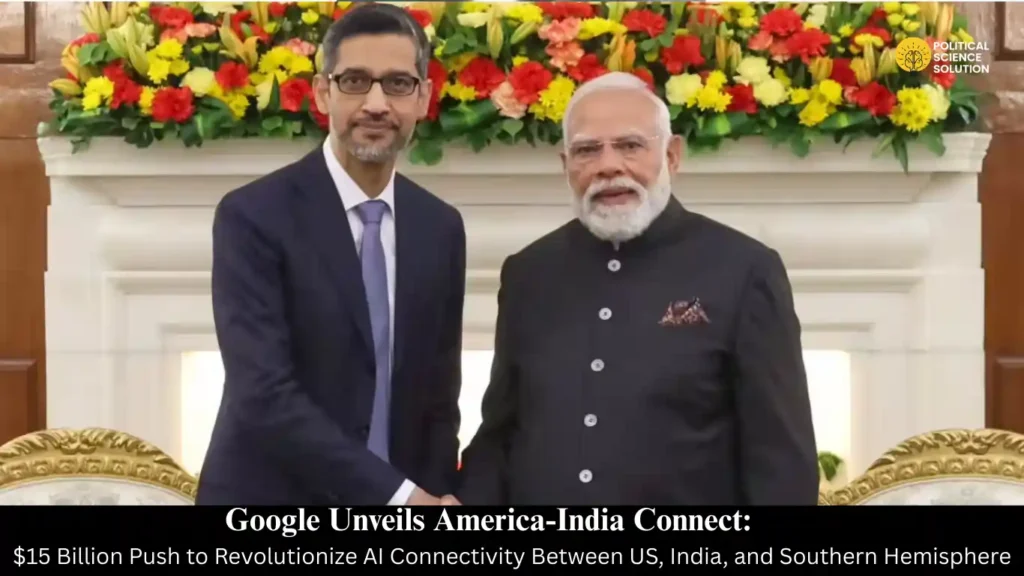
New Delhi: In a landmark announcement at the India AI Impact Summit 2026, Google CEO Sundar Pichai revealed the America-India Connect initiative, a transformative collaborative infrastructure project backed by a five-year, $15 billion (approximately ₹1.25 lakh crore) investment in India’s AI ecosystem. This ambitious endeavor seeks to forge resilient, high-capacity digital pathways linking the United States, India, and key regions across the Southern Hemisphere, while cementing Visakhapatnam (Vizag) as a premier global subsea cable landing hub.
The announcement, delivered during Pichai’s keynote address in New Delhi, underscores Google’s strategic vision to ensure that advancements in artificial intelligence remain accessible worldwide. By addressing vulnerabilities in existing internet backbone routes, the project aims to safeguard against potential disruptions and prevent the widening digital divide from morphing into an “AI divide.”
Core Elements of America-India Connect
Central to the initiative is the creation of a state-of-the-art international subsea gateway in Visakhapatnam, a port city on India’s eastern seaboard. This new landing point will diversify India’s international connectivity, which has historically relied heavily on western ports like Mumbai and eastern ones like Chennai.
Google detailed several groundbreaking cable routes under the program:
- A direct fiber-optic link spanning from Vizag and Chennai on India’s east coast to South Africa. When paired with Google’s established Equiano and Nuvem submarine cable systems, this forms a robust, alternative corridor routing traffic from the American East Coast around the African continent straight to Vizag.
- A separate direct connection from Vizag to Singapore. Combined with existing Bosun and Tabua cables, this pathway opens a South Pacific route, channeling data from the American West Coast via Australia to Vizag.
- An additional fiber-optic tie between Mumbai on India’s west coast and Western Australia, further enhancing redundancy and capacity.
Collectively, these developments introduce three fresh subsea paths connecting India to Singapore, South Africa, and Australia, alongside four targeted fiber-optic routes. The enhanced network bolsters overall resilience, capacity, and speed across four continents.
These southern routes complement existing northern corridors, including the Blue, Raman, and Sol cables that carry data from the American East Coast through the Red Sea to Mumbai. By offering geographically diverse alternatives, America-India Connect minimizes single points of failure and reduces exposure to regional instabilities, such as the cable disruptions reported in the Red Sea in 2024.
Pichai highlighted the initiative’s forward-looking impact, stating that it introduces vital new subsea cable systems to elevate AI connectivity between India, the United States, and various southern hemisphere destinations. He added, “We believe India is going to have an extraordinary trajectory with AI,” positioning the country as a key partner in shaping the global AI landscape.
The Critical Role of Submarine Cables in the Digital Age
Submarine communications cables remain the unseen foundation of worldwide internet traffic. Laid across ocean floors, these fiber-optic systems handle over 95 percent of intercontinental data flows. Each cable incorporates numerous optical fibers—ultra-thin glass or plastic strands—that transmit information using light pulses, enabling massive throughput measured in multiple terabits per second with remarkably low signal degradation over long distances.
Protective engineering includes steel reinforcement, waterproof sheathing, and periodic repeaters to boost signals. Despite their resilience, cables face ongoing threats from fishing operations, ship anchors, seismic events, and intentional interference.
India has actively expanded its own undersea network in recent years, with projects linking Chennai to the Andaman and Nicobar Islands and Kochi to Lakshadweep, strengthening domestic reach to outlying territories.
Transforming Vizag into a Global AI and Connectivity Center
The America-India Connect program dovetails seamlessly with Google’s broader commitment to establish a flagship AI hub in Visakhapatnam. This facility will deliver gigawatt-scale computing power, environmentally sustainable data centers powered by clean energy, and the new subsea gateway itself.
Strategically located on India’s eastern coastline, Vizag stands to benefit from its proximity to major maritime trade lanes. The initiative effectively converts historic shipping corridors between the “New World” and the Indian subcontinent into ultra-fast digital highways, fueling economic expansion, technological innovation, and cross-border collaboration.
Broader Commitments Unveiled at the Summit
Google used the India AI Impact Summit platform to roll out additional programs designed to accelerate AI adoption and societal benefit:
- A $30 million commitment to the Government Innovation Impact Challenge, empowering organizations globally to harness AI for reinventing public service delivery.
- An equivalent $30 million allocation for the AI for Science Impact Challenge, funding researchers worldwide who apply AI to drive scientific discovery.
- Expanded collaborations via Google DeepMind’s National Partnerships for AI framework, working alongside Indian government agencies, universities, and research bodies to democratize access to cutting-edge AI tools for priority national objectives.
- A dedicated partnership with Karmayogi Bharat to advance Mission Karmayogi, transitioning India’s civil service toward more dynamic, role-oriented governance models while cultivating a workforce prepared for tomorrow’s challenges.
- Product enhancements tailored for the Indian market, featuring live speech-to-speech translation capabilities, self-paced learning tools, and JEE Main preparation resources within the Gemini app.
- Google Cloud’s role as the principal cloud provider for iGOT Karmayogi, supporting more than 20 million government employees across over 800 districts, with phased introduction of content in more than 18 Indian languages to overcome linguistic barriers.
Pichai also spotlighted exploratory work with AIIMS institutions in India, developing AI-assisted systems that enable patients to describe symptoms and generate preliminary reports to support medical professionals.
Strategic Importance for AI Equity and Global Resilience
The America-India Connect launch highlights how foundational physical infrastructure underpins AI progress. As machine learning models grow increasingly data-intensive and latency-sensitive, dependable, diversified connectivity becomes indispensable for equitable participation in the AI revolution.
For India, these investments signal a shift toward becoming not merely an AI adopter but a central contributor and exporter of advanced capabilities. Through integrated efforts spanning infrastructure, education, public administration, scientific research, and language inclusivity, Google is helping build an ecosystem where AI serves inclusive, sustainable development.
As discussions continue at the India AI Impact Summit 2026 on harnessing artificial intelligence for humanity’s greatest challenges, the America-India Connect initiative stands out as a concrete, ambitious step toward interconnected, resilient digital futures—bridging continents, economies, and opportunities for generations to come.
FAQs
1. What exactly is the America-India Connect initiative?
America-India Connect is a major collaborative infrastructure project led by Google to strengthen global digital connectivity, with a strong focus on supporting AI growth. It forms a key part of Google’s five-year, $15 billion (around ₹1.25 lakh crore) investment in AI infrastructure in India. The project establishes new high-capacity fiber-optic routes and subsea cable systems linking India (especially the east and west coasts) with the United States and various Southern Hemisphere locations, including Singapore, South Africa, and Australia. By creating diverse, resilient pathways for data traffic, it aims to improve speed, reliability, and redundancy for AI workloads, cloud services, and internet traffic across four continents.
2. Why is Visakhapatnam (Vizag) so important in this project?
Visakhapatnam has been chosen as the site for a brand-new international subsea cable gateway, marking a major expansion beyond India’s traditional landing points in Mumbai and Chennai. Google is developing direct fiber-optic connections from Vizag to Chennai (extending toward South Africa) and from Vizag to Singapore. This positions Vizag as a central hub for east-coast connectivity. The city will also host Google’s largest AI infrastructure investment outside the US, featuring gigawatt-scale compute resources, clean-energy-powered data centers, and this new gateway—turning Vizag into a global hotspot for AI computation and international data exchange.
3. What new subsea cable routes are being introduced under America-India Connect?
The initiative introduces three primary new subsea paths and four strategic fiber-optic routes:
• A direct east-coast route from Vizag/Chennai to South Africa, creating a southern bypass around Africa that connects the US East Coast to India (integrating with Google’s Equiano and Nuvem systems).
• A direct route from Vizag to Singapore, forming a South Pacific corridor via Australia to link the US West Coast to India’s east coast (building on Bosun and Tabua cables).
• A west-coast connection from Mumbai to Western Australia for added Pacific redundancy. These additions complement existing cables (like Blue, Raman, and Sol through the Red Sea) and reduce risks from single-route vulnerabilities, such as geopolitical issues or cable cuts in sensitive areas like the Red Sea.
4. How does this initiative help prevent an “AI divide” and support India’s AI future?
Google has emphasized that reliable, diverse, and high-bandwidth connectivity is essential to stop the digital divide from becoming an “AI divide.” AI applications—especially training massive models, real-time inference, and cloud-based services—require enormous data volumes and ultra-low latency. By adding resilient southern routes and boosting overall capacity, America-India Connect ensures faster, more dependable access to frontier AI tools for users, businesses, researchers, and governments in India and beyond. It aligns with India’s push to become a leading AI nation, supporting economic growth, innovation, and inclusive access through partnerships in education, public services, science, and multilingual content.
5. Besides the subsea cables, what other announcements did Google make at the India AI Impact Summit 2026?
Alongside America-India Connect, Google unveiled several related programs:
• $30 million for the Government Innovation Impact Challenge to fund AI-driven improvements in public services worldwide.
• Another $30 million for the AI for Science Impact Challenge to back global researchers using AI for scientific breakthroughs.
• DeepMind partnerships with Indian government bodies, universities, and institutions under the National Partnerships for AI to expand access to advanced AI for national priorities.
• Collaboration with Karmayogi Bharat to advance Mission Karmayogi, building a future-ready civil service with content in 18+ Indian languages on the iGOT platform (serving over 20 million public servants).
• Product updates for India, including live speech-to-speech translation, self-study tools, and JEE Main practice in the Gemini app, plus AI exploration with AIIMS for symptom-based patient reports to assist doctors.