

New Delhi: In a landmark legislative move that positions Gujarat as the second state in India to implement a Uniform Civil Code, the Gujarat Assembly has officially passed the Gujarat Uniform Civil Code (UCC) 2026 Bill. The passage, achieved through a majority voice vote following an intense seven-hour debate, underscores the state’s commitment to a common legal framework that governs critical personal matters irrespective of religion, caste, or community. This development comes just days after a high-level committee submitted its final report, making Gujarat the trailblazer after Uttarakhand, which became the first state to adopt a similar UCC Bill in February 2024.
The bill, formally titled the Gujarat Uniform Civil Code, 2026, was tabled in the Assembly by Chief Minister Bhupendra Patel on March 24, 2026. Addressing the House, the Chief Minister described the legislation as a historic moment for Gujarat and the nation, rooted deeply in constitutional principles and India’s civilizational ethos. With this enactment, Gujarat joins a select group of regions advancing the vision outlined in Article 44 of the Indian Constitution under the Directive Principles of State Policy, which directs states to strive for a Uniform Civil Code applicable to all citizens.
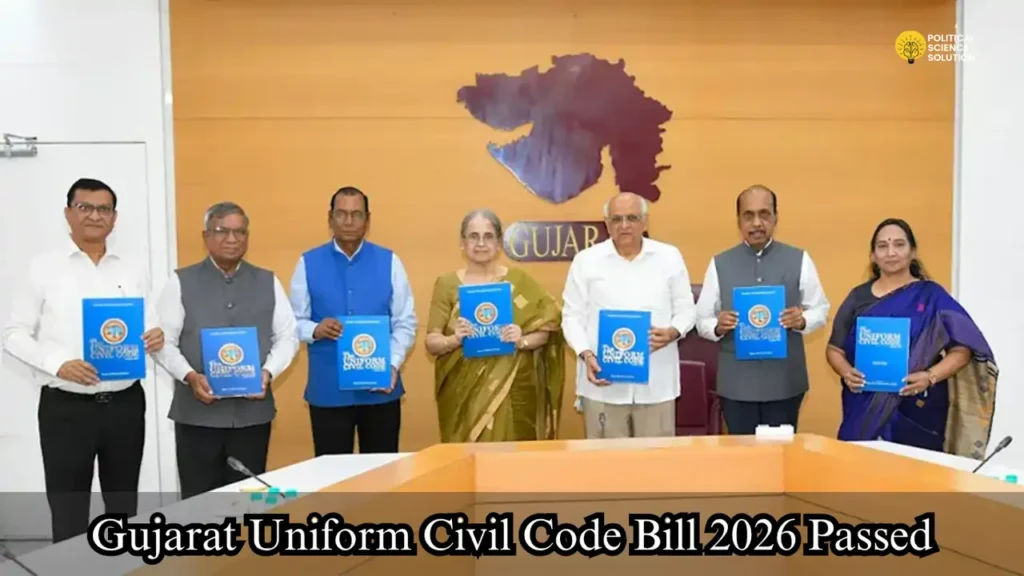
Understanding the Core Objective and Scope of Gujarat UCC 2026
At its heart, the Gujarat Uniform Civil Code Bill 2026 seeks to establish a unified, secular legal framework for marriage, divorce, succession, inheritance, adoption, and live-in relationships. This common code applies across the state and extends to residents of Gujarat living outside its territorial limits, ensuring consistency regardless of religious or cultural backgrounds. The “Objects and Reasons” section of the bill explicitly states its aim to create this uniform legal structure, replacing the patchwork of community-specific personal laws that have long governed these areas.
Key among its provisions is the complete prohibition of bigamy. No individual can enter into a second marriage while their first spouse is still alive, and a marriage is deemed valid under the code only if neither party has a living spouse at the time of solemnization. This measure directly addresses polygamous practices prevalent in certain personal laws, promoting monogamy as the standard.
Live-in relationships receive special attention through mandatory registration requirements. Couples must register their live-in partnerships, with formal processes outlined for their termination as well. Failure to register attracts penalties of up to three months’ imprisonment or a fine of Rs 10,000. For individuals aged 18 to 21, parents or guardians will be informed of the registration. The bill imposes strict punishments for any cases involving coercion, fraud, or deceit. Provisions of the Protection of Children from Sexual Offences (POCSO) Act apply where minors are involved, and additional stringent penalties are enforced if a married person enters into a live-in relationship with another individual.
Chief Minister Bhupendra Patel emphasized during the tabling that live-in registration under Section 384 “is not to curtail freedom but to ensure legal protection for daughters. Those who hide their identity and commit fraud in marriage will have no place in Gujarat.” He further highlighted how registration regulates such relationships, protects women from abandonment, and safeguards children’s rights to identity, maintenance, and inheritance.
Mandatory Marriage and Divorce Regulations: Ensuring Transparency and Gender Justice
Marriage registration forms a cornerstone of the bill. All marriages, irrespective of religion, must be registered within 60 days of solemnization. Non-compliance invites a penalty of up to Rs 10,000. Cases of forced, coerced, or fraudulent marriages, along with multiple marriages, carry stringent punishment of up to seven years’ imprisonment. “Mandatory registration ensures legal recognition, protects women and children, and prevents fraudulent marriages,” the Chief Minister stated.
On the divorce front, the code introduces uniform rules requiring court approval followed by mandatory registration. Any divorce not processed through this formal channel is considered invalid and may result in punishment of up to three years. Women are explicitly granted the unconditional right to remarry post-divorce. These provisions, according to CM Patel, ensure transparency, prevent fraud, and establish a uniform and fair divorce process across all communities.
Equal inheritance rights stand out as a transformative element. Sons and daughters across all religions will now enjoy identical rights to parental property. The bill eliminates discriminatory practices, such as those where, under certain personal laws, daughters receive only half the share of sons. CM Patel pointed out, “While our country reveres women, in practice, under personal laws, Muslim daughters receive half the inheritance of sons. What kind of justice is this? Is that daughter not a citizen of India? Through Part 2, Chapter 1 of this bill, we ensure that every daughter in Gujarat gets equal 100% rights to her father’s property.” He also stressed the elimination of inhumane practices like ‘Nikah Halala’, which undermine women’s dignity.
The legislation further guarantees financial maintenance for women and provides legal recognition for all children born out of any relationship, reinforcing protection for vulnerable groups.
Exemptions, Cultural Sensitivity, and No Interference in Religious Practices
Mindful of India’s diverse fabric, the bill fully exempts members of Scheduled Tribes (as defined under Article 366(25) of the Constitution) and certain other groups whose customary rights are constitutionally protected. This exemption ensures that tribal customs and traditions remain untouched. CM Patel clarified that the code does not interfere with religious customs or traditions, focusing solely on the legal aspects of civil matters.
Practices such as cousin marriages in certain communities, particularly minority groups, will continue to remain legally valid where permitted by custom. “In minority communities, cousin marriage is a valid tradition, and the Bill clearly states that such marriages will remain legally valid where permitted by custom. Thus, such traditions will continue under UCC where accepted; the law does not prohibit them,” the Chief Minister assured the Assembly.
Geographical and cultural diversity of the state has been meticulously considered to ensure no community is treated unfairly. The bill explicitly states it does not aim to curtail cultural diversity or individual freedoms.
Background: Why India Needs a Uniform Civil Code Now
The Uniform Civil Code draws its constitutional mandate from Article 44, which envisions a common set of laws for all citizens on matters of marriage, divorce, and inheritance. Currently, personal laws vary widely—such as the Hindu Marriage Act for Hindus, Sikhs, Jains, and Buddhists, and Muslim Personal Law (Sharia) for Muslims—often leading to inconsistencies in rights and protections.
Gujarat’s move follows in the footsteps of Goa, which has maintained a form of common civil code under the Portuguese Civil Code of 1867. The need for a UCC in India stems from several pressing factors: ensuring equality before the law by replacing religion-based personal laws with a secular framework; advancing gender justice, as women’s rights in inheritance, property, and divorce have historically varied and often been patriarchal under customary practices; and fostering national integration by separating religion from personal laws to promote social harmony.
The Supreme Court has repeatedly highlighted this urgency. In the Shah Bano Case of 1985 and the Sarla Mudgal Case of 1995, among others, the apex court underscored the importance of implementing a UCC to address discriminatory issues and uphold constitutional values.
Challenges to UCC implementation persist, including concerns that it threatens cultural diversity and religious freedom, alongside the lack of consensus among various communities. However, proponents argue it strengthens equality and justice.
Chief Minister Bhupendra Patel’s Address: Invoking Sanatan Values and Rigveda
While tabling the bill, CM Bhupendra Patel invoked Sanatan values and references from the Rigveda to frame the UCC as an embodiment of India’s ancient civilizational ethos of unity and equality. He quoted principles of collective harmony—”walking together, speaking together and being united in thought”—as reflected in the Rigveda, where truth is one and justice must be uniform, irrespective of religion.
The Chief Minister aligned the bill with Article 44 and Prime Minister Narendra Modi’s vision of “Ek Bharat Shreshtha Bharat.” He described it as a step toward a unified legal framework grounded in constitutional principles, essential for achieving social equality alongside economic development under the goal of Viksit Bharat@2047.
The bill was prepared following extensive public consultations and a detailed study by a high-level committee chaired by retired Supreme Court judge Justice Ranjana Prakash Desai. The committee examined representations from citizens and organizations, reviewed Supreme Court judgments, analyzed existing personal laws, studied the Uttarakhand UCC, and drew insights from global legal models in democratic countries. Drafting involved visiting districts across Gujarat to gather public opinions and foster close public relations.
“Registration helps regulate such relationships and protects women from abandonment. It also ensures better protection of children’s rights to identity, maintenance, and inheritance,” CM Patel added, championing the bill’s benefits for women and children.
Post-passage, the Chief Minister took to X (formerly Twitter) to hail the moment: “Due to the implementation of the Uniform Civil Code, a common legal framework will be implemented in the state for all religions and communities on issues like marriage, divorce, inheritance and adoption. It will be ensured that women of all religions and castes get equal rights, so that their status of respect and security will be further strengthened.”
He continued, noting that “geographical and cultural diversity” of the state has been considered so that “no community is treated unfairly.” The implementation, he said, will strengthen the “social fabric of the state” and create an environment for development for people of all societies and communities. “We will be able to move forward more quickly to realize the vision of a developed India given by the Honorable Prime Minister Shri Narendrabhai Modi by building a developed Gujarat,” the post concluded.
Deputy CM Harsh Sanghavi Echoes Equality Message
Deputy Chief Minister Harsh Sanghavi reinforced the bill’s significance on X: “Historic! Under the leadership of Hon’ble Chief Minister Shri Bhupendra Patel ji, the BJP government has passed the UCC in the Legislative Assembly. No one above the law. No citizen below. Equal Gujarat. Empowered Gujarat.”
Implications and the Road Ahead for Viksit Bharat
By mandating these uniform provisions, the Gujarat UCC 2026 Bill aims to eliminate discrimination based on religion or caste while ensuring equality before the law. It focuses on women’s welfare by providing uniform rules for maintenance and property rights, thereby strengthening their protection and dignity while safeguarding children’s rights.
This legislation not only addresses long-standing calls from the judiciary but also studies successful models from democratic nations worldwide. As Gujarat implements the code, it sets a precedent for other states, potentially accelerating the national discourse on personal law reforms.
The seven-hour debate in the Assembly reflected robust discussions, yet the bill passed with overwhelming support, signaling broad consensus within the House. With exemptions carefully carved out and cultural sensitivities preserved, the Gujarat Uniform Civil Code 2026 stands as a balanced yet bold stride toward equality, justice, and national integration.
As the state gears up for enforcement, experts anticipate it will enhance legal clarity, empower women economically, and foster greater social cohesion. For residents of Gujarat and observers nationwide, this marks a pivotal shift from fragmented personal laws to a cohesive, rights-based system aligned with the constitutional dream of a truly secular and equitable society.
FAQs
1. What is the Gujarat Uniform Civil Code (UCC) 2026 Bill?
The Gujarat Uniform Civil Code 2026 Bill is a new law passed by the Gujarat Assembly that establishes a common legal framework for marriage, divorce, succession, inheritance, adoption, and live-in relationships for all citizens, irrespective of religion. Gujarat becomes the second state after Uttarakhand to implement UCC.
2. What are the key provisions of the Gujarat UCC Bill 2026?
Major provisions include mandatory registration of marriages within 60 days (penalty up to ₹10,000), prohibition of bigamy with up to 7 years punishment, mandatory court-approved divorce registration, equal inheritance rights for sons and daughters, and compulsory registration of live-in relationships with penalties for non-compliance.
3. Does the Gujarat UCC 2026 apply to everyone in the state?
The UCC applies to all residents of Gujarat irrespective of religion, but it exempts Scheduled Tribes (STs) and certain groups whose customary rights are protected under the Constitution. It also respects certain customary practices like cousin marriages where permitted by community traditions.
4. How does the Gujarat Uniform Civil Code protect women’s rights?
The bill ensures equal inheritance rights for daughters, provides maintenance rights, grants women unconditional right to remarry after divorce, mandates registration of live-in relationships to prevent abandonment, and eliminates discriminatory practices such as unequal property shares and Nikah Halala.
5. When was the Gujarat UCC Bill passed and what is its main objective?
The Gujarat Assembly passed the UCC Bill 2026 after a 7-hour debate on March 24-25, 2026. The main objective is to promote equality before the law, gender justice, and national integration by replacing religion-based personal laws with a uniform secular code, in line with Article 44 of the Indian Constitution.