
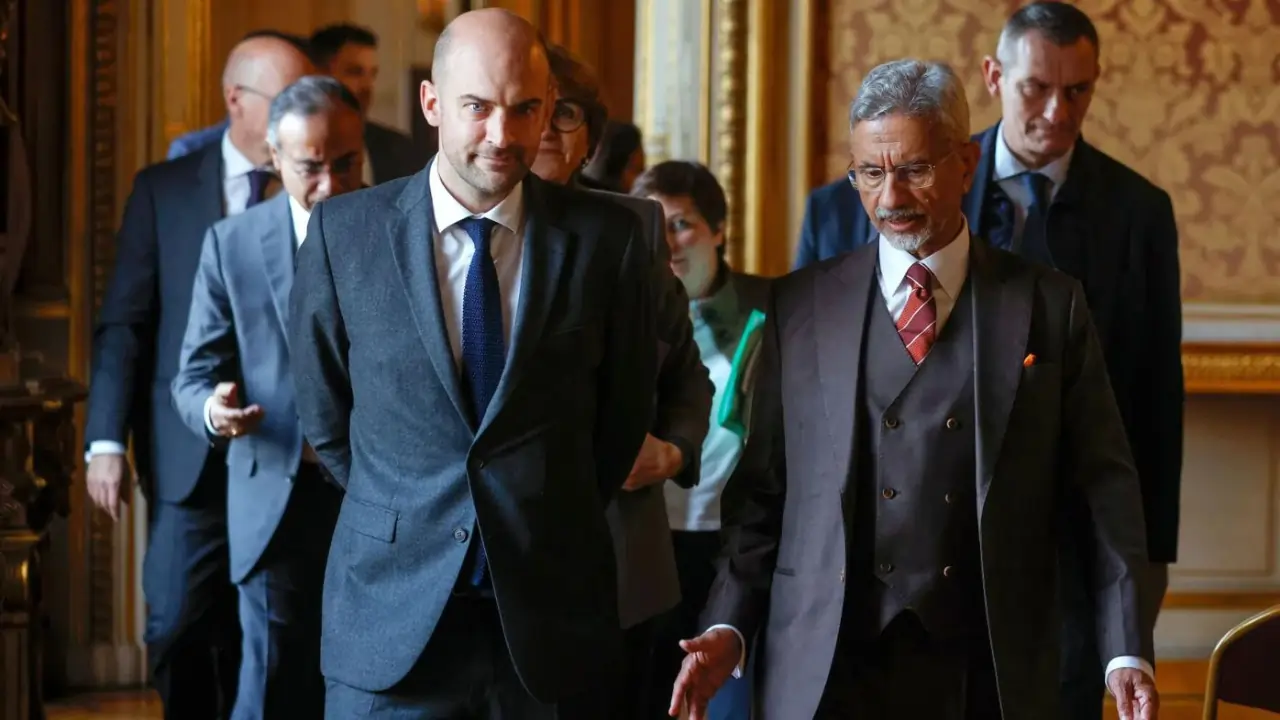
New Delhi: On January 7, 2026, India’s External Affairs Minister Dr. S. Jaishankar participated in a groundbreaking diplomatic event by joining the Weimar Triangle format for the first time. This meeting, held in Paris, brought together the foreign ministers of France, Germany, and Poland alongside India’s top diplomat, signaling a new chapter in India’s strategic outreach to continental Europe.
The historic engagement occurred amid accelerated global diplomacy focused on the Russia-Ukraine conflict, energy security, and strengthening partnerships beyond traditional alliances. Jaishankar’s presence as a guest marked the inaugural invitation of a non-European partner to a Weimar Triangle foreign ministers-level discussion, highlighting India’s rising stature as a key global player.
What is the Weimar Triangle? Origins and Evolution
The Weimar Triangle is a flexible regional political cooperation framework comprising France, Germany, and Poland. It was formally established in 1991 through a joint declaration signed in the German city of Weimar by the foreign ministers of the three nations. This initiative came in the immediate aftermath of the Cold War, during a period of profound transformation in Europe.
The early 1990s saw major developments: German reunification, the democratic transition in Central and Eastern Europe, and the redefinition of security architectures within NATO and the European Union (EU). Poland, emerging from decades under Soviet influence, actively sought integration into Western institutions. The Weimar Triangle served as a vital confidence-building mechanism to facilitate Franco-German-Polish reconciliation, drawing inspiration from the successful post-war Franco-German model.
The grouping’s core objectives include:
- Promoting reconciliation among France, Germany, and Poland, with France playing a pivotal role in bridging historical divides between Germany and Poland.
- Institutionalizing regular political consultations to coordinate on European security, foreign policy, and integration processes.
- Supporting Poland’s integration into Western structures, which culminated in its accession to NATO in 1999 and the EU in 2004.
Over the years, the Weimar Triangle has evolved into a non-institutional, consensus-driven platform without a permanent secretariat or binding treaty. It operates through regular interactions at multiple levels, including heads of government, foreign ministers, and ministers for European affairs. Key outcomes have included policy coordination within the EU, support for NATO enlargement, and ongoing dialogue on critical issues such as European security, the Russia-Ukraine conflict, energy security, and democratic resilience.
Beyond Formal Diplomacy: Societal and Economic Dimensions
The Weimar Triangle’s influence extends far beyond high-level diplomacy. It fosters civil society cooperation, youth exchanges, academic collaborations, and business networks. These initiatives promote intercultural dialogue, enhance people-to-people contacts, and improve mobility across Europe, contributing to stronger societal ties among the three nations.
India’s Landmark Participation: Discussions and Strategic Significance
During the January 7 meeting in Paris, Jaishankar engaged in candid discussions with:
- French Minister for Europe and Foreign Affairs Jean-Noël Barrot
- German representatives, including Foreign Minister Johann Wadephul
- Polish Foreign Minister Radosław Sikorski
The talks were described by Jaishankar as “short but deep and open,” focusing on three main areas: India-EU relations, the Indo-Pacific region, and the ongoing conflict in Ukraine.
Jaishankar highlighted the emerging multi-polar world marked by volatility and uncertainty, emphasizing the need for deeper collaboration among like-minded countries sharing common outlooks. He noted that India’s growing engagement with Europe—both through Brussels and bilaterally—naturally extends to flexible formats like the Weimar Triangle to advance broader cooperation.
The minister expressed confidence that ties between India and the EU, along with its member states, hold the greatest unrealized potential among India’s major relationships. He thanked his counterparts for a highly useful exchange that underscored the growing strategic alignment between India and key European powers.
Earlier in the day, Jaishankar held bilateral talks with Barrot, reviewing the special strategic partnership between India and France—India’s earliest such partnership in Europe. Discussions covered enhanced cooperation across sectors and global issues, with Jaishankar conveying India’s anticipation of welcoming French President Emmanuel Macron soon.
The Weimar Triangle ministers also expressed satisfaction with India’s steps to reduce reliance on Russian oil imports, amid broader discussions on supporting Ukraine and forging peace solutions compliant with international law.
Why This Engagement Matters for India-Europe Relations
India’s participation reflects a deliberate shift toward minilateral diplomacy, deepening engagement with continental Europe beyond bilateral ties. It recognizes Poland’s increasing strategic relevance within the EU and NATO, while complementing existing strategic partnerships with France and Germany, and emerging defense and economic ties with Poland.
In the current geopolitical context, Europe is reassessing its strategic autonomy amid the Russia-Ukraine war, energy insecurity, and transatlantic uncertainties. India is viewed as a reliable strategic partner, a key stakeholder in the Indo-Pacific, and an influential voice of the Global South. This engagement enhances India’s diplomatic footprint in Europe, strengthens ties with the EU’s core political actors, and aligns with India’s preference for issue-based coalitions over rigid alliances.
The Weimar Triangle exemplifies the global rise of flexible, issue-driven groupings, similar to the Quad in the Indo-Pacific, AUKUS, and I2U2. These platforms enable rapid responses to challenges while preserving strategic autonomy.
Challenges Facing the Weimar Triangle and the Path Forward
Despite its achievements, the Weimar Triangle faces limitations, including the absence of binding mechanisms, reliance on political will, divergent threat perceptions among members (particularly on Russia and defense spending), and periods of inconsistent activity due to domestic changes.
Looking ahead, renewed commitment among members to shared priorities—such as European security, defense cooperation, energy transition, and external dialogue—could elevate its relevance. Engaging partners like India offers opportunities to increase the grouping’s global influence and bolster EU-India strategic convergence.
Conclusion: A Step Toward Greater Stability in Global Affairs
India’s first-ever engagement with the Weimar Triangle on January 7, 2026, represents more than a diplomatic milestone—it underscores the deepening convergence between India and Europe on security, energy, and global governance. As Jaishankar noted, strengthening such relationships can bring greater stability to the international economy and politics in a churning world. With upcoming high-level visits, including German Chancellor Friedrich Merz to India and potential EU leaders, 2026 appears poised for an upswing in India-Europe ties. This historic Paris meeting paves the way for expanded cooperation, mutual benefits, and a more balanced
FAQs
1. What exactly is the Weimar Triangle?
The Weimar Triangle is a flexible, non-formal political cooperation framework between France, Germany, and Poland.
It was established in 1991 in the German city of Weimar through a joint declaration by the three countries’ foreign ministers.
The grouping was originally created to support German-Polish reconciliation after the end of the Cold War, promote European integration, strengthen political dialogue, enhance security cooperation, and assist Poland’s integration into Western institutions (especially NATO and the EU).
2. When and how did India first engage with the Weimar Triangle?
India’s first-ever engagement with the Weimar Triangle took place on January 7, 2026, in Paris.
External Affairs Minister Dr. S. Jaishankar joined the Foreign Ministers of France (Jean-Noël Barrot), Germany, and Poland (Radosław Sikorski) for discussions.
This marked the first time a non-European country was invited to participate in a Weimar Triangle foreign ministers-level meeting.
3. Why is India’s participation in the Weimar Triangle considered significant?
This engagement is viewed as a major diplomatic milestone because it demonstrates:
India’s shift toward flexible, issue-based coalitions rather than rigid alliances It also complements India’s already strong strategic partnerships with France and Germany, and its rapidly developing ties with Poland in defence and economic domains.
India’s expanding outreach to continental European minilateral groupings
Growing strategic convergence between India and core European powers on issues like security, energy, global governance, and the Indo-Pacific
Recognition of Poland’s rising strategic importance within the EU and NATO
4. What were the main topics discussed during India’s meeting with the Weimar Triangle?
The discussions were described as short but deep and open. The key focus areas included:
The ongoing Russia-Ukraine conflict and related global implications The Weimar Triangle ministers also appreciated India’s steps to reduce dependence on Russian oil imports. The meeting reflected shared concerns about a volatile, multi-polar world and the importance of cooperation among like-minded countries.
The state of India-EU relations
Developments in the Indo-Pacific region
5. Does the Weimar Triangle have a formal institutional structure like the EU or NATO?
No.
The Weimar Triangle is deliberately designed to be non-institutional and flexible.
It has no permanent secretariat, no binding treaty, and no rigid decision-making mechanisms. The format relies entirely on political consensus, regular high-level consultations (heads of government, foreign ministers, European affairs ministers), and voluntary coordination on shared priorities such as European security, energy transition, defence cooperation, and support for democratic resilience