

New Delhi: As of March 8, 2026, two southern Indian states—Karnataka and Andhra Pradesh—have taken bold steps to restrict social media access for minors, marking the first formal state-level initiatives in the country. These announcements reflect mounting worries about digital addiction, mental health risks, cyberbullying, exposure to harmful content, and declining academic performance among young users. With India boasting over a billion internet users and the world’s second-largest smartphone market, the moves highlight a critical debate on child online safety versus digital rights.
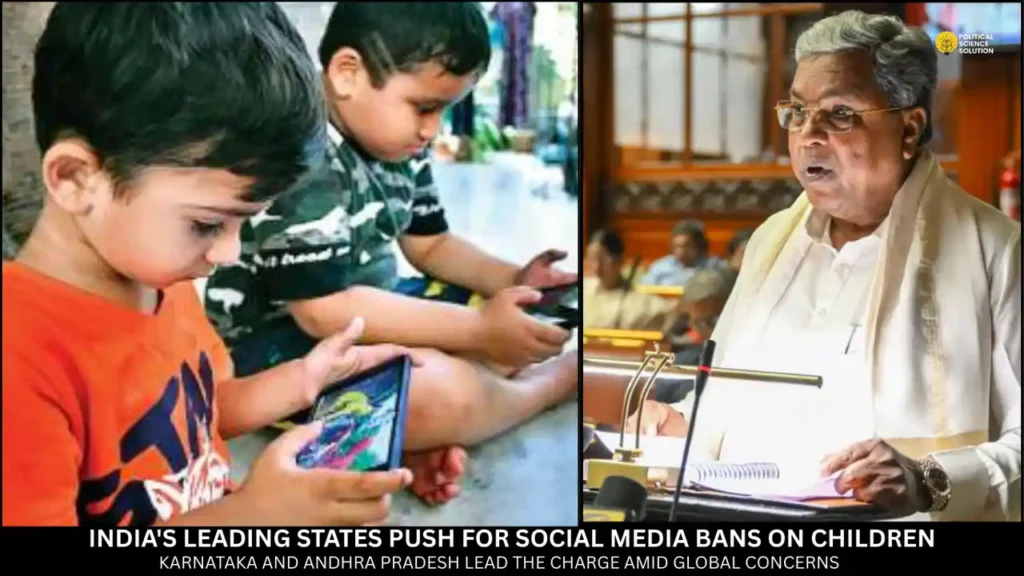
Karnataka Becomes First State to Announce Social Media Ban for Under-16s
On March 6, 2026, Karnataka Chief Minister Siddaramaiah unveiled a major policy during his presentation of the 2026-27 state Budget in the Legislative Assembly. He declared that social media usage would be banned for children under the age of 16, explicitly stating: “With the objective of preventing adverse effects of increasing mobile usage on children, usage of social media will be banned for children under the age of 16.”
This positions Karnataka—home to Bengaluru, India’s premier tech hub—as the pioneering state in imposing such a restriction. The announcement falls under broader education and child welfare goals, aiming to shield youngsters from negative impacts like excessive screen time, sleep disruption, anxiety, and reduced focus. Siddaramaiah emphasized that the policy targets social media platforms specifically, not general mobile phone access, though he offered no immediate details on enforcement timelines, mechanisms, or penalties for non-compliance.
The proposal has positioned Karnataka at the forefront of India’s response to a global trend, drawing parallels to international efforts while sparking discussions on practicality in a highly connected society.
Andhra Pradesh Plans Swift Implementation for Under-13 Ban, Eyes Extension
In a near-simultaneous move on the same day, March 6, 2026, Andhra Pradesh Chief Minister N. Chandrababu Naidu addressed the state Legislative Assembly, announcing plans to prohibit social media access for children below 13 years old. Naidu confirmed that a dedicated program to enforce this restriction would roll out within the next 90 days.
The initiative stemmed from recommendations by IT and Education Minister Nara Lokesh. Naidu further revealed ongoing deliberations about extending similar curbs to the 13-16 age bracket, with a final decision to follow wider consultations and consensus-building. He underscored the government’s dedication to safeguarding children from excessive social media’s potential harms, prioritizing overall well-being and mental health protection.
Responding to Karnataka’s announcement, Lokesh posted on X, humorously noting “imitation is the sincerest form of flattery” while expressing satisfaction that neighboring states were aligning with Andhra Pradesh’s earlier ideas on shielding young minds from digital risks. He wished Karnataka success in execution.
National and International Context Fueling the Momentum
These state actions align with broader national conversations. The Economic Survey 2025-26 urged age-based social media limits and curbs on targeted digital ads for children, citing “digital addiction” as a key threat. It advocated simpler devices, usage caps, and content filters to minimize exposure to violent, sexual, or gambling material.
At the central level, preliminary talks on age restrictions have started in the Ministry of Electronics and Information Technology. IT Minister Ashwini Vaishnaw recently confirmed engagements with platforms on the issue, though no nationwide law has emerged yet.
Globally, Australia’s Online Safety Amendment (Social Media Minimum Age) Act—effective late 2025—set a precedent as the world’s first nationwide enforcement, requiring platforms to block and deactivate under-16 accounts on services like Instagram, YouTube, Snapchat, TikTok, Facebook, Twitch, and Reddit. The law addresses addictive designs, cyberbullying (impacting over 50% of young Australians per surveys), and health risks.
French President Emmanuel Macron, speaking at the India-AI Impact Summit last month, urged India to follow suit, noting France’s push for a under-15 ban and similar steps in Spain and other European nations. As G7 chair, Macron linked child protection to AI and digital abuse challenges.
Challenges in Enforcement and Feasibility
Tech industry voices have raised operational hurdles for state-specific bans. The internet’s borderless nature complicates geo-fencing, with differing age limits (16 in Karnataka, 13 in Andhra Pradesh) potentially creating inconsistencies. Experts argue a uniform central law would enable better platform compliance.
A Meta spokesperson affirmed willingness to comply with Karnataka’s rule once enforced but stressed equitable application across all teen-used apps, warning that partial bans could push users to unregulated spaces or bypass safeguards.
The Internet Freedom Foundation criticized blanket bans as disproportionate, arguing they overlook platform design flaws, weak data protections, and digital literacy gaps. In India, where girls face access barriers, such measures risk widening the gender digital divide by justifying permanent restrictions.
Other states like Goa have explored similar ideas, including school phone curbs and parental tools.
Balancing Protection and Rights in the Digital Age
Karnataka and Andhra Pradesh’s announcements represent a watershed moment in India’s approach to youth online safety. While driven by genuine concerns over addiction and harm, questions linger about implementation, effectiveness, and unintended consequences like reduced information access or expression rights.
As discussions intensify at state and national levels, these pioneering efforts could catalyze a unified framework—or expose enforcement pitfalls—in one of the world’s largest digital markets. The coming months will reveal whether these bans translate into actionable policy and how platforms, parents, and youth adapt.
FAQs
1. What exactly have Karnataka and Andhra Pradesh announced regarding social media use by children?
Karnataka has become the first Indian state to formally announce a ban on social media usage for children under the age of 16. This was declared by Chief Minister Siddaramaiah during the presentation of the state’s 2026-27 Budget on March 6, 2026. The stated goal is to prevent the adverse effects of increasing mobile phone and social media usage on children’s well-being, including issues like digital addiction and mental health impacts.
Andhra Pradesh, on the same day, announced plans to prohibit social media access for children below 13 years old, with implementation targeted within the next 90 days. Chief Minister N. Chandrababu Naidu mentioned that the government is also deliberating on extending restrictions to the 13-16 age group after wider consultations and consensus-building.
2. When will these bans actually take effect, and how will they be enforced?
No specific effective date has been set for Karnataka’s ban yet, as the announcement focused on the policy intent without detailing timelines or enforcement mechanisms. Chief Minister Siddaramaiah clarified that children under 16 can still use mobile phones for other purposes (like education or communication), but social media access would be restricted both in schools and at home.
In Andhra Pradesh, the under-13 restriction is expected to roll out through a dedicated program within 90 days (by early June 2026). Details on enforcement remain under consideration, with no concrete methods outlined publicly so far.
3. How feasible is it to implement these state-level social media bans in India?
Experts and tech industry voices have highlighted significant challenges. Internet regulation falls under the Union government’s domain (as per the Constitution), raising potential jurisdictional issues for state-specific rules. Enforcing geo-restrictions at the state level is technically difficult due to the borderless nature of the internet and platforms.
Differences in age thresholds (16 in Karnataka vs. 13 in Andhra Pradesh) could create inconsistencies for platforms. Many believe a uniform central law would be more practical. Platforms may require robust age verification (e.g., ID checks, facial recognition, or behavioral analysis), but children could bypass restrictions using fake details or VPNs. Critics note that partial or state-only bans risk pushing users toward unregulated sites.
4. What are the main reasons behind these proposed bans?
The governments cite growing concerns over digital addiction, excessive screen time, exposure to harmful content (violent, sexual, or gambling-related), cyberbullying, mental health issues (anxiety, sleep disruption), declining attention spans, and academic performance among children. These align with national recommendations in the Economic Survey 2025-26, which called for age-based limits and promotion of simpler devices with content filters.
Globally, the moves draw inspiration from Australia’s 2025 nationwide ban for under-16s and similar discussions in France, Spain, and other countries, where leaders like French President Emmanuel Macron have urged India to adopt protective measures.
5. What criticisms or concerns have been raised about these bans?
Digital rights groups like the Internet Freedom Foundation argue that blanket bans are disproportionate and could do more harm than good by failing to address root causes (e.g., addictive platform designs, poor data protection, lack of digital literacy). In India, such restrictions might widen the digital gender divide, as families could use them to justify limiting girls’ online access permanently.
Tech companies (e.g., Meta) have said they would comply but warn that uneven rules across apps or regions could drive teens to less safe, unregulated spaces. Some experts advocate for graded approaches, parental controls, education, and platform accountability over outright bans. Others question enforceability, comparing it to past ineffective restrictions like porn bans.