

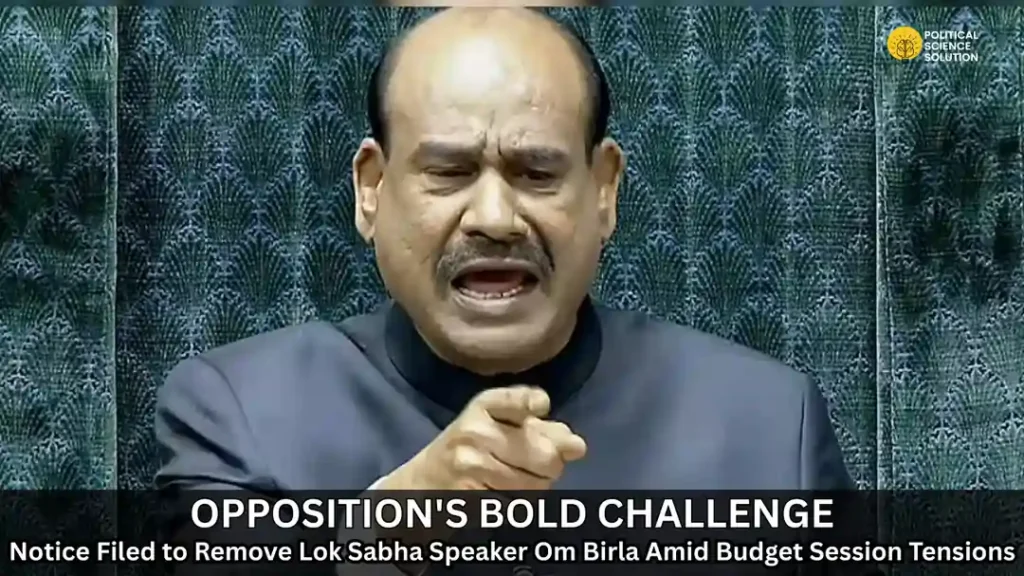
New Delhi: In a striking escalation of parliamentary friction during the 2026 Budget Session, opposition parties have launched a formal bid to unseat Lok Sabha Speaker Om Birla. The move, initiated on February 10, 2026, highlights deep-seated dissatisfaction with the conduct of House proceedings and raises fresh questions about the balance of power in India’s lower chamber.
Genesis of the Controversy
The opposition’s dissatisfaction reached a boiling point following several contentious episodes in recent sittings. Key grievances include the Speaker’s decision to prevent Leader of Opposition Rahul Gandhi from referencing or elaborating on passages from the unpublished memoir of former Army Chief General M M Naravane. Opposition benches viewed this restriction as an unfair curb on debate freedom. Compounding the issue were remarks attributed to Speaker Birla suggesting a potential security threat to Prime Minister Narendra Modi within the parliamentary premises—an assertion that drew sharp criticism for allegedly sensationalizing matters and stifling opposition points.
These incidents unfolded against the backdrop of heated discussions on the Motion of Thanks to the President’s Address, culminating in the suspension of multiple opposition members. Frustrated by what they described as partisan handling of debates, a coalition of opposition groups decided to channel their protests into a constitutional mechanism rarely invoked.
The Notice Submission and Initial Backing
On February 10, a written notice was formally presented to the Secretary-General of the Lok Sabha, seeking a resolution for Speaker Birla’s removal. The document garnered endorsements from 118 members across various opposition outfits, including prominent signatories from the Congress, DMK, Samajwadi Party, RJD, and Left parties. Interestingly, the Trinamool Congress opted not to join the effort, with indications that its members favored granting the Speaker a short window—potentially seven days—to address the complaints before pushing ahead with such a drastic step.
The notice invoked Article 94(c) of the Constitution, which empowers the Lok Sabha to remove its Speaker through a resolution supported by a majority of the House’s total then-existing membership (commonly understood as an effective majority, accounting for vacancies).
Procedural Hurdles and the Speaker’s Unconventional Response
Almost immediately after submission, the notice encountered technical difficulties. Lok Sabha Secretariat officials identified multiple errors, most notably repeated references to events dated February 2025—despite the current year being 2026. Such inaccuracies could have justified outright dismissal under established rules governing admissibility.
In an unexpected display of procedural fairness, Speaker Birla personally instructed the Secretariat on February 11, 2026, to assist in rectifying the deficiencies rather than rejecting the document outright. He emphasized the need for swift corrections so the amended notice could advance in line with parliamentary conventions. Opposition members reportedly withdrew the original version and submitted a revised one, now properly aligned with the correct timeline.
This intervention has been interpreted by observers as a commitment to due process, even when the motion targets the presiding officer himself. The corrected notice is expected to feature on the business agenda once the Budget Session’s second phase begins on March 9, 2026, potentially as early as the opening day, running through April 2.
Self-Imposed Recusal: A Rare Gesture of Propriety
Demonstrating a strong sense of impartiality, Speaker Birla announced he would voluntarily step away from chairing Lok Sabha sessions until the resolution is fully addressed. Although the Constitution does not mandate such recusal, Birla cited moral grounds for his decision, ensuring that deliberations proceed without any perception of influence from the office under scrutiny.
During this interim period, a panel of presiding officers or the Deputy Speaker will manage daily proceedings. The Speaker, however, retains full rights to participate in discussions, deliver statements, and exercise his vote when the matter reaches a decision stage—though he will not wield a deciding vote in case of a tie.
Constitutional Framework Governing Removal
The removal process for the Lok Sabha Speaker is enshrined in Article 94 of the Constitution, which covers vacation, resignation, and ouster from the Speaker and Deputy Speaker positions. Clause (c) explicitly allows removal via a House resolution backed by a majority of all then members.
To initiate proceedings:
- A written notice must be delivered to the Secretary-General, possibly jointly by multiple members.
- At least 14 clear days must elapse before the resolution can be moved.
- For admission and debate, the notice requires support from a minimum of 50 members.
Once listed, a motion for leave to introduce the resolution appears on the official business schedule. Notably, the Speaker cannot preside over debates concerning his own removal, preserving the integrity of the process.
Historical Context: Precedents of Unsuccessful Attempts
Efforts to dislodge a Lok Sabha Speaker remain exceptional and have never succeeded. Notable past cases involved:
- G.V. Mavalankar (first Speaker) in 1954
- Sardar Hukam Singh in 1966
- Balram Jakhar in 1987
In each instance, the motions fell short, reflecting both the stringent majority requirement and the political reality that Speakers are typically elected with backing from the ruling majority.
Political Implications and Likely Outcome
While the current notice carries symbolic weight—serving as a public critique of perceived bias—the opposition faces formidable odds. The ruling coalition commands a solid majority in the Lok Sabha, making it highly improbable for the resolution to secure the necessary votes.
Nevertheless, the episode underscores persistent strains in parliamentary functioning, particularly around managing disruptions, ensuring equitable speaking opportunities, and preserving the Speaker’s neutrality. As the session progresses toward its second leg, the controversy may influence broader debates on decorum, productivity, and cross-party cooperation.
With the fiscal blueprint for 2026-27 still under discussion, this rare constitutional maneuver serves as a reminder of the safeguards built into India’s democratic framework—mechanisms that allow accountability while demanding rigorous adherence to procedure.
FAQs
1. Why has the opposition submitted a notice to remove Lok Sabha Speaker Om Birla?
The opposition, led by Congress and supported by parties such as DMK, Samajwadi Party, RJD, and Left groups, filed the notice on February 10, 2026, citing alleged bias and partisan conduct by Speaker Birla. Key complaints include restricting Leader of Opposition Rahul Gandhi from quoting or discussing content from former Army Chief General M M Naravane’s unpublished memoir, disallowing certain opposition speeches during the Motion of Thanks to the President’s Address, and the suspension of several opposition MPs. Additional criticism focused on Birla’s remarks suggesting a possible security threat to Prime Minister Narendra Modi inside the House, which some viewed as inflammatory or aimed at curbing debate.
2. What is the constitutional provision for removing the Lok Sabha Speaker?
The process is governed by Article 94 of the Constitution of India, specifically clause (c), which states that the Speaker (or Deputy Speaker) of the House of the People may be removed by a resolution passed by a majority of all the then members of the Lok Sabha. This is commonly referred to as an effective majority—meaning a majority of the House’s total membership minus any vacancies (not just a simple majority of members present and voting). The provision applies exclusively to the Lok Sabha and does not extend to the Rajya Sabha Chairperson.
3. What are the key procedural steps required to remove the Speaker?
The procedure is stringent to maintain stability:
- A written notice must be submitted to the Secretary-General of the Lok Sabha (it can be signed jointly by multiple members).
- The notice requires support from at least 50 members for admission.
- At least 14 clear days’ notice must be given before the resolution can be moved.
- Once admissible, a motion for leave to introduce the resolution is listed in the House business for a scheduled day.
- During debate on the resolution, the Speaker does not preside (a panel or Deputy Speaker handles proceedings), though under Article 96, the Speaker may speak, participate, and vote (but without a casting vote in ties).
- The resolution must secure an effective majority to pass, leading to immediate removal (while the individual remains an MP unless disqualified otherwise).
In the current case, the original notice (backed by 118 MPs) had drafting errors—such as referencing events from February 2025 four times—prompting Speaker Birla to direct corrections on February 11, 2026. The revised notice is expected to be considered after the Budget Session’s second phase begins on March 9, 2026.
4. Has any Lok Sabha Speaker ever been successfully removed through this process in the past?
No, no Lok Sabha Speaker has ever been removed via such a resolution. Historical attempts include:
- Against the first Speaker, G.V. Mavalankar, in 1954.
- Against Sardar Hukam Singh in 1966.
- Against Balram Jakhar in 1987.
All previous motions failed to pass, largely due to the high threshold of an effective majority and the fact that Speakers are typically elected with majority-party support, making removal politically challenging.
5. What happens next in the current case against Speaker Om Birla, and is removal likely?
Speaker Birla voluntarily recused himself from presiding over Lok Sabha proceedings on moral grounds until the matter is resolved (though not constitutionally required), with a panel of chairpersons or the Deputy Speaker managing sessions in the interim. The corrected notice will likely be listed soon after the Budget Session resumes on March 9, 2026 (potentially on the opening day), following the mandatory 14-day notice period.
Given the ruling coalition’s strong majority in the Lok Sabha, the resolution faces very low chances of passing. The move is widely seen as symbolic—aimed at highlighting grievances over House management, fairness in debates, and opposition participation—rather than a realistic path to removal. It has, however, spotlighted ongoing parliamentary tensions during the Budget Session.