

New Delhi: On February 28, 2026, Prime Minister Narendra Modi inaugurated Micron Technology’s state-of-the-art semiconductor Assembly, Testing, Marking, and Packaging (ATMP) facility in Sanand, marking a historic milestone for India’s semiconductor industry. This US-based company’s Rs 22,516 crore investment represents the nation’s inaugural commercial semiconductor production unit, focused on converting advanced DRAM and NAND wafers into finished memory and storage products like Solid State Drives (SSDs), DRAM, and NAND devices essential for AI, data centers, mobiles, and advanced computing.
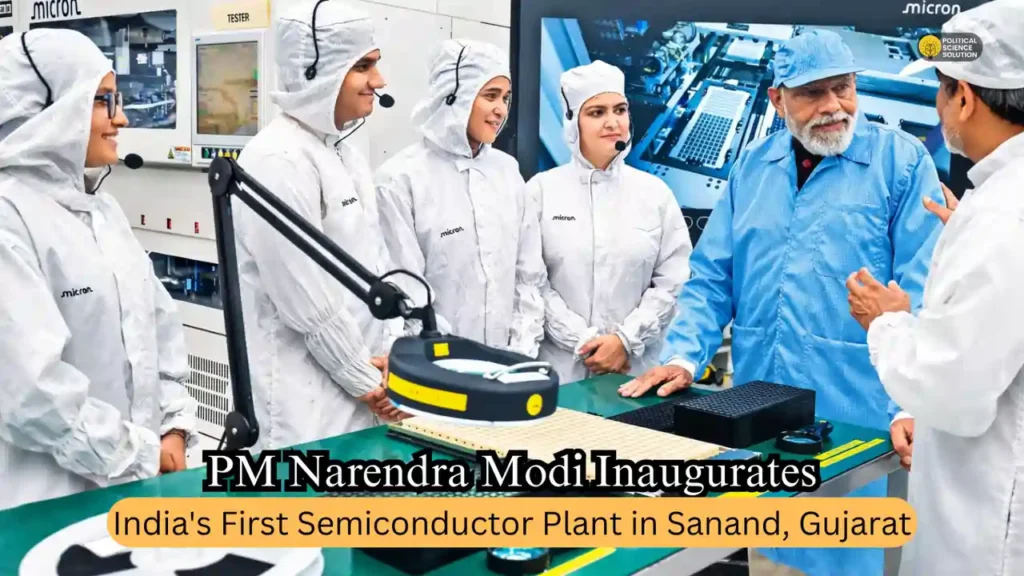
The event, attended by Gujarat Chief Minister Bhupendra Patel, Union Minister for Information and Broadcasting, Railways, and IT Ashwini Vaishnaw, US Ambassador to India Sergio Gor, Micron Chairman, President, and CEO Sanjay Mehrotra, and other dignitaries, underscored deepening India-US strategic ties in technology and supply chain security. During the ceremony, Micron handed over the first commercial Made-in-India shipment to Dell Technologies in the Prime Minister’s presence.
Prime Minister Modi highlighted the transformative journey of Sanand, a town he described as a place that “turns soil into gold.” He recalled his personal connection, mentioning visits by bus and bicycle during his earlier days, and credited a symbolic one-rupee SMS he sent to the late Ratan Tata inviting the Tata Nano plant to relocate from West Bengal. “Look what a Gujju can do with a Re 1 investment,” Modi quipped, noting how that invitation sparked an automobile revolution and ancillary ecosystem growth, boosting employment and investment.
Modi emphasized that the rapid timeline—from MoU signing in June 2023 during his US visit, groundbreaking in September 2023, machine installations by February 2024, to commercial production in February 2026—demonstrated India’s execution speed, completing in just 900 days what often takes years elsewhere. “When intentions are clear towards the country’s fast development, policies too are clear,” he stated.
The Prime Minister positioned this inauguration amid the AI revolution, declaring, “Oil was the regulator of the 20th century; the microchip will be the regulator of the 21st century.” He asserted India’s shift from software prowess to hardware strength, becoming “capable, competitive, and committed.” He stressed India’s integration into the global semiconductor value chain, securing critical minerals, and leveraging growing domestic demand in electronics, automobiles, and digital infrastructure.
Modi announced that 10 projects under the Semicon India programme have been approved, with three more facilities set to begin production soon in Noida (Uttar Pradesh), Assam, Odisha, and Punjab. He praised the plant’s sustainable features, including one of the world’s largest cleanrooms (nearly 500,000 square feet) with ultra-pure environments cleaner than operation theaters, 100% water reuse, and minimal consumption, balancing progress with environmental responsibility.
Union Minister Ashwini Vaishnaw called the day historic, fulfilling a six-decade dream for India’s semiconductor sector under Modi’s leadership. He noted electronics manufacturing grew sixfold and exports eightfold in the last decade, with mobile phones now among top exports. “Chips designed in India will now be manufactured in India,” Vaishnaw said, highlighting Semiconductor Mission 2.0’s focus on building the full ecosystem—including machinery, chemicals, gases, and design.
Chief Minister Bhupendra Patel described Gujarat as emerging as a “Global Capability Center” in AI and semiconductors, crediting the state’s 2022 semiconductor policy as the first in India. He praised swift approvals—within 24 hours of ISM clearance—and aligned progress with “Aatmanirbhar Gujarat for Aatmanirbhar Bharat.” Sanand and Dholera are positioning as major semiconductor hubs, reflecting entrepreneurial spirit and strong leadership.
US Ambassador Sergio Gor hailed the facility as symbolizing shared prosperity and security, crediting Modi’s vision and enduring friendship with the US President. “American leadership isn’t about doing it alone; it’s about working with partners who share common goals,” Gor said, noting India’s entry into global supply chains as essential and Gujarat’s supportive environment as a model.
Micron CEO Sanjay Mehrotra termed it a “memorable moment in history,” drawing inspiration from Sardar Vallabhbhai Patel. He emphasized memory and storage’s role in the AI era, with the plant producing crores of chips annually for global demand while adhering to sustainable practices.
The facility, under the India Semiconductor Mission (ISM), will initially employ 2,000 people, expanding to over 5,000 direct jobs, including opportunities for Divyang citizens as operators and technicians. It supports SSDs, RAM-type DRAM, and NAND products crucial for AI efficiency.
Significance for India’s Semiconductor Ambitions
This plant reduces India’s heavy import dependence on semiconductors, particularly from China, enhancing supply chain resilience against disruptions like trade wars or pandemics. Semiconductors are vital for defence, telecom (5G/6G), AI, space, and digital infrastructure, bolstering national security.
Economically, it attracts FDI, boosts electronics manufacturing, and positions India to capture a share of the projected $1 trillion global semiconductor market by 2030. It generates high-skilled jobs and aligns with Atmanirbhar Bharat.
Key Government Initiatives Driving the Sector
The India Semiconductor Mission (ISM) 1.0 built the ecosystem foundation; ISM 2.0, highlighted in the 2026-27 Budget with Rs 1,000 crore provision, emphasizes equipment, materials, full-stack Indian IP design, supply chain resilience, and skill development. The Modified Programme for Semiconductor and Display Manufacturing Ecosystem allocates significant funds (e.g., Rs 8,000 crore in related outlays) for wafer fabs and displays.
Other schemes include Compound Semiconductors & ATMP/OSAT for specialized segments, Design Linked Incentive (DLI) for startups/MSMEs in chip design, and global partnerships via India-US iCET, Semicon India platform, and programs like C2S and VLSI curriculum reforms for skilled manpower.
Challenges Ahead
Despite progress, hurdles remain: capital-intensive investments with long gestation periods and high risks; dependence on foreign technology, equipment, and IP; and gaps in specialized workforce and domestic supply chains for materials and infrastructure.
Modi assured global investors: “India is ready, India is reliable, and India delivers.” This decade, he predicted, will be India’s tech turning point, with Sanand emerging as a semiconductor gateway.
The inauguration signals India’s commitment to technological sovereignty, positioning it as a trusted partner in the AI-driven era. As Modi noted, after the successful India AI Impact Summit, this milestone reflects leadership in securing humanity’s future through chips and collaboration.
FAQs
1. What is the Micron semiconductor facility in Sanand, and why is it considered India’s first?
The facility is a state-of-the-art Assembly, Testing, Marking, and Packaging (ATMP) plant developed by US-based Micron Technology. It converts advanced DRAM and NAND wafers (sourced from Micron’s global network) into finished memory and storage products, including Solid State Drives (SSDs), DRAM modules, and NAND devices. This marks India’s inaugural commercial semiconductor production unit, as it is the first approved under the India Semiconductor Mission and has begun full-scale commercial operations with shipments (the first Made-in-India memory module was handed over to Dell Technologies during the inauguration). The plant represents a combined investment of approximately Rs 22,516 crore (around $2.75 billion) from Micron and government partners, focusing on advanced memory solutions critical for AI, data centers, mobiles, laptops, and global demand.
2. When was the facility inaugurated, and what were the key highlights of the event?
Prime Minister Narendra Modi inaugurated the facility on February 28, 2026, in Sanand, Gujarat. The ceremony highlighted rapid execution—from the MoU signed in June 2023 during Modi’s US visit, groundbreaking in September 2023, machine installations starting by February 2024, to commercial production commencing in February 2026 (completed in just ~900 days). Modi emphasized India’s shift from software strength to hardware leadership, stating that “the microchip will be the regulator of the 21st century” in the AI era. He also recalled his personal ties to Sanand (via a symbolic Re 1 SMS to late Ratan Tata for the Nano plant) and praised the plant’s sustainability features, including 100% water reuse and one of the world’s largest single-floor cleanrooms (nearly 500,000 square feet, ultra-pure environment cleaner than an operation theater). Attendees included Gujarat CM Bhupendra Patel, Union Minister Ashwini Vaishnaw, US Ambassador Sergio Gor, and Micron CEO Sanjay Mehrotra, underscoring strong India-US tech collaboration.
3. What products will the Sanand plant produce, and what is its production scale?
The ATMP facility specializes in advanced memory and storage: SSDs, RAM-type DRAM, and NAND products essential for AI systems, servers, mobiles, automobiles, defense, telecom (5G/6G), and space applications. It does not involve wafer fabrication (front-end) but focuses on back-end processes (assembly, testing, marking, packaging) of wafers received from abroad. In 2026, Micron expects to assemble and test tens of millions of chips annually, scaling to hundreds of millions in 2027 as the first phase ramps up. The plant serves global customers while supporting India’s growing domestic electronics and auto demand, with exports forming a significant portion.
4. How does this plant contribute to India’s semiconductor ecosystem and national goals?
It significantly reduces India’s import dependence on semiconductors (especially from China), enhancing supply chain resilience against global disruptions like trade wars or pandemics. The facility strengthens national security in critical sectors (defense, telecom, AI, space) and attracts FDI while boosting electronics manufacturing and exports. It aligns with Atmanirbhar Bharat by building a domestic ecosystem, generating high-skilled jobs (currently ~2,000 employees, expanding to over 5,000 direct roles, including opportunities for Divyang citizens), and fostering ancillaries. Under the India Semiconductor Mission (ISM) 1.0 and 2.0, it complements schemes like Semiconductor & Display Fabs, Compound Semiconductors & ATMP/OSAT, and Design Linked Incentive (DLI) for indigenous design and innovation. Modi noted 10 approved projects nationwide, with three more starting production soon in Noida, Assam, Odisha, and Punjab.
5. What challenges does India’s semiconductor industry still face, and how is the government addressing them?
Key challenges include high capital intensity with long gestation periods and operational risks; heavy reliance on foreign technology, equipment, and IP; and shortages in specialized skilled workforce plus underdeveloped domestic supply chains for materials, components, and infrastructure. The government counters these through ISM 2.0 (emphasizing equipment, materials, full-stack Indian IP, resilience, and skilling via programs like C2S and VLSI reforms), fiscal incentives (e.g., 50% central support under ATMP scheme plus Gujarat’s 20% incentives), global partnerships (India-US iCET, Semicon India platform), and proactive policies for rapid approvals and investor confidence. Gujarat’s early 2022 semiconductor policy and swift clearances exemplify this approach, positioning states like Gujarat (Sanand, Dholera) as emerging hubs.