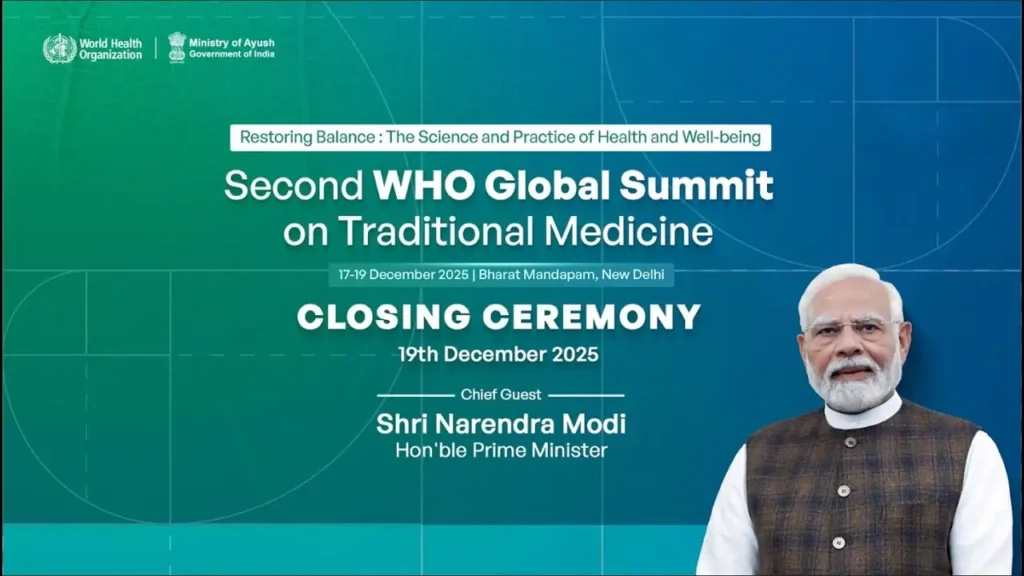
New Delhi: The Second World Health Organization (WHO) Global Summit on Traditional Medicine concluded on December 19, 2025, with unanimous adoption of the Delhi Declaration and a series of high-impact initiatives that signal a decisive shift toward integrating traditional, complementary, and integrative medicine into mainstream global healthcare systems.
Held at Bharat Mandapam under the theme “Restoring Balance: The Science and Practice of Health and Well-being,” the summit attracted senior policymakers, researchers, regulators, and practitioners from across the world, cementing India’s position as a leading force in this rapidly evolving field.
Prime Minister Calls for Urgent Global Action on Health Imbalances
In his closing address, Prime Minister Shri Narendra Modi stressed the pressing need for faster, more coordinated international efforts to restore equilibrium in human health. He pointed out that rising lifestyle-related disorders and chronic diseases are largely driven by multiple forms of imbalance, made worse by swift technological and societal shifts.
The Prime Minister described the summit as an effective platform for meaningful dialogue and cooperation among global stakeholders. He highlighted how principles of balance central to systems like Ayurveda directly address today’s most pressing health concerns.
India’s Growing Leadership Recognised Worldwide
Mr Modi took particular pride in the WHO Global Centre for Traditional Medicine, established in Jamnagar, Gujarat, following a 2022 decision by the international community to entrust India with this responsibility. The centre has since become a respected global focal point for joint research, regulatory development, evidence-building, and professional training, underscoring sustained confidence in Indian leadership.
He committed India to continue acting as an inclusive platform that strengthens partnerships in traditional medicine across nations.
Landmark Initiatives Unveiled During the Summit
The event featured several transformative announcements designed to advance evidence-based traditional medicine on a global scale.
Traditional Medicine Global Library Launched
A major highlight was the official launch of the Traditional Medicine Global Library, a digital platform that provides open and equitable access to peer-reviewed scientific studies, policy documents, and authenticated knowledge resources covering diverse traditional medicine systems.
New WHO South-East Asia Regional Office Building Inaugurated
Prime Minister Modi and WHO Director-General Dr Tedros Adhanom Ghebreyesus jointly inaugurated the new permanent premises of the WHO South-East Asia Regional Office (SEARO) in New Delhi. The modern complex will also host the WHO India Country Office and is positioned to serve as a regional powerhouse for research coordination, regulatory alignment, and capacity development.
Key Digital and Quality Assurance Measures for India’s AYUSH Sector
Two significant domestic initiatives were introduced:
- My Ayush Integrated Services Portal (MAISP) – A comprehensive master digital portal consolidating all services within the Ayush ecosystem and serving as the primary interface for the broader Ayush Grid.
- Ayush Mark – An upcoming global certification standard aimed at establishing consistent quality benchmarks for AYUSH products and services worldwide.
Ceremonial Releases and Recognitions
Additional ceremonial milestones included:
- Release of a commemorative postal stamp honouring Ashwagandha.
- Launch of the WHO technical report on standardised yoga training.
- Unveiling of the book “From Roots to Global Reach: 11 Years of Transformation in Ayush.”
The Prime Minister presented the Prime Minister’s Awards for Outstanding Contribution to the Promotion and Development of Yoga to distinguished recipients from India and overseas. He also visited the Traditional Medicine Discovery Space exhibition, which showcased the richness and contemporary applications of traditional knowledge systems from multiple countries.
Delhi Declaration: A Shared Global Commitment
The summit concluded with the adoption of the Delhi Declaration, which formally recognises traditional medicine as a common biocultural heritage of humanity. The declaration obliges member states to prioritise evidence generation, robust regulation, seamless integration into national health systems, and cross-sector collaboration, in full harmony with the WHO Global Traditional Medicine Strategy 2025–2034.
Understanding Traditional Medicine and India’s AYUSH Framework
Traditional medicine includes both well-documented (codified) systems and community-based (non-codified) practices that predate modern biomedicine and are deeply rooted in cultural traditions.
India’s AYUSH sector — Ayurveda, Yoga and Naturopathy, Unani, Siddha, and Homoeopathy — is currently valued at US$43.4 billion, having achieved nearly eight-fold growth over the past ten years.
Supporting this expansion are several dedicated national programmes:
- National AYUSH Mission (2014) – A centrally sponsored scheme focused on infrastructure development, service enhancement, and co-location of AYUSH facilities alongside conventional healthcare.
- Ayurgyan – Dedicated to advanced research, workforce training, drug standardisation, and medicinal plant studies.
- AOGUSY (AYUSH Oushadhi Gunvatta evam Uttapadan Samvardhan Yojana) – Centred on quality control, manufacturing standards, and pharmacovigilance for AYUSH medicines.
Other supporting efforts include public awareness campaigns, promotion of Medical Value Travel centred on traditional therapies, and large-scale digitisation through the Ayush Grid and Traditional Knowledge Digital Library.
Emphasis on Evidence, Safety, and Global Trust
Prime Minister Modi underlined that widespread acceptance of traditional medicine depends on rigorous scientific validation, internationally recognised regulatory frameworks, and innovative digital tools. He cited Ashwagandha as a standout example of an ancient herb gaining modern global credibility through systematic research on safety, quality, and efficacy — particularly noticeable during the COVID-19 period.
India is also pioneering integrative models, including evidence-based protocols for supportive cancer care, thereby broadening the scope of traditional systems from wellness to critical public health domains.
International Acclaim for India’s Achievements
WHO Director-General Dr Tedros Adhanom Ghebreyesus praised Prime Minister Modi for consistently elevating traditional medicine on the world stage. He recalled India’s successful advocacy for global collaboration during its G20 presidency and noted that the vision of “One Earth, One Health” perfectly echoes core traditional principles of balance, prevention, and harmony with nature.
Dr Tedros hailed India’s practical steps — including the dedicated Ministry of AYUSH and the operational success of the Jamnagar centre — for moving traditional medicine from cultural heritage to evidence-informed mainstream practice. He described the Delhi Declaration as a major leap forward and affirmed that India has proven traditional medicine to be a vibrant, evolving science essential to contemporary healthcare.
Union Health Minister Shri J P Nadda credited the Prime Minister’s visionary guidance for establishing AYUSH as a credible global healthcare option. He highlighted successful integrations such as dedicated AYUSH blocks in top institutions like AIIMS, enabling synergistic delivery and measurable gains in preventive and holistic care.
Minister of State for AYUSH Shri Prataprao Jadhav characterised the summit as a defining moment that repositions traditional medicine as a core component of people-centred, preventive healthcare worldwide.
Bilateral Cooperation Expanded
Parallel to the main proceedings, India conducted bilateral discussions with approximately 16 countries, including Brazil, United Arab Emirates, Malaysia, Mexico, Nepal, Sri Lanka, Vietnam, and Bhutan, aimed at forming Joint Working Groups for sustained collaboration.
A notable agreement was the extension of an MoU with Cuba, providing for an AYUSH Chair at a Cuban medical university and establishment of a Panchakarma Centre to facilitate Ayurveda’s incorporation into Cuba’s national health system.
The Second WHO Global Summit has transitioned global discourse from aspiration to concrete action, reinforcing a unified commitment to safe, effective, equitable, and sustainable healthcare that harmoniously blends ancient wisdom with modern science.
Frequently Asked Questions
1. What was the main outcome of the Second WHO Global Summit on Traditional Medicine held in New Delhi?
The summit concluded with the unanimous adoption of the Delhi Declaration. This landmark document recognises traditional medicine as a shared biocultural heritage of humanity and commits participating countries to strengthen evidence-based research, regulation, integration into national health systems, and cross-sector collaboration, in full alignment with the WHO Global Traditional Medicine Strategy 2025–2034.
2. What key initiatives were launched during the summit?
Several major initiatives were unveiled:
Release of a commemorative postal stamp on Ashwagandha, a WHO technical report on yoga training, and the book “From Roots to Global Reach: 11 Years of Transformation in Ayush.”
Traditional Medicine Global Library: A digital platform providing equitable global access to scientific data, policy resources, and validated knowledge on traditional medicine.
My Ayush Integrated Services Portal (MAISP): The master digital portal for India’s Ayush sector, serving as the central hub of the Ayush Grid.
Ayush Mark: A proposed international quality certification standard for AYUSH products and services.
Inauguration of the new WHO South-East Asia Regional Office (SEARO) building in New Delhi, which will also house the WHO India Country Office.
3. Why did Prime Minister Narendra Modi highlight Ashwagandha during the summit?
Prime Minister Modi cited Ashwagandha as a prime example of how ancient Indian herbs can gain global acceptance through modern scientific validation. He noted its increased worldwide attention, especially during the COVID-19 pandemic, and emphasised India’s ongoing research to establish its safety, quality, and efficacy, helping build international trust in traditional medicine.
4. How has India contributed to the global advancement of traditional medicine?
India has emerged as a global leader by:
Successfully advocating for traditional medicine during its G20 presidency and through high-level international engagements.
Hosting the WHO Global Centre for Traditional Medicine in Jamnagar, Gujarat, since 2022, which has become a hub for research, regulation, and capacity building.
Growing its AYUSH sector (Ayurveda, Yoga, Unani, Siddha, Homoeopathy) to a valuation of $43.4 billion, with nearly eight-fold expansion in the past decade.
Implementing national programmes such as the National AYUSH Mission, Ayurgyan, and AOGUSY to strengthen infrastructure, research, quality control, and integration with modern healthcare.
5. What bilateral achievements were made on the sidelines of the summit?
India held discussions with around 16 countries, including Brazil, UAE, Malaysia, Mexico, Nepal, Sri Lanka, Vietnam, and Bhutan, to deepen cooperation in traditional medicine, with plans to establish Joint Working Groups. A notable outcome was the extension of an MoU with Cuba, which includes setting up an AYUSH Chair at a Cuban medical university and establishing a Panchakarma Centre to integrate Ayurveda into Cuba’s national health system.