

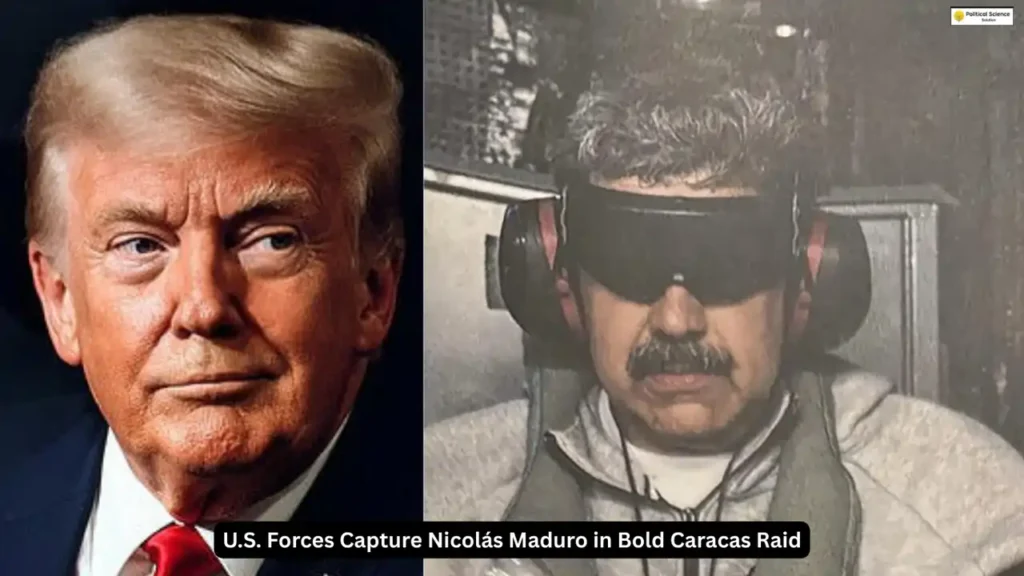
New Delhi: In an unprecedented military operation, United States elite forces seized former Venezuelan President Nicolás Maduro and his wife, Cilia Flores, from Caracas in the early hours of January 3, 2026. The couple was flown to New York, arriving on January 4, and are now held at Brooklyn’s Metropolitan Detention Center ahead of a federal court hearing set for noon on Monday.
The dramatic extraction has triggered intense international debate, threats of further U.S. action, and a fragile power transition in the oil-rich South American nation.
Details of the High-Risk Operation
Officials confirmed that the U.S. Army’s Delta Force led the 160-minute mission, supported by airstrikes and ground elements across three Venezuelan states. Months of regional military positioning preceded the raid, including the deployment of the USS Gerald R. Ford aircraft carrier and numerous warships in the Caribbean. Pre-operation strikes targeted over 30 boats allegedly involved in drug trafficking.
Satellite images released after the assault showed extensive damage to Fuerte Tiuna, a central military fortress in Caracas long associated with Maduro’s inner circle. Venezuelan Defense Minister Vladimir Padrino Lopez confirmed heavy losses among Maduro’s personal security detail, though no exact figures were provided.
At least 40 people died in the strikes, according to a senior Venezuelan official, including military members and civilians. The Cuban government reported 32 of its personnel – deployed on official missions – were killed in combat or bombing, prompting two days of national mourning on January 5 and 6. President Trump, speaking to reporters aboard Air Force One, acknowledged the Cuban casualties, noting, “A lot of Cubans were killed yesterday.”
Charges and Detention in New York
Maduro and Flores face expanded federal charges unsealed on January 4, building on a 2020 indictment. The accusations include narco-terrorism conspiracy, cocaine importation conspiracy, and possession of machine guns and destructive devices. Prosecutors allege senior Venezuelan officials collaborated with groups like the Sinaloa Cartel and Tren de Aragua, receiving profits in exchange for protection.
The couple is detained at the Metropolitan Detention Center in Brooklyn, a facility known for housing high-profile inmates but criticized for operational issues. Their initial court appearance on Monday will formally present the charges.
Power Transition and Interim Leadership
With Maduro removed, Vice President Delcy Rodríguez has assumed interim presidential duties. Venezuela’s Supreme Court directed her to serve in an acting capacity for 90 days – marking the first time a woman holds the role, even temporarily. The military, through Padrino Lopez, publicly endorsed Rodríguez and urged citizens to return to normal activities while maintaining nationwide readiness to protect sovereignty.
Rodríguez initially demanded Maduro’s release and pledged defense of the nation but later adopted a conciliatory approach. In a Sunday statement, she invited the U.S. to “collaborate” on shared development under international law for lasting coexistence.
Trump Administration’s Stance and Warnings
President Trump declared the operation a success during a Mar-a-Lago press conference, stating the U.S. would temporarily “run” Venezuela until a safe transition, with a focus on restarting oil production. He warned the mission serves as a deterrent to threats against American lives or sovereignty.
In subsequent remarks, Trump threatened a second strike if cooperation is withheld and told The Atlantic that Rodríguez would “pay a very big price, probably bigger than Maduro” for non-compliance. He also hinted at potential action against Colombia, saying its leader “won’t be doing it very long” and “Operation Colombia sounds good to me.”
Secretary of State Marco Rubio later clarified that the U.S. has no intention of day-to-day governance, limiting involvement to enforcing an “oil quarantine” to pressure policy shifts. Secretary of War Pete Hegseth contrasted the operation with the Iraq invasion, calling it the “exact opposite” – a strategic move securing resources without prolonged conflict or heavy American casualties.
Economic Fallout and Oil Sector Impact
Venezuela’s state oil firm PDVSA has directed joint ventures to reduce output by closing oilfields and well clusters amid stockpiles, diluent shortages, and halted exports due to U.S. tanker blockades and cargo seizures. The nation holds the world’s largest proven crude reserves at approximately 303 billion barrels, making control of production a central U.S. objective.
U.S. airlines resumed Caribbean routes on Sunday after brief airspace restrictions were lifted during the operation.
Opposition Voices and Domestic Reactions
Opposition leader María Corina Machado, recipient of the 2025 Nobel Peace Prize, described Maduro’s removal as “important but not enough.” She prioritized freeing all political prisoners, a call backed by French President Emmanuel Macron. Machado thanked global democratic leaders for support and spoke with Canadian Prime Minister Mark Carney, who endorsed a peaceful, Venezuelan-led transition.
Trump, however, questioned Machado’s viability as a leader, stating she lacks sufficient domestic respect and support.
Venezuelan expatriates in the U.S., particularly in Florida’s Doral community, celebrated with flags, anthems, and occasional cheers for Trump.
International Reactions: Condemnation and Support
Global responses revealed deep divisions. A joint statement from Brazil, Chile, Colombia, Mexico, Uruguay, and Spain rejected any external “control” or resource appropriation. Colombia’s Gustavo Petro labeled the action an assault on Latin American sovereignty, forecasting humanitarian crisis.
The European Union (26 of 27 members, excluding Hungary) demanded adherence to international law and respect for Venezuelan will. UK Prime Minister Keir Starmer supported a peaceful transition, noting Maduro was never recognized as legitimate. Spain’s Pedro Sánchez condemned the intervention as a violation of international norms.
UN General Assembly President Annalena Baerbock emphasized the UN Charter “is not optional,” citing prohibitions on force against territorial integrity. Singapore voiced grave concern over threats to sovereignty, especially for smaller states. India expressed deep concern and urged dialogue. North Korea called the strikes the most serious sovereignty encroachment.
Cuba’s Miguel Díaz-Canel rallied citizens to defend both revolutions, anticipating worsened shortages without Venezuelan aid. Rubio warned Cuba faces serious trouble due to its influence over Venezuelan security.
Support came from Israeli Prime Minister Benjamin Netanyahu, praising U.S. resolve to restore regional freedom and justice. Russia’s Dmitry Medvedev acknowledged the actions as unlawful yet consistent with defending national interests.
Pope Leo XIV, the first American pontiff, stressed that Venezuelan welfare must prevail, guaranteeing sovereignty, constitutional rule, human rights, and aid for the poorest amid economic hardship.
Analysts noted the operation may encourage China to assert claims over Taiwan and the South China Sea while providing Beijing ammunition to criticize U.S. actions globally.
Broader Implications and Ongoing Uncertainty
The raid underscores Venezuela’s strategic importance due to its massive oil reserves and long-running U.S. accusations of drug-related corruption. As Rodríguez navigates military loyalty, economic paralysis, and U.S. demands, questions persist over democratic transition, regional stability, and adherence to international norms.
With Maduro’s court date approaching and Trump reiterating resource-focused goals, the crisis remains fluid, carrying potential ripple effects across Latin America, global energy markets, and great-power relations.
This rapidly evolving situation continues to command worldwide attention as stakeholders weigh sovereignty, justice, and power in the post-Maduro era.
FAQs
1. What exactly happened in the U.S. military operation against Venezuela on January 3, 2026?
On January 3, 2026, U.S. elite forces, led by the Army’s Delta Force, conducted a rapid 160-minute operation in Caracas involving airstrikes, ground elements, and naval support. The mission targeted key sites, including the military complex Fuerte Tiuna, and resulted in the capture of former President Nicolás Maduro and his wife, Cilia Flores. They were immediately flown to New York. The operation followed months of U.S. military buildup in the Caribbean, including the positioning of the USS Gerald R. Ford aircraft carrier. At least 40 people were killed, including members of Maduro’s security team and 32 Cuban personnel supporting Venezuelan forces.
2. What charges do Nicolás Maduro and his wife face in the United States?
Maduro and Cilia Flores face federal charges based on a 2020 indictment that was expanded and unsealed on January 4, 2026. The charges include narco-terrorism conspiracy, conspiracy to import cocaine into the U.S., possession of machine guns and destructive devices, and related conspiracies. U.S. prosecutors allege that senior Venezuelan officials collaborated directly with drug trafficking organizations such as the Sinaloa Cartel and Tren de Aragua, providing protection in exchange for profits. Maduro has consistently denied any involvement in criminal activities. The couple is scheduled to appear in federal court in the Southern District of New York on Monday, January 6, 2026.
3. Who is currently leading Venezuela after Maduro’s removal?
Delcy Rodríguez, Maduro’s former Vice President, has assumed the role of interim or acting president. Venezuela’s Supreme Court ordered her to take presidential powers in an acting capacity for 90 days, making her the first woman to hold the position, even temporarily. On January 4–5, the Venezuelan military, through Defense Minister Vladimir Padrino Lopez, formally recognized Rodríguez as the country’s acting leader and urged citizens to resume normal daily activities. Rodríguez has shifted from initial defiance to a more conciliatory tone, inviting the U.S. to “collaborate” while seeking “respectful relations.”
4. What has President Trump said about U.S. involvement in Venezuela going forward?
President Donald Trump initially stated that the United States would temporarily “run” Venezuela during the transition period and focus on “getting the oil flowing” from the country’s vast reserves. He later warned interim leader Delcy Rodríguez of severe consequences, including a possible second military strike, if she does not cooperate with U.S. demands. However, Secretary of State Marco Rubio clarified on January 5 that the U.S. does not plan to govern Venezuela day-to-day. Instead, involvement will be limited to enforcing an existing “oil quarantine” to pressure changes in oil policy and drug trafficking.
5. How has the international community reacted to the U.S. operation?
Reactions have been sharply divided:
- Strong condemnation came from Cuba, Brazil, Chile, Colombia, Mexico, Uruguay, Spain, the European Union (26 of 27 members), India, Singapore, North Korea, and the UN General Assembly President, who emphasized violations of international law and sovereignty.
- Opposition leader María Corina Machado and expatriate Venezuelans celebrated the removal, while Canada, France, and the UK called for a peaceful, Venezuelan-led democratic transition.
- Israel and Russia’s Dmitry Medvedev offered varying degrees of support or acknowledgment of U.S. consistency in defending its interests.
- Pope Leo XIV stressed that the welfare and sovereignty of the Venezuelan people must take priority.
The operation has raised concerns about potential ripple effects, including emboldening China’s territorial assertions and straining U.S.–Latin America relations.