

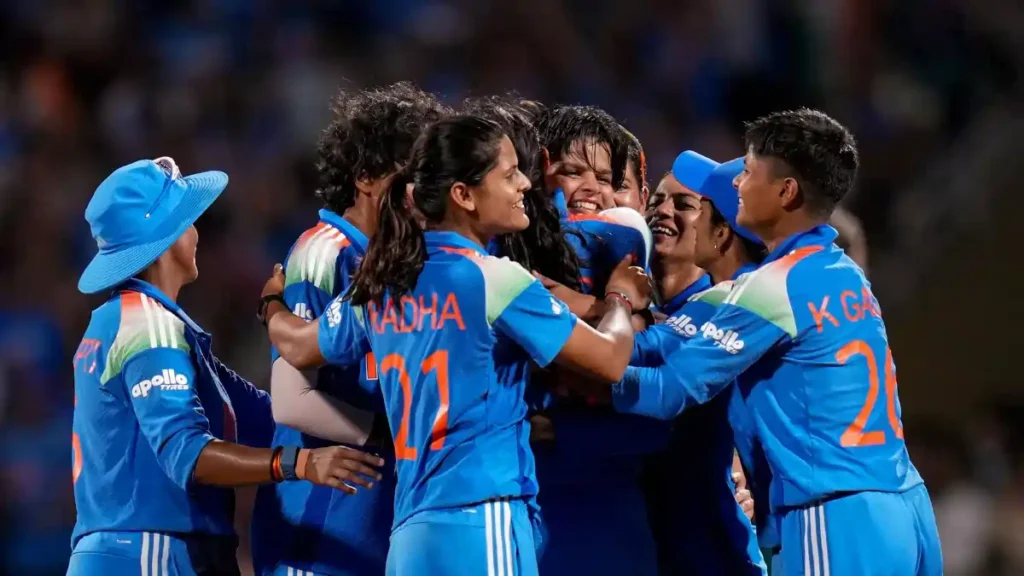
New Delhi: In a watershed moment for Indian sports, the nation’s women’s cricket team scripted an indelible chapter of glory, shedding the ghosts of finals past to lift their first-ever ICC Women’s ODI World Cup trophy. On a pulsating night at the D.Y. Patil Stadium in Navi Mumbai, Team India defeated a resilient South African side by 52 runs, culminating a journey of grit, skill, and unyielding determination that has captured the imagination of a billion hearts.
The victory, sealed in the early hours of November 3, 2025, marks India’s maiden world title across both ODI and T20I formats, finally putting behind the heartbreaks of the 2005 and 2017 World Cup finals. The win has been hailed as a transformative event for women’s cricket globally, signaling a new era of recognition and growth.
A Tournament of Firsts: ICC Women’s Cricket World Cup 2025 in India
The 2025 edition of the ICC Women’s Cricket World Cup was the 13th iteration of the prestigious tournament, first held in England in 1973. Hosting the event for the first time in years, India provided the perfect stage for a spectacle of this magnitude. Australia, with seven titles, still holds the record for the most championships, but the 2025 tournament was destined to crown a new champion. For India, this was their third appearance in a World Cup final, and as the adage goes, the third time proved to be the charm.
The Grand Finale: India vs. South Africa – A Nerve-Wracking Contest
The stage was set for a classic encounter. South African captain Laura Wolvaardt won the toss and, perhaps mindful of the occasion and the dew factor later, elected to field first.
India’s Innings: A Collective Batting Masterclass
The Indian innings was built on a foundation of strategic partnerships. The explosive opening duo of Smriti Mandhana and Shafali Verma provided a blistering start, stitching together a century partnership that set the tone. Mandhana, the elegant left-hander, played a composed innings of 45 runs from 58 deliveries, finding the boundary eight times before departing.
Her partner, the young powerhouse Shafali Verma, was in devastating form. She took charge of the innings, unleashing a barrage of powerful strokes on her way to a magnificent 87 off just 78 balls. Her innings was laced with seven boundaries and two towering sixes, putting the South African bowlers on the back foot. Following Mandhana’s dismissal, Verma combined with the talented Jemimah Rodrigues (24 off 37 balls) for a steadying 62-run stand, guiding India to a commanding position at 166/2.
Just as India looked to accelerate, they encountered a minor stumble. However, the middle order ensured there was no collapse. Captain Harmanpreet Kaur (20 off 29 balls) joined all-rounder Deepti Sharma to add a crucial 52 runs, pushing India beyond the 200-run mark and stabilizing the innings.
The final flourish, which ultimately proved to be the difference, came from the partnership between Deepti Sharma and wicket-keeper Richa Ghosh. Shedding the tag of a pure bowler, Deepti Sharma played a mature and counter-attacking innings, scoring a vital 58 runs from 58 deliveries, including three fours and a six. At the other end, Richa Ghosh provided the late-order fireworks, smashing 34 runs off a mere 24 balls, with three fours and two sixes. Their partnership propelled India to a formidable total of 298/7 in their allotted 50 overs.
For the Proteas, Ayabonga Khaka was the most successful bowler, finishing with figures of 3/58, managing to apply the brakes at crucial junctures.
South Africa’s Chase: Wolvaardt’s Valiant Century Meets Deepti’s Magic
Chasing a daunting 299 for victory, South Africa began steadily, putting on a fifty-run opening stand. However, the Indian bowlers struck at regular intervals to keep the pressure on. Tazmin Brits (23 off 35 balls) was the first to depart.
Amid the falling wickets, South African captain Laura Wolvaardt stood tall, playing a captain’s knock reminiscent of her record-breaking 169 in the semi-final against England. She displayed sublime class and authority, dismantling the Indian bowling attack. Just as it seemed she was single-handedly steering her team towards an improbable victory, the golden arms of India’s all-rounders turned the tide.
Shafali Verma, capping off her dream all-round performance, snared two crucial wickets for 36 runs, while spinner Shree Charani applied further pressure. This reduced South Africa to 148/5, tilting the balance firmly in India’s favor.
But Wolvaardt was not done yet. She found an able partner in Annerie Dercksen (37 off 35 balls), and the duo forged a dangerous 61-run partnership for the sixth wicket. The momentum began to shift, and anxiety crept into the Indian camp. Wolvaardt brought up a magnificent, fighting century—101 runs from 98 balls, including 11 fours and a six—under immense pressure.
With the match hanging in the balance, Deepti Sharma produced a spell of legendary proportions. In a game-changing over, she dismissed the set and dangerous Annerie Dercksen, breaking the threatening partnership. The very next ball, she delivered the knockout punch, trapping the centurion Laura Wolvaardt LBW. That double-strike triggered a dramatic South African collapse, sending them from a hopeful 209/5 to a desperate 221/8.
Deepti Sharma was unplayable. She became the first Indian woman to take a four-wicket haul in a World Cup final and didn’t stop there. She polished off the tail to finish with a sensational five-wicket haul, registering figures of 5 for 39 in 9.3 overs. South Africa’s innings eventually folded for 246 runs in 47.3 overs, sparking wild celebrations in the Indian camp and across the stadium.
The Architects of Victory: Stars Shine on the Grandest Stage
The Player of the Match award was fittingly bestowed upon Shafali Verma for her defining all-round performance. Her explosive 87 with the bat and two critical wickets with the ball made her the cornerstone of India’s victory.
However, the Player of the Tournament award went to the irrepressible Deepti Sharma. Her contribution in the final—a vital half-century and a match-winning five-wicket haul—epitomized her immense value to the team throughout the competition.
A Nation Rejoices: Presidential and Prime Ministerial Acclaim
The historic victory elicited proud and enthusiastic reactions from the highest offices of the country.
President Droupadi Murmu took to social media to congratulate the team, calling it a “watershed moment” that will “take women’s cricket to even higher performances.” She praised the players for their determination and inspiring performance, stating, “the girls have made India proud.”
Prime Minister Narendra Modi described the win as “spectacular,” adding that it “will motivate future champions to take up sports.” In his message, he highlighted the team’s “great skill and confidence” in the final and applauded their “exceptional teamwork and tenacity throughout the tournament.”
Other dignitaries, including Lok Sabha Speaker Om Birla and Union Home Minister Amit Shah, also extended their wishes, with Shah calling it a “crowning moment for the nation” and stating that “Team India has elevated India’s pride to the skies.”
BCCI’s Landmark Reward: A Rs. 51 Crore Tribute
In a move that underscores the significance of this achievement, the Board of Control for Cricket in India (BCCI) announced a staggering cash reward of ₹51 crore for the World Cup-winning team, encompassing players, coaches, and support staff.
BCCI secretary Devajit Saikia, in a conversation with ANI, drew a parallel to the iconic 1983 Men’s World Cup win, saying, “In 1983, Kapil Dev brought about a new era and encouragement in cricket by making India win the World Cup. The same excitement and encouragement has been introduced by the women today.” He credited the team, led by Harmanpreet Kaur, for not just winning the trophy but for “winning the hearts of all Indians” and “paving the way for the next generation of women cricketers.”
Saikia also highlighted the transformative steps taken by the BCCI in recent years to promote women’s cricket, including pay parity and a significant increase in prize money. He noted that under the leadership of ICC Chairman Jay Shah, women’s World Cup prize money was increased by 300%, from $2.88 million to $14 million, a monumental step in promoting the women’s game globally. The total prize money for the Indian team from the ICC and BCCI combined is an all-time high of approximately ₹37.3 crore, a 239% growth from previous editions.
A Legacy Forged in Navi Mumbai
The ICC Women’s ODI World Cup 2025 final was more than just a cricket match; it was a cultural reset. The sight of the Indian women’s team hoisting the trophy in front of a home crowd, led by the brilliance of Shafali Verma and Deepti Sharma, will be etched in memory forever. This victory transcends sport—it is a powerful beacon of inspiration, a testament to years of perseverance, and the dawn of a bold new epoch for women’s cricket in India and beyond. The champions have not just brought home a trophy; they have brought home a billion dreams.
FAQs
1. Who won the ICC Women’s ODI World Cup 2025?
The Indian women’s cricket team won the ICC Women’s ODI World Cup 2025, securing their first-ever title in the tournament’s history. They defeated South Africa by 52 runs in a thrilling final at the D.Y. Patil Stadium in Navi Mumbai.
2. Who were the key players in the final for India?
All-round performances from Deepti Sharma and Shafali Verma were instrumental in India’s victory.
Shafali Verma was named Player of the Match for her 87 runs and 2 crucial wickets.
Deepti Sharma was awarded Player of the Tournament and was the hero of the final, scoring 58 runs and taking a game-changing 5-wicket haul (5/39).
3. What was the total prize money announced for the winning Indian team?
The Board of Control for Cricket in India (BCCI) announced a massive cash reward of ₹51 crores for the entire team, including players, coaches, and support staff. Combined with the ICC prize money, the total reward for the team is an all-time high of approximately ₹37.3 crore, marking a 239% growth from the previous edition.
4. Why is this World Cup win considered so significant for India?
This victory is historic because it is the Indian women’s team’s first-ever World Cup title in any format (ODI or T20I). It helped them overcome the heartbreak of losing two previous finals in 2005 and 2017. The win is seen as a transformative moment that is expected to massively boost the profile, investment, and inspiration for women’s cricket in India and worldwide.
5. How did the national leaders react to the victory?
The win received acclaim from the highest levels of the Indian government:
- President Droupadi Murmu called it a “watershed moment” that would inspire higher performances.
- Prime Minister Narendra Modi described it as a “spectacular victory” that will motivate future champions.
- Union Home Minister Amit Shah termed it a “crowning moment for the nation,” stating the team had “elevated India’s pride to the skies.”