

New Delhi: A political firestorm has erupted in Assam after a high-powered Group of Ministers (GoM) submitted its long-awaited report recommending Scheduled Tribe (ST) status for six major communities — Tai Ahom, Chutia, Moran, Motok, Koch-Rajbongshi, and Tea & Adivasi tribes — sparking immediate backlash from existing Scheduled Tribe organisations who warn of statewide rail and highway blockades if the proposals move forward without iron-clad safeguards.
The 2025 Assam ST status controversy centres around a three-tier reservation model that the GoM claims will protect the current 15% ST quota (10% ST-Plains + 5% ST-Hills) while accommodating communities that together constitute roughly 27% of Assam’s population — more than double the existing ST population of 12.4%.
What Exactly Does the GoM Report Recommend?
The GoM, constituted specifically to find a via-media between the decades-old demand of the six communities and the legitimate fears of existing tribes, has proposed the following structure:
- Creation of a New “ST (Valley)” Category Tai Ahom, Chutia, Tea & Adivasi tribes, and Koch-Rajbongshi (excluding those in undivided Goalpara district) would be placed in this entirely new category with separate reservation percentages for state government jobs and educational institutions.
- Inclusion of Smaller Communities in Existing ST (Plains) Moran, Motok, and Koch-Rajbongshi residents of the erstwhile Goalpara region would be directly added to the current ST (Plains) list, which already enjoys 10% reservation.
- Complete Protection for Existing Quotas at State Level The report repeatedly emphasises that the existing ST (Plains) 10% and ST (Hills) 5% quotas will remain “fully protected” and untouched at the state level.
- Single National ST Pool for Central Jobs & Education At the all-India level, however, there is no scope for sub-categorisation. All newly included communities and existing STs will compete under the single 7.5% national ST quota, a point that has become the biggest flashpoint.
- Interim Relief Through OBC Sub-Quota Until Parliament passes the required constitutional amendment, the GoM suggests immediate sub-categorisation within the existing 27% OBC quota to provide temporary relief to the six communities.
Why Existing Tribes Are Furious
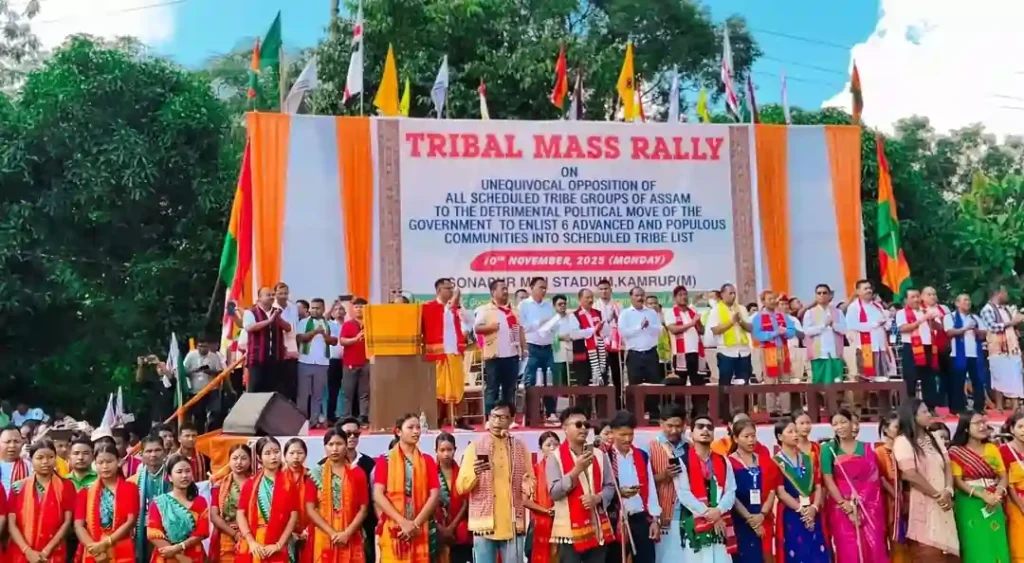
Leaders of the Coordinating Committee of Tribal Organisations of Assam (CCTOA), the umbrella body representing current ST groups including Bodos, Missing, Karbi, Dimasa, Rabha, and others, have rejected the report outright.
Speaking to reporters, CCTOA chief convener Aditya Khaklari said, “At the state level everything looks protected on paper, but nationally there is only one ST list. When Tai Ahom, Chutia, Koch-Rajbongshi — communities that are educationally and economically far ahead in Upper Assam — enter the same 7.5% national pool, our children will be completely crowded out from central jobs, IITs, IIMs, AIIMS, UPSC, and SSC examinations.”
Khaklari pointed out that the six communities combined are estimated at 27% of Assam’s population against the existing STs’ 12.4%, giving the new entrants a massive numerical advantage in open national competition.
Violence Erupts in Bodoland
Tensions boiled over on Saturday evening when hundreds of students, largely from the Bodo community, stormed the Bodoland Territorial Council (BTC) Secretariat in Kokrajhar and vandalised furniture and vehicles. The BTC, carved out under the 2003 Bodo Accord, is administered primarily by the Bodo tribe, Assam’s single largest Scheduled Tribe.
The Kokrajhar district administration promptly imposed prohibitory orders under Section 144 CrPC across the town and near the BTC Secretariat, banning gatherings of five or more persons and warning of strict action against rail and national highway blockades.
Government Rushes to Calm Nerves
In a late-night statement on Sunday, Chief Minister Himanta Biswa Sarma announced that the state cabinet had reviewed both the GoM report and the ground situation. He declared the government’s willingness to hold direct talks with protesting organisations.
“Ministers Dr Ranoj Pegu, Keshab Mahanta and Pijush Hazarika have been authorised to meet CCTOA leaders and explain every clause of the report. If needed, I myself will sit across the table with them,” the Chief Minister said, underlining that the report “paves the way for extending ST status to the six communities without affecting the rights or interests of existing ST groups.”
Congress Accuses CM of “Divide and Rule”
The opposition Indian National Congress wasted no time in attacking the BJP-led government. Assam Pradesh Congress Committee president and Jorhat MP Gaurav Gogoi accused Chief Minister Sarma of deliberately stoking conflict between communities.
In a strongly-worded post on X (formerly Twitter), Gogoi wrote:
“Congress passed an Assembly resolution during Tarun Gogoi’s government supporting ST status for these six communities WITHOUT affecting existing tribes. But Himanta Biswa Sarma’s report fails to guarantee that existing ST rights remain fully intact. This is classic British-era divide-and-rule politics — pitting indigenous tribes against indigenous tribe.”
Gogoi demanded that the state government immediately withdraw the report and restart consultations afresh.
Six Communities Welcome the Report
Representatives of the six aspirant communities, on the other hand, expressed cautious satisfaction.
Khitish Barman, chief adviser of the All Koch Rajbongshi Students Union (AKRSU), told journalists: “We are happy the government has finally acknowledged our historical and cultural claims. We never wanted conflict with our existing tribal brothers and sisters. Their quotas at the state level remain 100% intact. The Kokrajhar violence happened even before the report was made public — clearly provoked by vested interests.”
Leaders of Tai Ahom, Chutia, Moran, Motok, and Tea-Adivasi organisations echoed similar sentiments, urging calm and continued dialogue.
Constitutional and Legal Road Ahead
Granting ST status is not in the hands of the state government alone. Under Article 342 of the Constitution, only the President (on the advice of the Union Government) can notify new Scheduled Tribes, and any modification requires parliamentary legislation.
The Lokur Committee (1965) guidelines — primitive traits, distinctive culture, geographical isolation, shyness of contact with the community at large, and backwardness — remain the broad criteria used by the Registrar General of India and the National Commission for Scheduled Tribes while evaluating claims.
Several of the six communities, particularly Tai Ahom and Chutia, have faced criticism in the past for not fitting the “primitive traits” criterion, given their historical kingdoms and advanced administrative systems centuries ago. The GoM report, however, argues that cultural distinctiveness and historical marginalisation post-Ahom kingdom fall satisfy constitutional parameters.
Interim OBC Sub-Quota: A Temporary Patch?
While Parliament may take years to amend the ST list, the GoM has recommended immediate sub-categorisation of Assam’s 27% OBC quota to provide urgent relief to the six communities. Assam already has a highly fragmented OBC list (MOBC, More OBC, etc.), and further division could open another Pandora’s box of demands from smaller castes currently in the OBC category.
What Happens Next?
All eyes are now on the proposed meeting between state ministers and CCTOA leaders. If talks fail, tribal organisations have threatened an agitation larger than the 2019–2020 anti-CAA protests, including indefinite rail and NH blockades — a move that could paralyse transport and supply chains across the Northeast.
Meanwhile, the six communities have announced celebration rallies across Upper and Lower Assam, signalling that any rollback under pressure would trigger an equally fierce counter-movement.
As Assam heads into 2026 Assembly elections, the ST status imbroglio has emerged as the state’s most explosive identity issue since the Assam Accord and the Bodo movement — with the potential to reshape electoral alliances, reservation mathematics, and inter-community relations for decades to come.
For now, the ball is firmly in Chief Minister Himanta Biswa Sarma’s court: can he convince existing tribes that their future is secure, while delivering on a 50-year-old promise to six historically significant communities? The coming weeks will decide whether Assam witnesses dialogue or disruption on a scale rarely seen before.
FAQs
2. What is the new “ST (Valley)” category proposed in the GoM report?
The six communities are:
Tea & Adivasi tribes (commonly called Tea Garden communities) Together, these groups are estimated to form around 27% of Assam’s population.
Tai Ahom
- Chutia
- Moran
- Motok (Matak)
- Koch-Rajbongshi
2. Which six communities have been recommended for Scheduled Tribe (ST) status in Assam?
The report suggests a third category called ST (Valley) in addition to the existing ST (Plains) and ST (Hills). Tai Ahom, Chutia, Tea-Adivasi tribes, and most Koch-Rajbongshis would be placed in this new category with separate state-level reservation percentages, while Moran, Motok, and Koch-Rajbongshis of old Goalpara area would go into the existing ST (Plains) list.
3. Will the existing ST (Plains) 10% and ST (Hills) 5% quotas be reduced if these six communities get ST status?
According to the GoM report: No at the state level. The report repeatedly states that the current 10% ST (Plains) and 5% ST (Hills) quotas will remain “fully protected” for jobs and education in Assam government institutions. However, at the national level (central jobs, UPSC, IITs, AIIMS, etc.), everyone will compete in the single 7.5% all-India ST pool with no sub-categories.
4. Why are existing Scheduled Tribes (Bodo, Karbi, Mising, etc.) opposing the recommendations?
Existing ST organisations (CCTOA) fear that in the national-level open competition, the six new communities (especially the numerically strong and relatively advanced Tai Ahom, Chutia, and Koch-Rajbongshi of Upper Assam) will dominate the 7.5% central ST quota, leaving very few seats for the current ST communities who are only 12.4% of Assam’s population compared to the new groups’ combined 27%.
5. Who has the final power to grant ST status to these six communities?
Only Parliament can grant or modify Scheduled Tribe status (Article 342 of the Constitution). The Assam government can only recommend; the final decision requires a bill in Parliament and presidential notification. The state can, however, provide interim benefits through sub-quotas within the existing 27% OBC reservation until Parliament acts.