
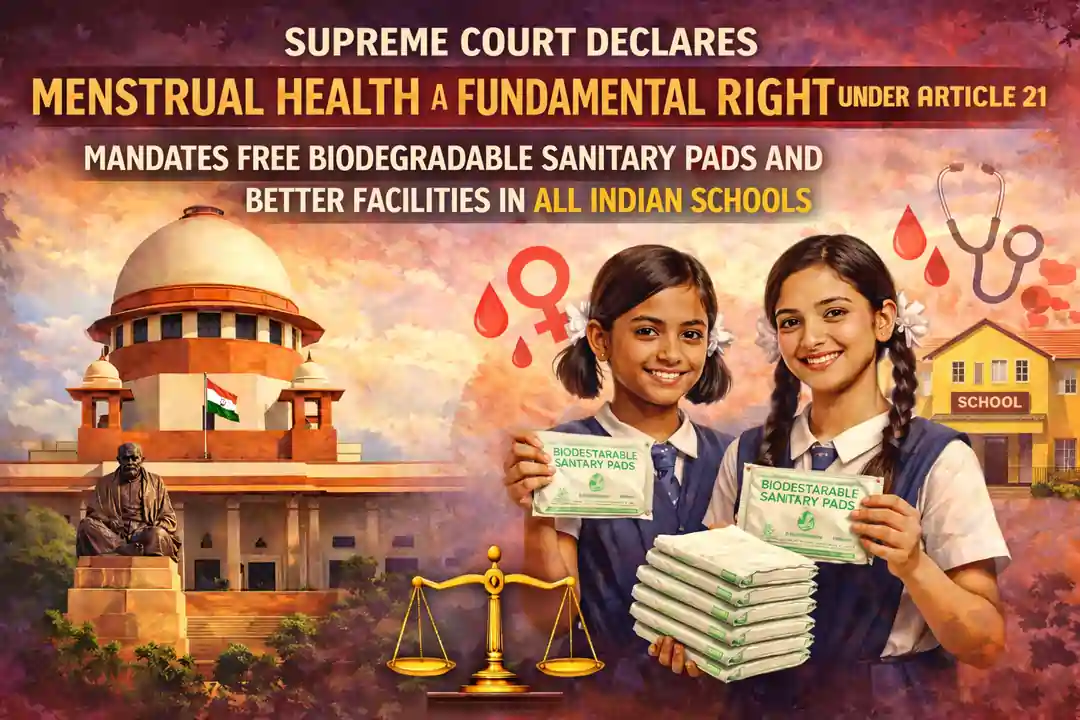
New Delhi: In a transformative ruling that strengthens gender equality and girls’ access to education, the Supreme Court of India has explicitly recognized the right to menstrual health as an essential element of the fundamental right to life and personal dignity guaranteed by Article 21 of the Constitution. Delivered on January 30, 2026, by a bench comprising Justices J.B. Pardiwala and R. Mahadevan in the case of Dr. Jaya Thakur v. Government of India (Writ Petition (C) No. 1000 of 2022), the 127-page judgment expands constitutional protections to address “period poverty” and its severe impact on adolescent girls’ health, education, and self-respect.
The verdict arose from a public interest litigation filed by Dr. Jaya Thakur, which spotlighted widespread deficiencies in menstrual hygiene management (MHM) across Indian schools. These shortcomings force many girls to miss classes, drop out entirely, or resort to unsafe alternatives like old clothes, leading to infections, discomfort, and long-term setbacks in personal development.
Menstrual Health Recognized as Integral to Right to Life and Dignity
The bench firmly declared that the right to life under Article 21 goes beyond mere survival—it encompasses health, bodily autonomy, privacy, and a life free from humiliation or exclusion. “Dignity cannot be reduced to an abstract ideal; it must find expression in conditions that enable individuals to live without humiliation, exclusion, or avoidable suffering,” the judgment stated.
For menstruating girls, the absence of proper MHM tools subjects them to stigma, stereotyping, and physical risks. The court highlighted how using unhygienic substitutes or extending absorbent use harms reproductive health. It emphasized that access to safe, effective, and affordable menstrual products is crucial for achieving the highest standard of sexual and reproductive well-being.
The ruling powerfully affirmed: “A period should end a sentence – not a girl’s education.” This memorable line underscores that menstruation—a natural biological process—must never become a barrier to learning or personal growth.
Linking Menstrual Hygiene to Equality and Right to Education
The Supreme Court connected the issue to Article 14 (equality before law) and Article 21A (right to education), noting that structural barriers disproportionately affect girls. Inaccessibility to sanitary products creates gender-specific obstacles, preventing equal participation in school life compared to boys or girls from better-resourced families.
Education was described as a “multiplier right” that unlocks other freedoms and opportunities. Without adequate MHM, girls face absenteeism or unsafe practices, both infringing on bodily autonomy and decisional freedom. The judgment rejected any excuse based on resource constraints, asserting that the state has a positive duty to safeguard menstrual health under Article 21.
The ruling also addressed intersectional challenges, such as how disability combined with gender further restricts access to education and hygiene facilities.
Mandatory Directions for Nationwide Implementation
To enforce change, the court issued binding, pan-India directives applicable to all government, government-aided, and private schools, covering Classes 6 to 12:
- Full rollout of the Union’s Menstrual Hygiene Policy for School-going Girls in every relevant institution.
- Free supply of oxo-biodegradable sanitary napkins (meeting ASTM D-6954 standards) to all eligible girls, ideally via vending machines placed inside toilet areas for discretion and ease.
- Creation of dedicated Menstrual Hygiene Management (MHM) corners equipped with spare innerwear, uniforms, disposable bags, and emergency supplies.
- Provision of functional, gender-segregated toilets with reliable water supply, soap for handwashing, covered waste bins for proper disposal, and consistent cleanliness and maintenance.
- Inclusive design features to support children with disabilities, ensuring barrier-free access.
- Regular sensitization programs for male teachers, boys, and school staff on menstruation as a biological reality, aiming to eliminate harassment, invasive curiosity, or stigma and foster shared responsibility.
Non-compliance carries serious consequences: states face accountability for government schools failing RTE Act Section 19 standards (separate washrooms, barrier-free access), while private institutions risk derecognition.
Expert Praise: A Major Advance in Women’s Empowerment and Public Health
Public health leaders welcomed the decision as a milestone. Rajeev Jayadevan, former President of IMA Cochin, called it an essential intervention to curb infections, lower absenteeism, advance equality, and protect mental well-being by normalizing a natural process.
Poonam Muttreja of Population Foundation of India highlighted reduced health risks and school dropouts through free pads, while stressing sustainable disposal, water access, and education for enduring benefits.
Dr. Ishwar Gilada, a specialist in sexual health, urged prompt execution, integration of menstrual topics into broader health curricula, and vending systems akin to condom distribution, plus robust disposal protocols.
Building on Existing Government Efforts
The judgment reinforces schemes like the Scheme for Promotion of Menstrual Hygiene (awareness, access, eco-friendly disposal), National Guidelines on MHM under Swachh Bharat Abhiyan (rural focus), Pradhan Mantri Bharatiya Janaushadhi Pariyojana (‘Suvidha’ biodegradable pads at Rs. 1 each), Beti Bachao Beti Padhao (awareness campaigns), and Samagra Shiksha (vending machines and incinerators in schools).
A Step Toward True Gender Justice
By elevating menstrual health to constitutional status, the Supreme Court has dismantled a key barrier rooted in silence and inequality. The ruling compels systemic reforms—procurement, infrastructure upgrades, training, and oversight—to eradicate period-related exclusion.
As states and schools implement these measures, millions of adolescent girls stand to gain uninterrupted education, better health, and greater dignity. This verdict marks a progressive leap in recognizing biological realities as matters of fundamental rights, ensuring menstruation empowers rather than hinders India’s future generations.
FAQs
1. What exactly did the Supreme Court rule regarding menstrual health?
The Supreme Court declared that the right to menstrual health and access to proper menstrual hygiene management (MHM) is an integral part of the fundamental right to life and personal dignity under Article 21 of the Indian Constitution. The bench, comprising Justices J.B. Pardiwala and R. Mahadevan, held that lack of safe, affordable, and effective menstrual hygiene facilities violates girls’ rights to health, privacy, bodily autonomy, equality (Article 14), and education (Article 21A). The court emphasized that menstruation is a natural process, not a source of shame, and dignity requires real conditions free from humiliation, stigma, or health risks.
2. Which schools are covered by the Supreme Court’s directions, and what specific facilities must they provide?
The directives apply nationwide to all schools—government-run, government-aided, and private—in both urban and rural areas, for adolescent girls in Classes 6 to 12. Key mandatory requirements include:
Inclusive features for children with disabilities (barrier-free access). The court stressed that private schools risk derecognition for non-compliance, while states will be held accountable for government schools failing RTE Act norms.
Free supply of oxo-biodegradable sanitary napkins (compliant with ASTM D-6954 standards), preferably through vending machines inside toilet premises for privacy.
Functional, hygienic, gender-segregated toilets with reliable water supply, soap for handwashing, covered waste bins for safe disposal, and regular maintenance.
Dedicated Menstrual Hygiene Management (MHM) corners stocked with spare innerwear, uniforms, disposable bags, and emergency supplies.
3. Why did the Supreme Court link menstrual hygiene to the right to education and equality?
The judgment explained that inaccessibility to sanitary products and proper facilities creates structural discrimination and gender-specific barriers. Girls often resort to unhygienic alternatives (like rags), leading to infections, prolonged use risks, absenteeism, or dropouts. This impairs equal participation in education compared to boys or girls who can afford products, violating Article 14 (equality) and Article 21A (right to education). The court described education as a “multiplier right” essential for long-term development, and stated that no girl should be forced to choose between dignity and schooling. A famous line from the ruling: “A period should end a sentence – not a girl’s education.”
4. What role does the judgment assign to men and boys in addressing menstrual stigma?
The Supreme Court dedicated a section to the importance of involving men, directing schools to conduct regular sensitization programs for male teachers, boys, and staff. The aim is to educate them about menstruation as a biological reality, prevent harassment, invasive questioning, or exclusion, and promote it as a shared societal responsibility rather than solely a women’s issue. This step seeks to normalize the topic, reduce stigma, and foster an inclusive, supportive school environment.
5. How does this ruling build on existing government schemes, and what happens next for implementation?
The verdict mandates pan-India enforcement of the Union’s ‘Menstrual Hygiene Policy for School-going Girls’ and aligns with ongoing initiatives like the Scheme for Promotion of Menstrual Hygiene (awareness and eco-friendly disposal), National Guidelines under Swachh Bharat Abhiyan, Pradhan Mantri Bharatiya Janaushadhi Pariyojana (‘Suvidha’ pads at ₹1 each), Beti Bachao Beti Padhao (awareness campaigns), and Samagra Shiksha (vending machines and incinerators). Implementation is mandatory and time-bound, with states/UTs responsible for procurement, infrastructure, training, monitoring, and accountability. Experts have called it a monumental step for reducing health risks, absenteeism, and empowering girls through sustainable, stigma-free access to menstrual hygiene. Non-compliance could lead to legal consequences, ensuring real change on the ground.