
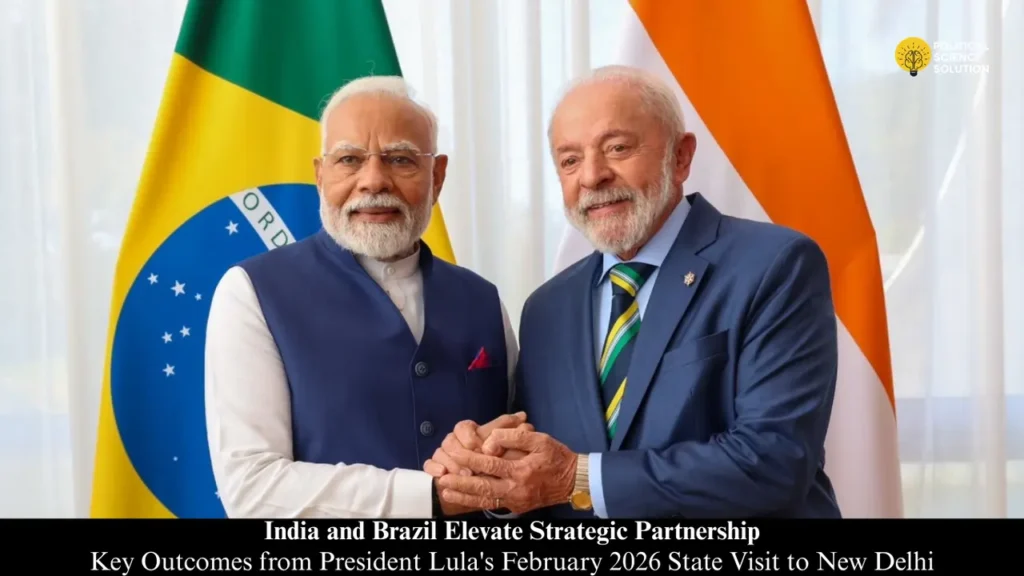
New Delhi: The State Visit of Brazilian President Luiz Inácio Lula da Silva to India from February 18 to 22, 2026, has emerged as a pivotal chapter in the evolving India-Brazil relations, reinforcing their Strategic Partnership established in 2006. Hosted by Prime Minister Narendra Modi, this engagement—Lula’s second State Visit to India—built on reciprocal high-level exchanges, including Modi’s visit to Brazil in July 2025. The visit blended ceremonial traditions, substantive bilateral dialogues, and participation in the 2nd AI Impact Summit, yielding concrete advancements in trade, technology, energy, defense, and global governance.
Historic Diplomatic Foundations and Recent Momentum
Diplomatic ties between India and Brazil trace back to 1948, evolving into a multifaceted collaboration through shared platforms like BRICS, IBSA, G-20, G-4, BASIC, UN, WTO, UNESCO, and WIPO. Brazil’s co-founding role in the Global Biofuel Alliance and its 2022 ratification of the International Solar Alliance underscore aligned priorities in renewable energy and climate action.
Bilateral trade demonstrated strong momentum, surging over 25% in 2025 to reach USD 15.21 billion. This growth, facilitated by the India-MERCOSUR Preferential Trade Agreement (in force since 2009), sets the stage for further expansion. During the visit, leaders ambitiously revised their bilateral trade target upward to USD 30 billion by 2030, directing officials to remove non-tariff barriers, tackle anti-dumping and countervailing duties, and promote sectors like telecommunications, cosmetics, and aviation.
Ceremonial Welcome and High-Level Engagements
President Lula received a grand traditional reception with a guard of honour at Rashtrapati Bhavan’s forecourt on February 21. He paid respects to Mahatma Gandhi at Rajghat and held meetings with President Droupadi Murmu, who hosted a State Banquet. External Affairs Minister Dr. S. Jaishankar called on the visiting leader. Prime Minister Modi hosted a lunch following in-depth talks at Hyderabad House, covering bilateral priorities, regional dynamics, and Global South concerns.
Lula’s delegation included eleven Cabinet Ministers from Foreign Affairs, Finance, Health, Environment, Agriculture, Education, Communications, Science & Technology, and Small and Medium Enterprises, plus prominent business leaders and civil society figures.
Advancing Digital Transformation and AI Collaboration
A centerpiece of the visit was Lula’s participation in the 2nd AI Impact Summit (February 19-20), themed “Shaping AI for Humanity, Inclusive Growth & Sustainable Future.” Discussions focused on democratizing AI innovation, equitable benefit sharing, and resource access for developing nations. Leaders endorsed multilateral frameworks, including UN resolutions, the Global Digital Compact, UNESCO’s AI Ethics Recommendation, and BRICS AI governance declarations.
The adoption of the Joint Declaration on Digital Partnership for the Future marked a landmark step, envisioning mutual trust-based progress in Digital Public Infrastructure (DPI), joint projects, and inclusive transformation. Both nations launched the Open Planetary Intelligence Network (OPIN) to integrate digital and climate agendas, supporting the Paris Agreement and 2030 Sustainable Development Goals. Emphasis was placed on AI in education, startup incubation, hackathons, and multilateral digital governance addressing AI risks and opportunities.
Strengthening Economic and Trade Ties
Leaders expressed optimism over the India-Brazil Business Leaders Forum and encouraged private sector aviation collaborations. The entry into force of the Cooperation and Facilitation Investment Agreement and amended Double Taxation Avoidance Convention was welcomed for fostering predictable investment flows.
Efforts to expand the India-MERCOSUR PTA aim to enhance market access in agriculture, agro-industry, and industrial goods through timely negotiations. The MoU on Mutual Recognition of Electronic Certificates of Origin modernizes trade facilitation for secure, efficient origin verification.
Health, Pharmaceuticals, and MSME Cooperation
Health sector synergies drove MoUs between Brazil’s ANVISA and India’s CDSCO for faster reciprocal approvals and affordable medicines. Focus areas include local production of vaccines, strategic inputs, and treatments for socially determined diseases like Hansen’s disease. Private partnerships, such as Fiocruz with Biocon Pharma and Lupin Limited, target R&D in essential medicines for rare, oncological, and socially determined conditions.
An MoU on Micro, Small and Medium Enterprises (MSME), entrepreneurship, and handicrafts promotes policy exchanges, expert training, and institutional support to enhance managerial and technical capabilities.
Defense, Security, and Strategic Sector Advancements
Defense cooperation gained traction following 2025’s Strategic Dialogue and Joint Defence Committee Meeting. Leaders advocated co-design, co-production, and industrial partnerships aligning India’s Atmanirbhar Bharat with Brazil’s defense ecosystem. A trilateral MoU involving Mazagon Dock Ltd supports Scorpene Class submarine maintenance.
Agreements extend to peaceful space uses (satellite design, launch vehicles, data sharing), maritime cooperation, and cybersecurity post the inaugural India-Brazil Cyber Dialogue in November 2025. Both condemned terrorism unequivocally, with Brazil denouncing attacks in Pahalgam (April 2025) and New Delhi (November 2025). They committed to disrupting terror financing via UN and FATF mechanisms, building on the 2025 agreement against international terrorism and transnational crime. Environmental crimes, including wildlife trafficking and illegal mining, were prioritized for joint action.
Energy Transition, Climate, and Critical Minerals Focus
Prime Minister Modi praised Brazil’s COP30 leadership in Belém (November 2025) and the Tropical Forests Forever Facility. Both endorsed the Belém 4x Pledge on sustainable fuels and initiatives under Global Biofuels Alliance, ISA, and CDRI (with Brazil eyeing Co-Chair role 2026-28).
A July 2025 renewable energy MoU covers solar, wind, biomass, hydro, hydrogen, and storage. New MoUs on rare earth elements, critical minerals, and steel supply chains aim to bolster exploration, mining, processing, recycling, and sustainable practices for clean energy technologies. Oil and gas investments emphasize deepwater exploration, emissions reduction, and carbon capture.
Multilateralism and Global South Advocacy
Leaders called for UNSC reform, including expansion and mutual support for permanent seats. India appreciated Brazil’s endorsement of its 2028-29 non-permanent bid. Emphasis was on revitalized multilateralism, peaceful dispute resolution, and greater Global South representation in global governance.
Agriculture, Science, and People-to-People Connections
Complementarities in agriculture—driven by opposite seasons—support expanded trade, joint R&D in animal genetics, nutrition, nano-fertilizers, and sustainable technologies under WTO principles. The MAITRI 2.0 program fosters agrifood innovation.
Science and technology ties include the upcoming Joint Commission meeting (August 2026) and Brazil’s access to India’s Traditional Knowledge Digital Library. People-to-people links advanced via 10-year reciprocal multiple-entry visas, migration cooperation, cultural/sports/yoga exchanges, tourism plan negotiations, and MoUs on education, archival cooperation, and media.
Comprehensive List of Signed Agreements
Ten instruments were formalized:
- Joint Declaration on Digital Partnership for the Future
- MoU on Rare Earths and Critical Minerals
- MoU on Mining for Steel Supply Chain
- MoU on Postal Services (best practices, digital transformation, e-commerce, financial inclusion, UPU coordination)
- MoU on MSME, Entrepreneurship, and Handicrafts
- ANVISA-CDSCO MoU
- MoU on Electronic Certificates of Origin
- TKDL Access Agreement (CSIR-INPI)
- Education MoU (Ministry of Education-IIIT Bangalore)
- University partnerships (Federal University of Minas Gerais-IIMC; SRFTI-ECA-USP)
Private pacts include Fiocruz collaborations and ApexBrasil-FICCI trade promotion.
Union Minister Piyush Goyal termed the visit a “defining moment,” highlighting democracy, diversity, and growth in defense, energy, agriculture, health, pharma, minerals, AI, and space. Commerce Minister Jyotiraditya Scindia signed the postal MoU, emphasizing inclusive service delivery.
This visit solidifies India and Brazil as indispensable partners in shaping a resilient, equitable multipolar world, with tangible benefits for their citizens and the broader Global South.
FAQs
1. When did President Lula visit India, and what was the main purpose?
President Lula paid a State Visit to India from February 18 to 22, 2026, at the invitation of Prime Minister Narendra Modi. It was his fifth visit to India and second State Visit. Key activities included participating in the 2nd AI Impact Summit (February 19-20) and holding bilateral talks with PM Modi on February 21 to advance the Strategic Partnership.
2. What new bilateral trade target was set during the visit?
Leaders revised the bilateral trade goal from the previous $20 billion to an ambitious $30 billion by 2030. This follows strong growth, with trade rising over 25% in 2025 to reach USD 15.21 billion. Both sides committed to eliminating non-tariff barriers, addressing duties, and expanding cooperation in areas like telecommunications, cosmetics, aviation, and the India-MERCOSUR Preferential Trade Agreement.
3. What major agreements were signed during the visit?
Ten key instruments were signed, including:
• Joint Declaration on Digital Partnership for the Future
• MoU on Rare Earths and Critical Minerals
• MoU on Mining for the Steel Supply Chain
• MoU on Postal Services
• MoU on Micro, Small and Medium Enterprises (MSME), Entrepreneurship, and Handicrafts
• ANVISA-CDSCO MoU for pharmaceutical regulations
• MoU on Electronic Certificates of Origin
• Access to India’s Traditional Knowledge Digital Library (TKDL)
• Education-related MoUs (e.g., digital transformation and university partnerships) These focus on digital infrastructure, critical minerals, health, MSMEs, and trade facilitation.
4. How did the visit address digital and AI cooperation?
President Lula joined the AI Impact Summit themed “Shaping AI for Humanity, Inclusive Growth & Sustainable Future.” Leaders adopted the Joint Declaration on Digital Partnership for the Future, emphasizing Digital Public Infrastructure (DPI), AI adoption in education, joint projects on model training and data protection, startup incubation, hackathons, and the launch of the Open Planetary Intelligence Network (OPIN) to link digital and climate transformations.
5. What progress was made in defense, energy, climate, and Global South issues?
Defense ties advanced with calls for co-production, a trilateral MoU on submarine maintenance, space cooperation, and cybersecurity. Energy and climate efforts included praise for Brazil’s COP30 role, support for sustainable fuels, renewable energy MoUs, and critical minerals collaboration. Both reaffirmed UNSC reform for permanent seats, mutual support in multilateral forums (BRICS, G-20, IBSA), and stronger Global South representation for equitable global governance. Visa validity for tourist/business entries was extended to 10 years reciprocally.