

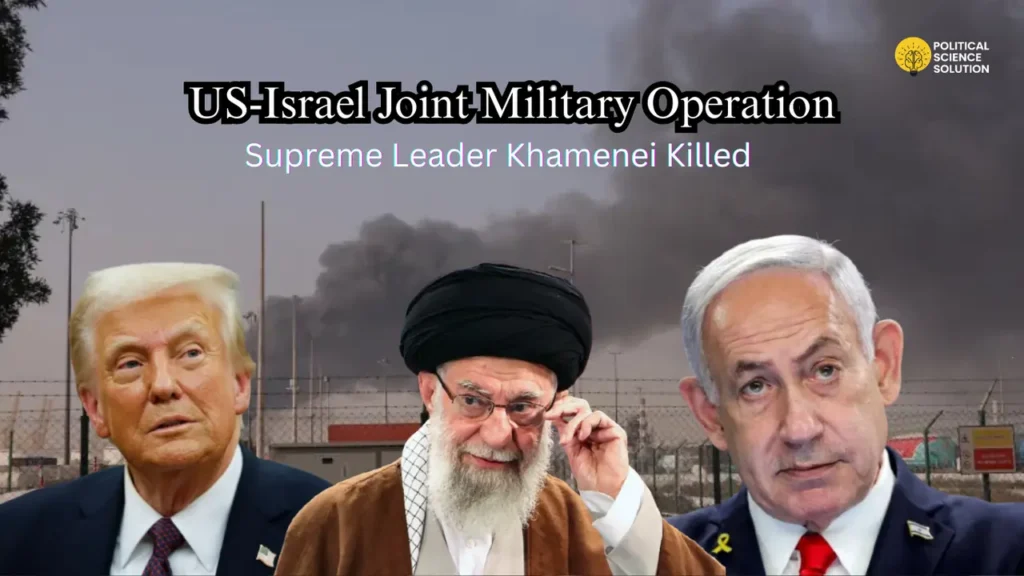
New Delhi: On February 28, 2026, the United States and Israel commenced a large-scale joint military campaign against the Islamic Republic of Iran, officially designated by the Pentagon as Operation Epic Fury. The operation began with precision airstrikes aimed at decapitating key elements of Iran’s political and military leadership while simultaneously degrading its missile production, air defense network, and naval capabilities.
The opening wave focused heavily on high-value targets in and around Tehran. Reports indicate that the compound associated with Supreme Leader Ayatollah Ali Khamenei sustained direct hits. Within hours, U.S. President Donald Trump publicly confirmed the death of the 86-year-old supreme leader, a statement later corroborated by Iranian state television and the Supreme National Security Council on the morning of March 1, 2026.
Alongside Khamenei, several family members—including a daughter, grandchild, daughter-in-law, and son-in-law—were reported killed in the same strike. Israeli and American officials described the action as the culmination of months of meticulous planning and intelligence sharing between Washington and Jerusalem.
Casualties Among Iran’s Elite and Widespread Destruction Across Provinces
Beyond the supreme leader, the initial assaults claimed the lives of numerous senior figures within Iran’s power structure. Intelligence sources cited in international reporting confirmed the deaths of approximately forty high-ranking officials. Among those named by the Israel Defense Forces were Defense Council Secretary Ali Shamkhani, Defense Minister Brigadier General Aziz Nasirzadeh, and Islamic Revolutionary Guard Corps (IRGC) Commander General Mohammad Pakpour.
The IRGC swiftly appointed Ahmad Vahidi as its new commander-in-chief to fill the immediate leadership gap. Strikes extended far beyond the capital, hitting Islamic Revolutionary Guard Corps bases, missile launch facilities, drone production sites, military airfields, and naval headquarters in twenty-four of Iran’s thirty-one provinces. Israeli aircraft alone reportedly delivered more than 1,200 munitions during the first twenty-four hours of the campaign. U.S. naval and air assets supported the effort, resulting in the confirmed sinking of nine Iranian naval vessels.
Inside Iran, residents described scenes of chaos. Loud explosions echoed through Tehran, Karaj, Isfahan, Qom, and Kermanshah. A near-total internet blackout severely restricted communication, while the country’s airspace was closed indefinitely. Civilians formed long lines at banks to withdraw cash and at fuel stations in anticipation of shortages. The Iranian Red Crescent Society released preliminary figures indicating 201 people killed and 747 injured nationwide. The single deadliest incident occurred in Minab, southeastern Iran, where a strike near an elementary school for girls killed at least 148 individuals and left 95 others wounded.
President Trump Outlines Objectives: Nuclear Threat Elimination and Call for Internal Uprising
In an eight-minute video address posted to Truth Social on February 28, President Trump framed the military action as a defensive necessity to prevent Iran from ever acquiring a nuclear weapon. He vowed that U.S. and allied forces would completely destroy Iran’s ballistic missile program and associated industrial infrastructure.
The president repeatedly referenced longstanding grievances, most prominently the 1979 seizure of the American embassy in Tehran and the 444-day hostage crisis that followed the Islamic Revolution. Trump urged ordinary Iranians to take shelter during the bombardment but also encouraged them to prepare to seize control of their government once the military phase concluded, describing the moment as potentially the “only chance for generations” to end clerical rule.
Israeli Prime Minister Benjamin Netanyahu delivered a parallel message, asserting that the strikes were pre-emptive in nature and intended to neutralize an existential threat. He called on all segments of Iranian society to rise against what he termed the “yoke of tyranny” and establish a free, peaceful state.
Iran Launches Widespread Retaliatory Missile and Drone Barrage
Tehran responded within hours. The IRGC announced the commencement of large-scale counterattacks using ballistic missiles and drones against Israeli territory and U.S. military facilities throughout the Middle East. Iranian officials claimed strikes had been directed at twenty-seven locations hosting American forces or allied assets.
Eight countries reported incoming projectiles: Israel, Bahrain, Iraq, Jordan, Kuwait, Oman, Qatar, Saudi Arabia, and the United Arab Emirates. Iranian Foreign Minister Abbas Araghchi denounced the original strikes as wholly unprovoked, illegal, and illegitimate, promising that Iran’s armed forces would deliver a decisive response.
Reported Losses and Damage from Iranian Counterstrikes
In Israel, nine civilians were killed and 121 injured. One ballistic missile completely destroyed a synagogue in Beit Shemesh, claiming eight lives, while additional strikes caused structural damage across forty buildings in Tel Aviv and scattered shrapnel injuries elsewhere.
U.S. Central Command confirmed three American service members killed in action and five others seriously wounded, although defensive systems intercepted the majority of incoming threats. Bahrain experienced a significant fire at the U.S. Navy’s Fifth Fleet headquarters in Juffair following a drone strike, with four people treated for shrapnel wounds. The United Arab Emirates recorded three fatalities and fifty-eight injuries from falling debris and fires in residential and airport areas of Abu Dhabi and Dubai.
Kuwait reported one death and thirty-two wounded after strikes near Ali al-Salem Air Base and Kuwait International Airport. Qatar documented sixteen injuries, mostly from shrapnel at Al Udeid Air Base. Oman noted five injuries linked to drone attacks on Duqm port and a nearby oil tanker. Jordan and Saudi Arabia reported successful interceptions with no confirmed fatalities, though localized property damage occurred.
Global Aviation Disruption and Energy Security Concerns
The conflict triggered one of the most severe disruptions to international air travel since the COVID-19 pandemic. Major carriers—including Emirates, British Airways, Lufthansa, Air India, Virgin Atlantic, and Turkish Airlines—canceled or suspended flights to and from Tel Aviv, Dubai, Abu Dhabi, Amman, Bahrain, and Tehran. Several nations partially or fully closed their airspace as a precaution.
Maritime security in the Strait of Hormuz came under immediate threat. Iranian forces reportedly warned commercial shipping that passage would be prohibited, and at least three oil tankers were struck and set ablaze. Given that roughly twenty percent of global oil and gas transits the narrow waterway and that ninety percent of Iran’s crude exports pass through Kharg Island, analysts warned of potential spikes in energy prices.
Leadership Transition Amid Ongoing Hostilities
With Khamenei’s death, Iran activated constitutional provisions to manage the supreme leadership vacancy. An interim three-member council was established, comprising President Masoud Pezeshkian, Supreme Court Chief Justice Gholam-Hossein Mohseni-Ejei, and Ayatollah Alireza Arafi representing the Guardian Council. The Assembly of Experts—an elected body of eighty-eight senior clerics—holds formal responsibility for selecting a permanent successor, although active combat across the country is expected to complicate and delay the process.
Historical Context and Diplomatic Breakdown
The current escalation follows a twelve-day air campaign between Israel and Iran in June 2025 and repeated warnings from both Washington and Jerusalem that further advancement of Iran’s nuclear and ballistic missile programs would trigger military action. Indirect negotiations held in February 2026 failed to produce any breakthrough, with Iran insisting that any limitation on its nuclear activities must be accompanied by full sanctions relief and refusing to include its missile program in the discussions.
Reports also surfaced that Saudi Crown Prince Mohammed bin Salman privately urged President Trump to act decisively against Iran, despite the kingdom’s public stance favoring dialogue and refusing to allow its territory or airspace to be used for offensive operations against Tehran.
As U.S. and Israeli forces continued strikes into March 2, 2026—including fresh attacks on central Tehran—the region braces for further escalation. The death of the supreme leader, combined with heavy casualties on multiple fronts and disruption of critical energy transit routes, has placed the Middle East at the edge of a broader and potentially prolonged conflict with unpredictable consequences for global stability and security.
FAQs
1. What triggered the US and Israel to launch strikes on Iran, and what is Operation Epic Fury?
The joint military campaign, codenamed Operation Epic Fury by the US (and referred to as Operation Roaring Lion by Israel), began on February 28, 2026. President Donald Trump authorized the strikes to eliminate what the US described as an imminent nuclear threat from Iran, destroy its ballistic missile arsenal and production facilities, degrade proxy terror networks, and cripple its naval forces. The operation followed failed indirect nuclear negotiations in February 2026, repeated warnings about Iran’s advancing nuclear and missile programs, and a prior 12-day air conflict in June 2025. Trump emphasized preventing Iran from ever obtaining a nuclear weapon while also calling for the Iranian people to overthrow their regime once the military phase ends.
2. Was Iran’s Supreme Leader Ayatollah Ali Khamenei really killed, and what are the immediate consequences?
Yes, Ayatollah Ali Khamenei, Iran’s supreme leader since 1989, was killed on February 28, 2026, in a precision strike on his compound in Tehran during the opening phase of the operation. His death—along with family members including a daughter, grandchild, daughter-in-law, and son-in-law—was confirmed by Iranian state media and the Supreme National Security Council on March 1, 2026. Iran declared 40 days of official mourning. The killing created a major leadership vacuum, triggering an interim three-member council (including President Masoud Pezeshkian, Supreme Court Chief Justice Gholam-Hossein Mohseni-Ejei, and Ayatollah Alireza Arafi) under constitutional rules. The Assembly of Experts is responsible for selecting a permanent successor, though ongoing attacks are complicating the process.
3. What were the main targets and reported casualties from the US-Israeli strikes inside Iran?
The campaign targeted Islamic Revolutionary Guard Corps (IRGC) command centers, air defense systems, missile and drone launch sites, military airfields, naval headquarters, and leadership locations across 24 of Iran’s 31 provinces. Over 1,200 munitions were reportedly used by Israeli forces alone, with US support including air and sea operations. Key losses included around 40 senior officials, such as Defense Council Secretary Ali Shamkhani, Defense Minister Brig. Gen. Aziz Nasirzadeh, and IRGC Commander Gen. Mohammad Pakpour. The IRGC named Ahmad Vahidi as its new commander-in-chief. Casualties inside Iran stood at approximately 201 killed and 747 injured per Red Crescent reports, with the deadliest single incident being a strike near an elementary girls’ school in Minab that killed at least 148 people.
4. How has Iran retaliated, and what damage has occurred in the region?
Iran launched waves of ballistic missiles and drones targeting Israel and US military bases or allied sites in at least eight countries: Israel, Bahrain, Iraq, Jordan, Kuwait, Oman, Qatar, Saudi Arabia, and the United Arab Emirates. The IRGC claimed attacks on 27 locations. In Israel, nine people were killed (including eight in a synagogue strike in Beit Shemesh) and 121 injured, with damage reported in Tel Aviv. US forces confirmed three service members killed and five seriously wounded despite intercepting most threats. Other impacts included a major fire at the US Navy’s Fifth Fleet headquarters in Bahrain (four injured), three deaths and 58 injuries in the UAE from debris and fires, one death and 32 wounded in Kuwait, 16 injuries in Qatar, and five in Oman. Jordan and Saudi Arabia reported successful interceptions with no fatalities but some property damage.
5. What broader impacts has the conflict caused so far, and what might happen next?
The escalation has severely disrupted regional aviation, with thousands of flights canceled or suspended by carriers like Emirates, British Airways, Lufthansa, and Air India due to airspace closures in multiple countries—the most significant travel disruption since the COVID-19 pandemic. Concerns over energy security have risen, as Iran threatened to block the Strait of Hormuz (through which about 20% of global oil and gas passes), and reports emerged of missile strikes on oil tankers. Inside Iran, panic led to bank runs, fuel queues, and a near-total internet blackout. As strikes continued into March 2 with fresh attacks on central Tehran, Trump indicated operations would persist “as long as necessary,” while world leaders expressed alarm over escalation risks. The situation remains highly fluid, with potential for wider involvement, leadership changes in Iran, and significant effects on global oil markets and regional stability.