

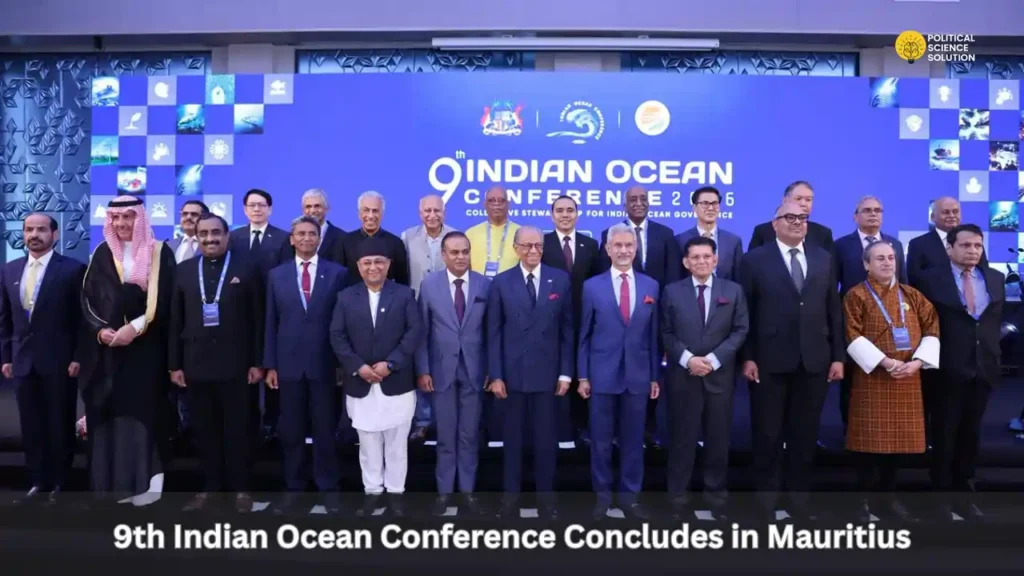
New Delhi: The 9th edition of the Indian Ocean Conference (IOC) successfully concluded in Mauritius, bringing together leaders and thinkers from across the region to deliberate on pressing maritime challenges and opportunities for collaborative growth. External Affairs Minister Dr S Jaishankar delivered a comprehensive address that highlighted India’s commitment to building trusted partnerships and ensuring a stable, prosperous Indian Ocean Region.
About the Indian Ocean Conference (IOC)
The Indian Ocean Conference was initiated in 2016 by India Foundation in partnership with regional think tanks and institutions. Over the years, it has evolved into a flagship consultative forum for countries in the Indian Ocean Region (IOR). The 9th edition witnessed participation from more than 40 countries and focused on regional cooperation under the framework of Security and Growth for All in the Region (SAGAR).
This annual platform continues to serve as a vital space for discussing achievements, prospects, and challenges facing the Indian Ocean, especially at a time when global turbulence has reached new heights.
EAM Dr S Jaishankar’s Five Key Points for Regional Deliberations
In his remarks on April 11, 2026, Dr S Jaishankar presented five important points for participants to reflect upon during the conference sessions.
First, he emphasised the fundamental importance of the Indian Ocean, describing it not just as a geographical space but as a complete ecosystem. It provides critical resources, enables essential connectivity, and shapes cultural identities developed over centuries. Any disruption in the ocean affects multiple aspects of daily life, making it necessary for nations to prepare for more challenging times ahead.
Second, Dr Jaishankar noted the progress made in overcoming colonial-era barriers through deeper regional cooperation, stronger economic linkages, rebuilt connectivity, and revival of traditional ties. He urged countries to draw inspiration from the spirit of the monsoons and stay focused on long-term goals despite increasing global fragmentation. The nations of the Indian Ocean must aim for greater cohesion, he stated.
Third, he acknowledged current global trends, observing that the world has become more competitive, fractured, and inward-looking. Benefits of globalisation are now often overshadowed by efforts to leverage or weaponise interdependencies. As a result, countries are prioritising resilience and seeking trusted partners.
Fourth, the minister highlighted growing anxieties around chokepoints. While physical chokepoints in sea lanes are well-known, he expanded the concept to include finance, technology, resources, and knowledge domains. Overcoming such control mindsets is essential for the well-being of the global economy.
Fifth, he called for deeper cooperation among Indian Ocean nations, referring to the region as a Global South Ocean. Collective resilience is the key to tackling shortages of food, fuel, and fertilisers, responding to natural disasters, and addressing conflict consequences. India has advanced this vision through its MAHASAGAR outlook and Neighbourhood First policy.
Global Uncertainties and the Situation in West Asia
Dr Jaishankar described the current global order as undergoing profound transition, shaped by shifting power balances, ongoing conflicts, economic fragmentation, and growing contestation. Nations are focusing more on security and resilience, creating a paradox where interdependence is deepening while competition intensifies.
He drew special attention to the conflict in West Asia, expressing deep concern and calling for an early return to normalcy. India firmly opposes the targeting of civilians, infrastructure, and commercial shipping. Safe and unimpeded navigation in the region is essential. The economic impacts have been widespread — rising energy prices affect entire societies, trade disruptions harm livelihoods, and fertiliser shortages threaten food security. These immediate challenges underline the need to address underlying issues to prevent future recurrences.
Pressing Challenges in the Indian Ocean Region
The minister stressed that pressures on the Indian Ocean are increasing, making the ocean’s vulnerability even more apparent. A full-blown conflict is now directly affecting all nations in the region, alongside grey-zone activities that blur lines between traditional and non-traditional threats.
Recent disruptions to shipping in the Red Sea have shown how quickly consequences spread. The spectrum of challenges — including piracy, terrorism, illegal, unreported and unregulated (IUU) fishing, drug trafficking, smuggling, and sea-lane interruptions — has become wider, more seamless, and more serious. Recent attacks on vessels such as the Iranian ship IRIS Dena highlight these risks.
No single country, however capable, can protect the maritime space alone. Dr Jaishankar called for shared commitment based on cooperation, transparency, and respect for international law. The Indian Ocean should be viewed as a global commons where both benefits and responsibilities are shared.
Institutional Mechanisms and Platforms for Cooperation
Strong institutional networks are vital for effective stewardship. The Information Fusion Centre-Indian Ocean Region (IFC-IOR) plays a key role in real-time maritime information sharing, enhancing domain awareness and operational coordination.
Other important platforms include the Indian Ocean Rim Association (IORA), Indo-Pacific Oceans Initiative (IPOI), BIMSTEC, Colombo Security Conclave, and Indian Ocean Naval Symposium (IONS). These forums facilitate dialogue, cooperation, and capacity building across the region.
India’s Role as First Responder and Net Security Provider
India has consistently acted as a First Responder in the Indian Ocean Region. It has provided rapid humanitarian assistance and disaster relief (HADR) in countries including Sri Lanka, Madagascar, and Mozambique, and responded to oil spills off Mauritius and Sri Lanka.
A recent example is Operation Sagarbandhu in Sri Lanka following Cyclone Ditwah, which included extensive HADR operations and a USD 450 million package for relief and reconstruction. India also serves as a net security provider through anti-piracy and anti-narcotics operations.
Development Partnerships Across the Indian Ocean
India’s engagement focuses on the priorities of partner countries and aims for sustainable outcomes. In Mauritius, projects include the Metro Express, water supply schemes, police academy, forensic laboratory, and archives. Dr Jaishankar recently joined Prime Minister Dr Navinchandra Ramgoolam to dedicate a Renal Transplant Unit and hand over 90 e-buses. A new Special Economic Package covers eight major initiatives in health, transport, and infrastructure.
In Seychelles, a Special Economic Package is being implemented in coordination with Foreign Minister Barry Faure. Sri Lanka benefits from projects in housing, health, education, cultural centres, connectivity, and livelihood enhancement. The Maldives is progressing on the Greater Male Connectivity Project, roads, water sanitation, and airport development.
In Madagascar, Indian support includes substantial rice supplies along with assistance in agriculture and energy. Partnerships also extend to Nepal, Bangladesh, Bhutan, Tanzania, and Mozambique, covering diverse aspects of economy and society.
Capacity Building, Defence Cooperation and Connectivity Initiatives
Many regional countries face challenges in monitoring their large Exclusive Economic Zones (EEZs). India provides training programmes and equipment support to partner navies and coast guards. The recently operationalised Maritime Rescue and Coordination Centre in Sri Lanka is a notable example.
Defence partnerships are rooted in cooperation, not confrontation. Joint exercises such as AIKEYME, Dosti, and MILAN build interoperability and trust for collective security.
Connectivity remains the unifying thread. India is central to initiatives like the India-Middle East-Europe Economic Corridor (IMEC), International North-South Transport Corridor (INSTC), and India-Middle East Transport Corridor (IMTT). All projects emphasise transparency, consultation, sovereignty, and genuine partnership.
As current Chair of IORA, India is committed to advancing sustainable development, capacity building, and regional integration. The minister also highlighted relevant Quad initiatives with Australia, Japan, and the United States, including the Partnership for Maritime Domain Awareness, Indo-Pacific Logistics Network, and Partnership for Cable Connectivity and Resilience.
Strategic Significance of the Indian Ocean Region
The Indian Ocean Region spans over 70 million square kilometres, connects more than 35 littoral states, and is home to around 40% of the global population. It handles approximately 50% of global container traffic, one-third of bulk cargo, and two-thirds of oil shipments.
Critical sea lanes and chokepoints like the Strait of Hormuz make it geopolitically vital. For India, with its 11,098.81 km coastline and over 1,300 islands, the region is central to national security. The Blue Economy offers huge potential through large EEZs — India’s EEZ alone is 2.4 million square kilometres — supporting sustainable fisheries, renewable energy, eco-tourism, and biodiversity conservation. The ocean is also the warmest and most biologically productive water body.
Major Challenges Facing the IOR
Key challenges include growing geopolitical competition from extra-regional powers through port and infrastructure investments in countries like Sri Lanka and the Maldives. Maritime security threats such as piracy, terrorism, IUU fishing, drug trafficking, and smuggling persist. Infrastructure and financial limitations in several IOR nations, including Mauritius, Seychelles, Sri Lanka, and the Maldives, add to the complexity.
Way Forward: Collective Stewardship for a Prosperous Indian Ocean
The 9th Indian Ocean Conference reinforced that collective stewardship is essential in this era of uncertainty. By moving beyond narrow calculations and embracing shared responsibility, nations can ensure a free, stable, and prosperous Indian Ocean Region. India remains fully committed to this vision.
The outcomes from Mauritius send a strong message that deeper cooperation, trusted partnerships, and respect for international law will shape the future of the Indian Ocean.
FAQs
1. What is the Indian Ocean Conference (IOC) and why is it important?
The Indian Ocean Conference is an annual flagship forum started in 2016 by India Foundation along with regional partners. It brings together over 40 countries to discuss security, economic cooperation, and sustainable development in the Indian Ocean Region under the SAGAR vision. It has become the most important platform for addressing regional challenges and promoting collective growth.
2. What were the main highlights of EAM Dr S Jaishankar’s speech at the 9th IOC?
Dr Jaishankar outlined five key points focusing on the importance of the ocean, overcoming colonial barriers, global trends, chokepoint anxieties, and the need for deeper cooperation. He also spoke about the West Asia conflict, India’s role as First Responder, development projects in Mauritius, Sri Lanka, Maldives, Seychelles, and the importance of connectivity and institutional mechanisms like IFC-IOR and IORA.
3. How is India contributing to the Indian Ocean Region?
India acts as a net security provider and First Responder through HADR operations (such as Operation Sagarbandhu), anti-piracy missions, and major development projects. It supports infrastructure in Mauritius (e-buses, Renal Transplant Unit), Sri Lanka, Maldives, Seychelles, and provides capacity building, training, and connectivity initiatives like IMEC and INSTC.
4. What are the biggest challenges facing the Indian Ocean Region?
Major challenges include geopolitical competition from extra-regional powers, maritime threats like piracy, terrorism, IUU fishing, drug trafficking, disruptions in chokepoints and sea lanes (e.g., Red Sea crisis and attacks on vessels like IRIS Dena), infrastructure gaps, and the impacts of conflicts in West Asia on energy, trade, and food security.
5. What is the future vision for the Indian Ocean Region according to the conference?
The conference emphasised collective stewardship, treating the Indian Ocean as a global commons with shared benefits and responsibilities. The focus is on building trusted partnerships, enhancing resilience, respecting international law, and advancing sustainable development through platforms like IORA, Quad, and other regional mechanisms for a free, stable, and prosperous Indian Ocean.