

New Delhi: A catastrophic explosion at a fireworks manufacturing unit in Tamil Nadu’s Virudhunagar district has left at least 25 people dead and several others injured, in one of the deadliest industrial accidents in recent times. The tragedy, which unfolded at the Vanaja Fireworks Industry in Kattanarpatti, has once again drawn national attention to persistent safety violations and regulatory gaps in India’s hazardous industries.
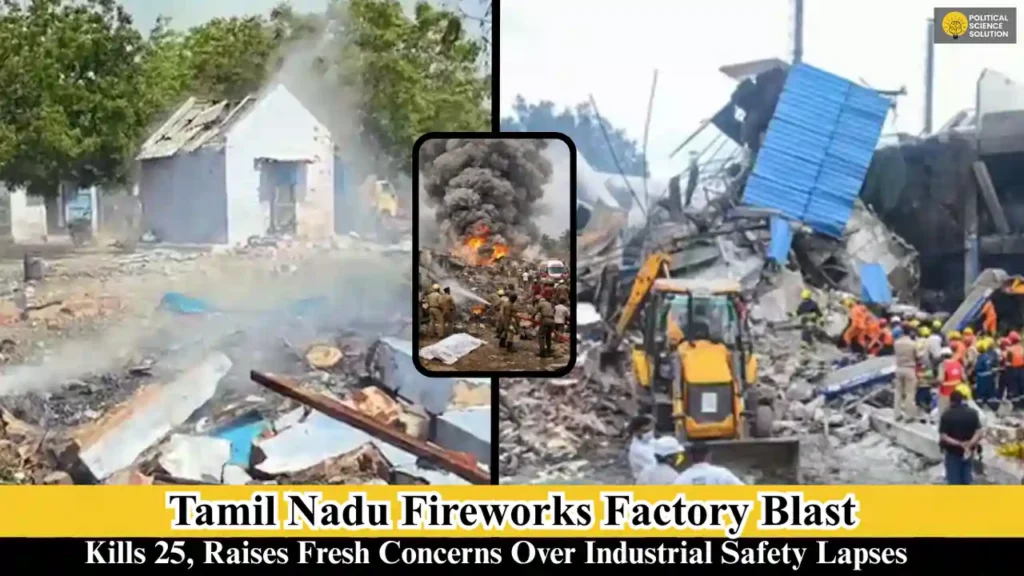
Explosion at Closed Facility Claims Lives
The blast occurred on Sunday evening at a time when the factory was officially supposed to remain closed. Despite this, approximately 50 workers were present within the premises when the explosion took place, according to district authorities.
Eyewitness accounts indicate that around 25 workers were stationed in a veranda area near the front of the factory when a fire suddenly broke out. Within moments, the blaze intensified, triggering a powerful explosion that damaged at least three rooms and reduced sections of the structure to rubble.
The presence of highly combustible materials inside the unit accelerated the spread of the fire, leaving workers with little time to escape.
Rescue Efforts Hampered by Continuous Blasts
Emergency response teams rushed to the site soon after the explosion. However, rescue operations were significantly slowed due to repeated bursts of firecrackers stored within the factory. These intermittent explosions created a highly volatile environment, forcing responders to proceed with extreme caution.
Compounding the crisis, a second explosion occurred around 7:20 p.m. during ongoing rescue operations. The incident injured at least 13 people, including a woman police constable, Kavitha, who suffered a fracture in her left hand. Fortunately, none of those injured in the second blast sustained severe burns.
Death Toll Rises, Victims Identified
The death toll climbed to 25 after two critically injured workers succumbed to severe burn injuries on Monday. The victims, identified as R. Petchiammal (51) and V. Panchavarnam (56), had sustained over 80% burns and were undergoing treatment at the Virudhunagar Government Medical College Hospital.
Officials confirmed that 22 of the deceased have been identified so far, with most of them being women. The intensity of the fire left several bodies charred beyond recognition, complicating identification efforts.
At least six individuals, including a 12-year-old boy, remain hospitalized and are receiving treatment for injuries sustained in the explosion.
Investigation Launched, Factory Officials Missing
Authorities have launched a comprehensive investigation into the cause of the explosion, which remains unknown at this stage. Preliminary findings, however, point to serious safety violations.
A formal complaint has been filed against the factory owner and the foreman, both of whom are currently absconding. Police have constituted four special teams to trace and apprehend them.
District Collector N.O. Sukhaputra stated that the factory’s operation on a Sunday constituted a “first violation,” as it was not permitted to function on that day. While the unit reportedly held a valid license, officials are now examining whether additional safety norms and regulatory conditions were breached.
Political Leaders Express Grief
The tragedy has elicited strong reactions from political leaders at both the state and national levels.
Prime Minister Narendra Modi described the incident as “deeply distressing” and extended his condolences to the families of the victims. Tamil Nadu Chief Minister M.K. Stalin also expressed “immense sorrow” over the loss of lives and assured that the state government would provide all necessary assistance to those affected.
Authorities have initiated relief measures, including medical support for the injured and compensation for the families of the deceased.
Fireworks Industry Faces Renewed Scrutiny
Accidents in India’s fireworks industry are not uncommon, particularly in regions like Virudhunagar, which is a hub for firecracker production. The sector plays a significant role in supplying materials for festivals, weddings, and other celebrations, but it has long faced criticism for inadequate safety standards.
The latest incident has intensified scrutiny of the industry, with questions being raised about enforcement of regulations and working conditions inside such units.
Broader Pattern of Industrial Accidents
The Virudhunagar explosion is part of a broader pattern of industrial accidents in India, where rapid industrialization has often outpaced safety enforcement.
Past disasters—including the 1984 Bhopal Gas Tragedy, the 1985 Oleum gas leak in Delhi, the 2017 NTPC Unchahar boiler explosion, and the 2020 Vizag gas leak—highlight recurring issues related to regulatory lapses, technical failures, and inadequate risk management.
Underlying Causes of Industrial Disasters
Experts attribute such incidents to a combination of systemic and operational factors:
- Regulatory Gaps: While India has a robust legal framework, enforcement remains inconsistent, and safety norms are sometimes relaxed to facilitate business operations.
- Operational Failures: Human error, poor maintenance, and violation of safety protocols are common contributing factors.
- Handling of Hazardous Materials: Industries dealing with flammable or toxic substances operate under inherently risky conditions, requiring strict adherence to safety measures.
- Economic Pressures: Cost-cutting and underinvestment in modern safety systems often compromise worker safety.
- Environmental Risks: Natural events can also exacerbate industrial hazards, though not directly linked to this incident.
Existing Safety Framework and Its Limitations
India has established multiple legal and institutional mechanisms to address industrial safety, including the Environment (Protection) Act of 1986, the Public Liability Insurance Act of 1991, and the Disaster Management Act of 2005.
Institutions such as the National Disaster Management Authority (NDMA) and specialized response units like the National Disaster Response Force (NDRF) are tasked with managing emergencies. Additionally, technological interventions such as Process Safety Management systems and community-based preparedness initiatives are designed to mitigate risks.
However, the recurrence of such accidents suggests that the primary challenge lies not in the absence of laws, but in their effective implementation.
Human Cost and Need for Reform
Beyond the statistics, the explosion has left a deep human impact. Many of the victims were women, highlighting the vulnerability of workers employed in hazardous industries. The presence of a child among the injured further raises concerns about labor practices and oversight.
Families of the deceased now face uncertain futures, having lost primary earners in a single tragic event.
Overall
The Tamil Nadu fireworks factory explosion underscores the urgent need for stronger enforcement of safety regulations, improved working conditions, and greater accountability within India’s industrial sector. As investigations continue and authorities seek those responsible, the tragedy serves as a stark reminder that lapses in safety can have devastating consequences.
Unless systemic issues are addressed and preventive measures are rigorously implemented, such incidents risk becoming a recurring feature of India’s industrial landscape rather than isolated tragedies.
FAQs
1. What caused the explosion at the Tamil Nadu fireworks factory?
The exact cause of the explosion at the Vanaja Fireworks Industry in Virudhunagar is still under investigation. However, preliminary reports suggest possible safety violations and operational lapses, including the factory functioning on a day it was supposed to remain closed.
2. How many people were affected in the incident?
At least 25 people lost their lives in the explosion, while several others were injured. Around 50 workers were present inside the factory at the time of the blast, and multiple victims suffered severe burn injuries.
3. Was there any violation of safety rules?
Yes, authorities have already identified that the factory was operating on a Sunday, which was not permitted. Further investigations are underway to determine additional violations related to safety protocols and licensing conditions.
4. What actions have been taken against those responsible?
A complaint has been filed against the factory owner and the foreman, both of whom are currently absconding. Police have formed special teams to locate and arrest them as part of the ongoing investigation.
5. Why are accidents common in India’s fireworks industry?
Such accidents often occur due to a combination of factors, including weak enforcement of safety regulations, handling of hazardous materials, poor maintenance, and cost-cutting measures. The fireworks industry, in particular, involves highly combustible substances, making strict safety compliance essential.