

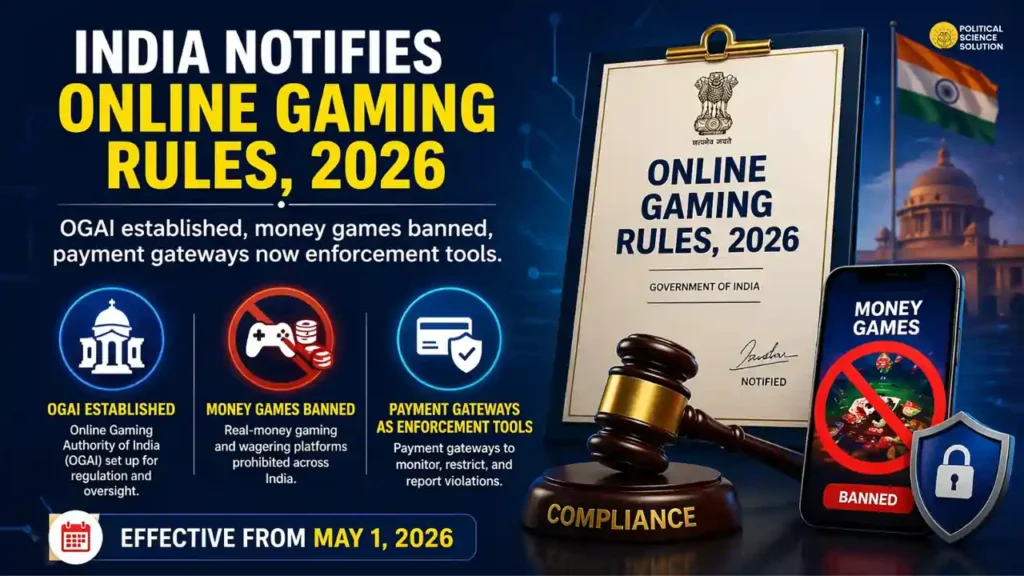
New Delhi: In a landmark move that reshapes the digital entertainment landscape, the Government of India has officially notified the Promotion and Regulation of Online Gaming Rules, 2026, operationalizing the parent Act passed last year. The rules, finalized by the Ministry of Electronics and Information Technology (MeitY) after extensive inter-ministerial consultations, are scheduled to come into force on May 1, 2026. This development brings a definitive stop to the unregulated expansion of the real-money gaming sector while establishing a unified national framework to address addiction, fraud, and regulatory arbitrage across states.
The End of Regulatory Arbitrage: A Unified National Framework
India’s online gaming market has expanded rapidly in recent years, boasting hundreds of millions of users and increasing monetisation, particularly through real-money formats. However, concerns over addiction, fraud, and the patchwork of differing state-level regulations prompted the Centre to intervene. The newly notified rules pave the way for the sector’s digital-first regulator and set out a framework that, notably, will not require mandatory registration or prior classification for most online social games.
This decision directly impacts highly valued start-ups that were previously operating in the burgeoning real-money gaming sector, including Dream11, PokerBaazi, Winzo, and Mobile Premier League. The rules establish clear definitions and compliance perimeters that distinguish between games involving monetary stakes and those that do not.
The Online Gaming Authority of India (OGAI): Powers and Composition
The cornerstone of the new regulatory architecture is the establishment of the Online Gaming Authority of India (OGAI), housed under MeitY. This authority is vested with wide-ranging powers, including the critical function of determining whether a game qualifies under one of three distinct categories:
- Online Money Game: Defined as any game played after depositing user fees or based on monetary stakes.
- Online Social Game: Games that do not involve staking money.
- Esports: Competitive, organized games involving skills such as physical dexterity and strategic thinking.
Beyond classification, OGAI possesses the authority to issue directions, hear complaints, and impose penalties for non-compliance. The composition of the authority is entirely government-led, featuring representatives from multiple key ministries, including the Ministry of Home Affairs, the Ministry of Finance, the Ministry of Information & Broadcasting, the Ministry of Sports, and the Ministry of Law. This multi-ministerial representation underscores the cross-cutting nature of online gaming regulation, touching on finance, public order, youth affairs, and legal frameworks.
The ‘Determination and Registration’ System: Not Universally Mandatory
A key feature of the Promotion and Regulation of Online Gaming Rules, 2026, is the introduction of a “determination and registration” system that is explicitly not universally mandatory. According to the notified rules, games are required to seek formal determination only in specific cases:
- When directed by the regulator (OGAI).
- When the game is offered as esports.
- When the government notifies certain categories based on factors like transaction value or scale.
Similarly, registration becomes compulsory only under notified conditions or specifically for esports offerings. The rules further clarify that determination decisions are game- and provider-specific, and they remain valid unless the game’s payment structure changes. This nuanced approach allows for lighter-touch regulation of low-risk social games while imposing stricter scrutiny on real-money games and esports.
Financial Institutions as Enforcement Tools: A Compliance Revolution
Perhaps the most significant expansion of the compliance perimeter involves bringing financial institutions directly into the regulatory net. For the first time, banks, payment gateways, and other intermediaries are now legally required to verify a game’s regulatory status before facilitating any transactions.
In the case of online money games, which are banned, these financial intermediaries are required to act on OGAI directions — including suspending or restricting payments. This provision effectively transforms the payments layer into a key enforcement tool, making it nearly impossible for unregulated or banned real-money gaming platforms to operate. Payment gateways that fail to comply could face penalties, turning them into gatekeepers of the new regulatory regime.
Two-Tier Grievance Redressal System for Users
On the user-facing side, the framework mandates a robust two-tier grievance redressal system. Gaming platforms are first required to provide an internal grievance mechanism where users can lodge complaints. If the user is not satisfied with the platform’s response, they can escalate the complaint directly to OGAI. Furthermore, decisions made by OGAI can be appealed to an Appellate Authority within the government, ensuring a clear hierarchy of dispute resolution.
Data Localisation Obligations for Gaming Platforms
The rules introduce stringent data localisation obligations. Gaming platforms offering online social games or esports are required to store traffic and related data within Indian borders. This means user data, gameplay logs, transaction metadata, and other related information cannot be transferred to servers outside India without violating the rules. This provision aligns India’s online gaming framework with broader national data sovereignty efforts.
Future-Ready Regulation: OGAI Empowered to Evolve the Rules
Recognizing the dynamic nature of technology and gaming, the government has empowered OGAI to issue future directions on several critical areas. These include:
- Advertising standards for gaming platforms.
- User safety protocols beyond the minimum requirements.
- Operational compliance measures as the industry evolves.
This flexibility leaves significant room for regulatory evolution, allowing the authority to respond to emerging threats such as deepfake avatars, new forms of in-game monetisation, or novel addiction mechanisms without requiring fresh legislation.
Mandatory User Safety Features: Age-Gating, Time Restrictions, and Counseling
The Promotion and Regulation of Online Gaming Rules, 2026, also introduce the concept of user safety features — defined as technical, procedural, operational, behavioral, or system-related safeguards appropriate to the risk profile of the game. Service providers are required to disclose these features at the time of application for determination or registration. The mandated safety features include:
- Age verification and age-gating mechanisms to prevent minors from accessing age-inappropriate games.
- Time restrictions to limit continuous gameplay sessions.
- Parental controls allowing guardians to monitor or restrict gaming activity.
- User reporting tools for reporting abusive behavior, cheating, or suspicious activity.
- Counseling support resources for users showing signs of problematic gaming behavior.
- Fair-play and integrity monitoring systems to detect cheating, collusion, or manipulation.
These features must be proportionate to the risk profile of each game, with more stringent requirements for money games and esports than for casual social games.
What This Means for Gaming Platforms and Startups
For existing gaming platforms, the path forward involves immediate compliance actions before the May 1, 2026, enforcement date. Platforms offering real-money gaming — now classified as “online money games” and banned — must cease operations or restructure their business models entirely. Platforms offering esports must seek formal determination and registration, while online social game providers can continue without mandatory registration unless directed otherwise by OGAI or notified by the government based on transaction value or scale.
All platforms, regardless of classification, must implement the two-tier grievance redressal system, comply with data localisation obligations, and publicly disclose their user safety features. Financial partnerships with payment gateways and banks must be renegotiated to ensure verification of regulatory status before any transaction processing.
Enforcement Timeline and Next Steps
With the rules published on April 23, 2026, and enforcement scheduled for May 1, 2026, the industry has just over one week to align with the new framework. OGAI is expected to issue initial operational guidelines immediately after the rules come into force, including clarification on determination procedures for esports and the notification of categories based on transaction value or scale.
The government’s message is clear: the era of regulatory ambiguity in India’s online gaming sector has ended. The Promotion and Regulation of Online Gaming Rules, 2026, establish OGAI as a powerful, government-led regulator, bring financial institutions into the compliance net, mandate data localisation, and introduce comprehensive user safety features — all while preserving a lighter-touch approach for most online social games.
For the hundreds of millions of Indian users, the new rules promise safer gameplay, clear grievance redressal, and protection from addiction and fraud. For the industry, the rules represent a fundamental reset — one that will separate compliant operators from those unwilling or unable to meet the new national standards.
FAQs
1. Do all online games in India need mandatory registration under the new 2026 rules?
No, not all games require mandatory registration. This is one of the most important distinctions in the new framework. According to the Promotion and Regulation of Online Gaming Rules, 2026, a “determination and registration” system has been introduced, but it is not universally mandatory. Games only need to seek formal determination from the Online Gaming Authority of India (OGAI) in specific cases: when the regulator directs it, when the game is offered as esports, or when the government notifies certain categories based on factors like transaction value or scale. Similarly, registration becomes compulsory only under notified conditions or specifically for esports offerings. For most online social games that do not involve staking money, prior registration is not required.
2. What is the Online Gaming Authority of India (OGAI) and who runs it?
The Online Gaming Authority of India (OGAI) is the newly established sectoral regulator for online gaming, housed under the Ministry of Electronics and Information Technology (MeitY). OGAI has wide-ranging powers, including determining whether a game qualifies as an Online Money Game (played after depositing user fees), an Online Social Game (no money staked), or esports (competitive games involving physical dexterity and strategic thinking). The authority can issue directions, hear complaints, and impose penalties. Its composition is entirely government-led, with representatives from multiple key ministries: Home Affairs, Finance, Information & Broadcasting, Sports, and Law.
3. How do the new rules involve banks and payment gateways in regulating online gaming?
The 2026 rules significantly expand the compliance perimeter by bringing financial institutions directly into the regulatory net. Banks, payment gateways, and other intermediaries are now legally required to verify a game’s regulatory status before facilitating any transactions. In the case of online money games, which are banned, these financial intermediaries must act on directions from OGAI — including suspending or restricting payments. This provision effectively makes the payments layer a key enforcement tool, ensuring that banned real-money gaming platforms cannot process deposits or withdrawals through regulated financial channels.
4. What user safety features must gaming platforms provide under the new rules?
The rules introduce mandatory user safety features — defined as technical, procedural, operational, behavioral, or system-related safeguards appropriate to the risk profile of the game. Service providers must disclose these features at the time of application for determination or registration. Required features include: age verification and age-gating to prevent minor access, time restrictions to limit continuous gameplay, parental controls for guardians, user reporting tools to report abuse or cheating, counseling support resources for problematic gaming behavior, and fair-play and integrity monitoring systems to detect manipulation or collusion.
5. Is there a grievance redressal system for users if they face issues on a gaming platform?
Yes, the framework mandates a two-tier grievance redressal system. First, gaming platforms must provide their own internal grievance mechanism where users can file complaints. If the user is not satisfied with the platform’s response, they can escalate the complaint directly to OGAI. Furthermore, any decision made by OGAI can be appealed to an Appellate Authority within the government. This creates a clear, hierarchical dispute resolution pathway for users. Additionally, platforms offering online social games or esports must comply with data localisation obligations, storing traffic and related data within India, which also aids in effective grievance handling and legal oversight.