

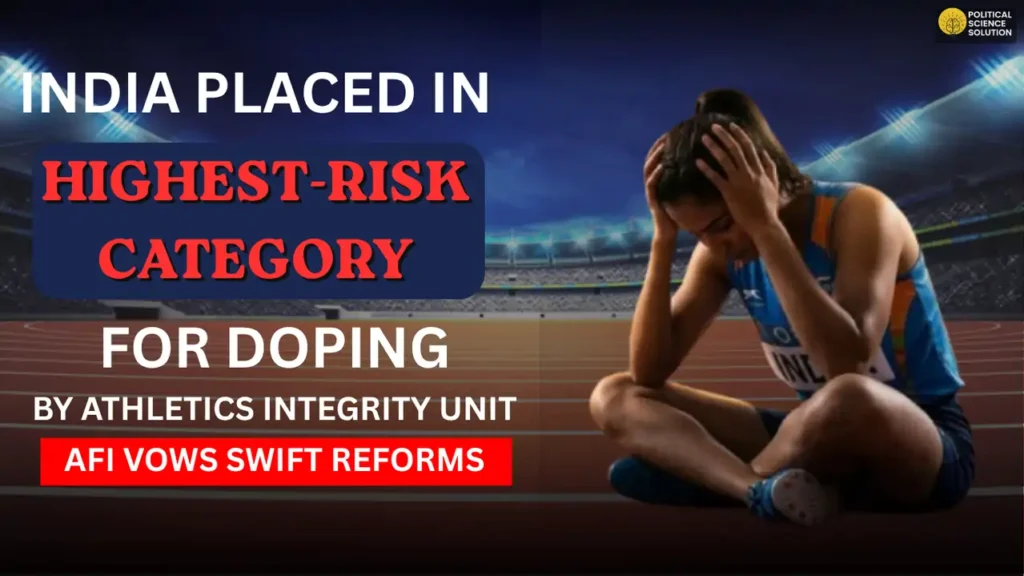
New Delhi: In a significant blow to the country’s sporting reputation, the Athletics Integrity Unit (AIU) has officially downgraded the Athletics Federation of India (AFI) from ‘Category B’ to ‘Category A’ — the highest-risk category for doping. The decision, made public on April 21, 2026, places India alongside nations with the most severe doping threats in world athletics, triggering stringent new anti-doping requirements for Indian athletes.
The AIU, which operates fully independent of World Athletics, is the Monaco-based international governing body responsible for integrity in track and field athletics, race walking, road running, cross country, mountain running, trail running, and ultra-running. The re-categorization of AFI has raised serious concerns over what the AIU describes as an “extremely high” risk of doping among athletes in the country.
Understanding the New Category ‘A’ Status
Under the World Athletics Anti-Doping Rules, the AIU Board classifies all Member Federations into three categories based on doping risk. Category ‘A’ represents the highest risk, Category ‘B’ denotes a medium doping risk, and Category ‘C’ signifies a low doping risk. By placing the AFI in Category ‘A’, athletes from India must now comply with considerably more stringent anti-doping requirements.
The AFI is the apex body for running and managing athletics in India. Its responsibilities include organizing the National Championships, training the Indian Athletics National Campers, and selecting the Indian Athletics Teams for various international competitions. With the new designation, the federation faces intense scrutiny and mandatory operational changes.
India’s Alarming Doping Statistics
The downgrade follows a multi-year trend of rising anti-doping rule violations (ADRVs) in Indian athletics. According to AIU data, India recorded 48 ADRVs in 2022, ranking second globally. In 2023, the number rose to 63, again ranking second. By 2024, India recorded 71 ADRVs, climbing to the number one rank worldwide. Even in the early months of 2025, the country recorded 30 ADRVs.
India’s positivity ratio — the percentage of samples testing positive — stood at 3.6 percent, which ranks among the highest in the world. Additionally, India has recently surpassed Kenya to top the AIU’s list of ineligible persons due to doping violations, with 148 athletes currently suspended.
What Is Doping? Understanding the Issue
Doping is defined as the act of consuming artificial and often illegal substances to gain an unfair advantage over others in sporting competitions. Common examples include anabolic steroids, human growth hormones, stimulants, and diuretics. The practice undermines the spirit of fairness, integrity, and the “level playing field” that sport is meant to represent.
The key driving factors behind doping in India include intense performance pressure, substantial financial incentives, and weak testing and monitoring systems. The “medal-at-all-costs” mentality has become deeply entrenched, pushing athletes toward performance-enhancing drugs (PEDs) despite serious consequences.
Health and Ethical Concerns
The use of PEDs carries both long- and short-term impacts on an athlete’s physical and mental health. Beyond individual health risks, doping widens inequalities within sport, as access to sophisticated drugs and masking techniques is uneven — favoring those with greater financial resources or connections. Other consequences include damage to reputation, financial loss for athletes and sponsors, and erosion of public trust in competitive sports.
Official Reaction from the Athletics Federation of India
Left red-faced by the designation, the AFI broke its silence on April 21, 2026, vowing to work closely with the National Anti-Doping Agency (NADA) and the Ministry of Youth Affairs and Sports to quickly come out of the category of worst doping offenders. In an official statement, the AFI acknowledged the AIU’s decision and expressed confidence that India will overcome the challenge.
The federation stated, “With continued collaboration with the AIU, NADA and the ministry of youth affairs and sports, AFI is confident that India will overcome the challenge and soon be removed from Category A.” The AFI has consistently maintained that doping undermines the growth of athletics in India. The federation noted that it has actively collaborated with anti-doping bodies, both domestic and international, to strengthen education, enhance testing, and support intelligence-led investigations.
Significantly, the AFI said it has strongly advocated for the criminalisation of those responsible for doping, particularly at the grassroots level, to deter coaches and parents from exploiting young athletes. The AIU has reportedly recognized AFI’s push for meaningful anti-doping reforms in India, and the federation remains committed to working closely with the AIU and NADA to combat doping at every level.
AIU Chair’s Critical Remarks
While upgrading India from Category B to Category A, AIU Chair David Howman stated that the doping situation in India “has been high-risk for a long time.” He added that, unfortunately, the “quality of the domestic anti-doping programme is simply not proportionate to the doping risk.”
Howman further noted, “While the AFI has advocated for anti-doping reforms within India, not enough has changed. The AIU will now work with the AFI to achieve reforms to safeguard the integrity of the sport of athletics, as we have done with other ‘Category A’ Member Federations.”
New Obligations Under Rule 15 for Category ‘A’ Nations
The re-categorization under Rule 15 of World Athletics’ Anti-Doping Rules brings a host of mandatory obligations for the AFI. According to the AIU, a Category ‘A’ Member Federation must ensure there is an effective, intelligent, and proportionate annual testing programme maintained and implemented within its jurisdiction. This programme must comply fully with the International Standard for Testing and Investigations.
Crucially, the testing programme must ensure that athletes of the national team in any World Athletics Series Event, Olympic Games, or World Athletics Ultimate Championship — and who are not already on the International Registered Testing Pool — have been adequately tested.
The required testing programme must include:
- In-competition testing
- No-notice out-of-competition testing
- Pre-competition blood testing for screening purposes and analyses as prescribed by the World Anti-Doping Agency (WADA)
If athletes do not reside or train from time to time in the country, it remains the responsibility of the Category ‘A’ Member Federation to ensure that the athletes are subject to testing abroad. Additionally, the federation must monitor the performance of elite athletes under its jurisdiction and keep the pool updated throughout the duration of the testing programme.
Stricter Participation Rules for Major Events
One of the most immediate and impactful consequences of the Category ‘A’ designation involves athlete eligibility for global championships. Under the new rules, no athlete may participate in the World Championships or Olympic Games unless, in the 10 months prior to the deadline set by the Integrity Unit for the relevant event, they have undergone at least three no-notice out-of-competition tests.
This requirement places Indian athletes under unprecedented scrutiny and logistical pressure, as compliance must be demonstrated well in advance of any major international competition.
India’s Domestic Anti-Doping Framework
In response to the growing crisis, India has several institutional mechanisms in place. The National Anti-Doping Agency (NADA) was set up as a registered society under the Societies Registration Act of 1860 in 2005 under the Ministry of Youth Affairs and Sports. The National Anti-Doping Act, 2022, provides a statutory framework for doping-free sports in India.
The NIDAMS Portal has been introduced to digitalise the planning and management of anti-doping activities, including dope testing, education, and awareness. On the international front, the World Anti-Doping Agency (WADA) — an independent international organization established in 1999 — publishes the World Anti-Doping Code and the annual Prohibited List. Furthermore, the National Anti-Doping (Amendment) Act, 2025 has further strengthened the regulatory framework in India.
Despite these measures, the AIU’s decision indicates that current efforts remain insufficient to deter, detect, and pursue doping at all levels, especially given the country’s consistent ranking among the top two for ADRVs in athletics between 2022 and 2025.
How the AIU Categorization Works
The classification process is governed by Rule 15.3.3 of the World Athletics Anti-Doping Rules, which has been in force since January 2026. Every three years, the AIU Board determines in its absolute discretion the category of each Member Federation by taking into account multiple factors. These include: the doping history of athletes and athlete support personnel; confidential intelligence or other information; the extent of success, or the potential for success, of the Member Federation in international events; and the effectiveness of the national anti-doping programme in the country.
Importantly, the AIU may change a Member Federation’s assigned category at any time within the three-year period, allowing for either upgrades or downgrades based on emerging evidence or reforms.
AFI’s Path Forward
The AFI has acknowledged that the road ahead will require sustained, transparent, and aggressive action. The federation’s commitment to criminalising doping at the grassroots level represents a notable shift in strategy, targeting not just athletes but also the coaches, parents, and support personnel who enable or encourage doping practices.
With collaboration among the AFI, NADA, the Ministry of Youth Affairs and Sports, and the AIU, Indian athletics now faces a defining moment. The world will be watching whether the nation can shed its status as the world’s worst doping offender and restore integrity to the sport.
As the AIU and World Athletics intensify their oversight, Indian athletes and administrators must adapt rapidly to new testing regimes, enhanced monitoring, and the ever-present risk of exclusion from the Olympics and World Championships. The coming months will determine whether the AFI’s vows translate into meaningful change — or whether India remains trapped in the highest-risk category for years to come.
FAQs
1. What does it mean that the Athletics Federation of India (AFI) has been moved to Category ‘A’ by the Athletics Integrity Unit (AIU)?
Being placed in Category ‘A’ means the AFI is now classified under the highest-risk category for doping according to World Athletics’ Anti-Doping Rules. This decision, which downgraded AFI from Category ‘B’, indicates an “extremely high” risk of doping among Indian athletes. As a result, Indian athletes must now comply with significantly more stringent anti-doping requirements, including mandatory minimum testing for national team athletes. Under Rule 15, a Category ‘A’ Member Federation must implement an effective, intelligent, and proportionate annual testing programme that complies with the International Standard for Testing and Investigations, including in-competition testing, no-notice out-of-competition testing, and pre-competition blood testing.
2. Why did the AIU downgrade India to the highest-risk doping category?
The downgrade was driven by India’s consistently high number of Anti-Doping Rule Violations (ADRVs) in athletics between 2022 and 2025. According to AIU data, India recorded 48 ADRVs in 2022 (ranked 2nd), 63 in 2023 (ranked 2nd), 71 in 2024 (ranked 1st), and 30 ADRVs in 2025. India’s positivity ratio of 3.6 percent is among the highest in the world. Additionally, India recently surpassed Kenya to top the AIU’s list of ineligible persons due to doping violations, with 148 suspended athletes. AIU Chair David Howman stated that the doping situation in India “has been high-risk for a long time” and that the “quality of the domestic anti-doping programme is simply not proportionate to the doping risk.”
3. What new obligations must Indian athletes and the AFI follow under Category ‘A’?
Under Rule 15 of the World Athletics Anti-Doping Rules, several strict obligations now apply. No athlete may participate in the World Championships or Olympic Games unless, in the 10 months prior to the deadline set by the Integrity Unit for the relevant event, they have undergone at least three no-notice out-of-competition tests. The AFI must ensure that athletes of the national team in any World Athletics Series Event, Olympic Games, or World Athletics Ultimate Championship are adequately tested. If athletes do not reside or train in the country, the AFI remains responsible for ensuring they are tested abroad. The federation must also monitor the performance of elite athletes and keep the testing pool updated throughout the programme’s duration.
4. How has the Athletics Federation of India responded to being placed in Category ‘A’?
The AFI acknowledged the AIU’s decision and vowed to work with the National Anti-Doping Agency (NADA) and the Ministry of Youth Affairs and Sports to quickly come out of the highest-risk category. The federation stated it has consistently maintained that doping undermines the growth of athletics in India and has actively collaborated with anti-doping bodies to strengthen education, enhance testing, and support intelligence-led investigations. Significantly, the AFI said it has strongly advocated for the criminalisation of those responsible for doping, particularly at the grassroots level, to deter coaches and parents from exploiting young athletes. The AFI expressed confidence that India will overcome the challenge and soon be removed from Category ‘A’.
5. What anti-doping initiatives already exist in India, and why have they been deemed insufficient?
India has several institutional mechanisms, including the National Anti-Doping Agency (NADA), set up in 2005 as a registered society under the Societies Registration Act of 1860 under the Ministry of Youth Affairs and Sports. The National Anti-Doping Act of 2022 provides a statutory framework for doping-free sports, and the National Anti-Doping (Amendment) Act of 2025 has further strengthened the regulatory framework. The NIDAMS Portal digitalises anti-doping activities like dope testing and education. Despite these efforts, the AIU Chair stated that not enough has changed, and the quality of the domestic anti-doping programme is simply not proportionate to the doping risk. The AIU will now work with the AFI to achieve reforms, as it has done with other Category ‘A’ Member Federations.