

New Delhi: In a dramatic political development that has sent shockwaves through Indian politics, the Aam Aadmi Party (AAP) has faced one of its biggest setbacks in recent times. On April 24, 2026, seven out of its ten Rajya Sabha members announced their exit from the party and declared a merger with the Bharatiya Janata Party (BJP). This move has not only drastically reduced AAP’s presence in the Upper House but also triggered a fierce legal and political battle over the interpretation of the anti-defection law enshrined in the Tenth Schedule of the Indian Constitution.
The defecting MPs include prominent faces such as Raghav Chadha, Sandeep Pathak, Ashok Mittal, Rajinder Gupta, Vikram Sahney (also referred to as Vikramjit Singh Sahney), Harbhajan Singh, and Swati Maliwal. Six of these seven MPs hail from Punjab, a state where AAP currently holds power and faces crucial Assembly elections in 2027. The remaining AAP representation in Rajya Sabha has now shrunk to just three members: Sanjay Singh, N.D. Gupta, and Balbir Singh.
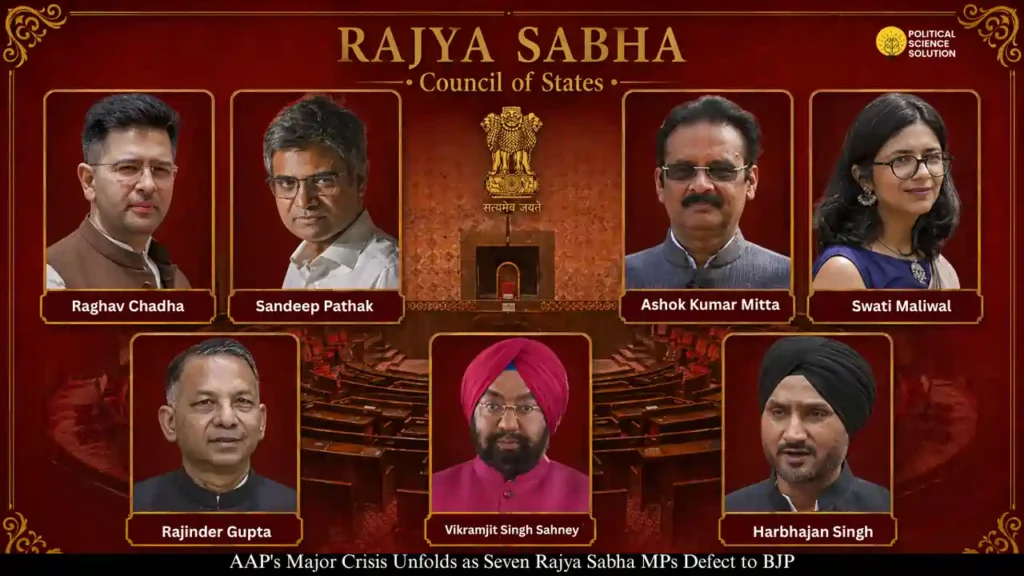
The Defection Announcement and Immediate Fallout
Raghav Chadha, who was recently removed as AAP’s deputy leader in Rajya Sabha, took the lead in addressing a press conference alongside Ashok Mittal and Sandeep Pathak. He asserted that the group of seven MPs, representing exactly two-thirds of AAP’s total strength of ten in the Upper House, had decided to merge with the BJP. Chadha and two others formally joined the BJP on the same day, with Swati Maliwal announcing her decision shortly after. The other members are yet to complete formal induction procedures but have quit AAP.
This development comes at a particularly sensitive time for AAP. The party lost power in Delhi recently and is gearing up for high-stakes battles ahead. Chadha and his colleagues cited internal issues, claiming the party had deviated from its founding principles of anti-corruption and good governance. They alleged that AAP was now controlled by “corrupt and compromised” elements, marking a sharp departure from its origins in 2012 as a movement against corruption.
AAP leaders, however, have strongly condemned the move as a betrayal of the voters’ mandate, especially in Punjab. Sanjay Singh, AAP’s leader in Rajya Sabha, expressed deep public anger in the state, noting protests against the “defectors” across Punjab. He dismissed any suggestions of outreach to Punjab MLAs by the Chadha group, calling such reports “false propaganda” aimed at creating confusion. Singh emphasized that no MLA would risk disqualification by switching sides.
AAP Files Disqualification Plea Before Rajya Sabha Chairman
In response, AAP wasted no time in mounting a legal challenge. On April 26, 2026, Sanjay Singh submitted a formal petition to Rajya Sabha Chairman C.P. Radhakrishnan (who also serves as Vice President), demanding the immediate disqualification of all seven MPs under the provisions of the Tenth Schedule. The plea specifically invokes Paragraph 2(1)(a), which deals with disqualification on grounds of defection, particularly for voluntarily giving up membership of the original political party.
Singh addressed a press conference following the submission, urging the Chairman to hear the matter expeditiously and deliver a just decision. He stated that the party had consulted constitutional experts, including senior advocate Kapil Sibal and former Lok Sabha Secretary-General P.D.T. Achary. According to them, the MPs remain liable for disqualification as the move does not qualify as a valid merger.
AAP has argued that while the defectors claim protection under the merger clause, the Tenth Schedule requires a genuine merger of the original political party, not merely a group of legislators switching allegiance. The petition challenges the “purported merger” and insists that such individual or group switches constitute defection, betraying both the party and the electorate who voted for them on AAP tickets.
The party has vowed to pursue the matter in higher courts, including the Supreme Court if necessary, citing precedents from Uttarakhand and Arunachal Pradesh where courts intervened in similar defection disputes. Singh highlighted that delays in such cases cause disappointment but AAP remains committed to upholding constitutional provisions.
Understanding the Anti-Defection Law: Tenth Schedule Explained
The controversy centers squarely on India’s anti-defection law, formally introduced through the Fifty-Second Amendment Act, 1985, and incorporated as the Tenth Schedule to the Constitution. Popularly known as the Anti-Defection Law, its primary objective is to combat the menace of political defections that undermine democratic stability and voter trust.
Key grounds for disqualification under the Tenth Schedule include:
- Voluntarily giving up membership of the political party on whose ticket the member was elected.
- Defying the party whip during voting in the House.
- An independently elected member joining a political party.
- A nominated member joining a party after six months of becoming a legislator.
The law entrusts the Speaker or Chairman of the House with the responsibility of adjudicating disqualification petitions. This setup aims to ensure fearless and swift decisions, preventing prolonged court battles that could allow defectors to continue enjoying the benefits of their position.
A significant strengthening came via the Ninety-First Constitutional Amendment Act, 2003, which removed the earlier provision allowing a one-third split without disqualification. Now, the threshold for any exception is set at two-thirds.
The Merger Exception Under Paragraph 4
The critical point of contention in this AAP-BJP switch is Paragraph 4 of the Tenth Schedule, which provides an exception to disqualification in cases of merger. It states that a member shall not be disqualified if their original political party merges with another political party, and at least two-thirds of the members of the legislature party agree to such merger.
The defecting MPs, led by Raghav Chadha, argue that they meet this exact threshold—seven out of ten. They claim this constitutes a valid merger, shielding them from disqualification. Chadha has publicly referenced this constitutional provision to justify the move.
However, AAP counters that the merger clause demands more than just numerical strength among legislators. It requires a genuine merger at the level of the original political party as a whole, not merely a faction of its parliamentary wing deciding to cross over. Legal experts and AAP leaders point to Supreme Court interpretations distinguishing between the “original political party” (the organizational structure) and the “legislature party” (elected representatives in the House).
In the landmark Subhash Desai vs Principal Secretary, Governor of Maharashtra (2023) case, the Supreme Court clarified that the legislature party cannot independently claim merger protection without involvement or decision from the original political party. Other judgments have emphasized timely adjudication by presiding officers and the need to prevent misuse of the merger clause to legitimize what essentially amounts to mass defection.
Former Lok Sabha Secretary-General P.D.T. Achary has noted that while the final decision rests with the Rajya Sabha Chairman, AAP may approach the Supreme Court for judicial review, especially on grounds of malafide intent or procedural lapses. The Kihoto Hollohan vs Zachillhu (1992) judgment upheld the law’s validity but made Speakers’ decisions subject to judicial review for violations of natural justice or constitutional mandates.
Broader Political Implications and Reactions
This episode has intensified scrutiny on the “politics of defection,” with AAP accusing the BJP of using central agencies like the Enforcement Directorate (ED) and Central Bureau of Investigation (CBI) to pressure opposition leaders before inducting them. BJP president Nitin Gadkari (referred to in some reports as Nitin Nabin) welcomed Chadha, Pathak, and Mittal at the party headquarters.
The timing adds layers of complexity. It occurs just a year after AAP’s setbacks in Delhi and ahead of Punjab polls, where the party holds government. Public sentiment in Punjab appears sharply divided, with AAP claiming widespread protests and anger against the seven MPs for “betraying” the state. Singh rejected any notion of Punjab MLAs being in touch with the defectors, asserting that such risks would lead to loss of membership under the same law.
On another front, AAP has also pushed back against controversies surrounding Arvind Kejriwal, including allegations related to a new bungalow allotted to him, dubbed by critics as ‘Sheesh Mahal 2’. The party has threatened defamation action against those circulating what it calls “fake” images.
Interestingly, Raghav Chadha himself had previously advocated for strengthening anti-defection provisions, highlighting the irony in the current situation where the two-thirds merger clause has enabled the very switch he and his group executed.
What Lies Ahead: Legal Battle and Democratic Questions
As the Rajya Sabha Secretariat has reportedly taken cognizance of the merger request and updated records—boosting BJP’s strength to 113 and NDA’s tally beyond 140—the ball now lies in the court of Chairman C.P. Radhakrishnan. AAP demands swift termination of the seven MPs’ memberships to uphold the spirit of the anti-defection law and protect the mandate of voters.
This case is likely to test the boundaries of the merger exception once again. Will the Chairman accept the numerical two-thirds claim as sufficient, or will deeper scrutiny into whether a true “merger” of the political party occurred prevail? Supreme Court precedents suggest that genuine party-level decisions matter, and artificial constructs to bypass disqualification could face challenges.
For Indian democracy, the episode revives long-standing debates about the effectiveness of the anti-defection law. Introduced to curb “horse-trading” and frequent floor-crossing that destabilized governments in the 1960s-80s, the law has itself faced criticism for stifling dissent and concentrating power in party high commands. Calls for reforms, including faster adjudication timelines (as urged in cases like Keisham Meghachandra Singh vs Speaker, Manipur, 2020) and possibly an independent tribunal instead of Speakers, continue to surface.
AAP has positioned its fight as a defense of constitutional values and people’s trust, particularly in Punjab. The defectors frame it as a principled realignment toward better governance. Whatever the outcome, this high-profile defection and the ensuing disqualification plea underscore the tensions between legislative arithmetic, party discipline, and democratic accountability in India’s parliamentary system.
The coming weeks and months will be crucial as legal proceedings unfold, potentially setting new precedents on how the Tenth Schedule is interpreted in an era of fluid political alliances. For now, AAP’s reduced strength in Rajya Sabha and the turmoil in its ranks mark a significant chapter in the party’s journey, testing its resilience ahead of future electoral battles.
FAQs
1. Will the 7 AAP Rajya Sabha MPs who joined BJP be disqualified under the anti-defection law?
The outcome is uncertain and depends on the interpretation of the Tenth Schedule by the Rajya Sabha Chairman. AAP has filed a disqualification petition arguing that the move does not qualify as a genuine “merger” of the original political party, even though seven out of ten MPs (two-thirds) have switched sides. The defecting MPs, led by Raghav Chadha, claim they are protected under Paragraph 4 of the Tenth Schedule, which exempts disqualification in case of a merger with the consent of at least two-thirds of the legislature party. Legal experts say the final decision rests with Rajya Sabha Chairman C.P. Radhakrishnan, and the matter may eventually reach the Supreme Court. Precedents from Uttarakhand and Arunachal Pradesh cases are likely to be cited by AAP.
2. What is the Tenth Schedule of the Indian Constitution and how does it apply to the AAP-BJP defection case?
The Tenth Schedule, popularly known as the Anti-Defection Law, was added to the Constitution through the 52nd Amendment Act, 1985, and later strengthened by the 91st Amendment in 2003. It disqualifies elected representatives for voluntarily giving up party membership or defying the party whip. However, it provides an exception under Paragraph 4: disqualification does not apply if the original political party merges with another party and at least two-thirds of its members agree to the merger. In the current case, AAP argues that a mere switch by seven MPs does not amount to a valid merger of the AAP party itself, while the defectors maintain they meet the two-thirds numerical requirement.
3. Who are the seven AAP Rajya Sabha MPs who quit the party and joined BJP in April 2026?
The seven MPs who resigned from AAP and announced their merger with BJP are:
- Raghav Chadha
- Sandeep Pathak
- Ashok Mittal
- Rajinder Gupta
- Vikram Sahney (Vikramjit Sahney)
- Harbhajan Singh
- Swati Maliwal
Six of these MPs are from Punjab. Raghav Chadha, Sandeep Pathak, and Ashok Mittal formally joined the BJP on April 24, 2026, while Swati Maliwal announced her decision the next day. This mass exit has reduced AAP’s strength in Rajya Sabha from 10 to just 3 MPs.
4. Why did AAP file a disqualification plea against its own Rajya Sabha MPs who joined BJP?
AAP filed the plea on April 26, 2026, through its Rajya Sabha leader Sanjay Singh to Rajya Sabha Chairman C.P. Radhakrishnan, seeking immediate disqualification of the seven MPs under Paragraph 2(1)(a) of the Tenth Schedule. The party claims the MPs were elected on AAP tickets and their decision to voluntarily leave and join the BJP amounts to defection. AAP argues that the so-called “merger” is not genuine because it lacks approval from the original political party and is merely a group of legislators switching sides. The party views this as a betrayal of the voters’ mandate, especially in Punjab.
5. What will be the impact of the AAP MPs defection on Punjab politics and the party’s future?
The defection has created significant turmoil for AAP, especially in Punjab, where six of the seven MPs are from the state and the party is currently in power. AAP leader Sanjay Singh has reported public anger and protests across Punjab against the “defectors.” The party fears this could damage its image and voter base ahead of the 2027 Punjab Assembly elections. However, Sanjay Singh has strongly denied that any AAP MLAs are in touch with the defectors, asserting that no sitting MLA would risk disqualification. The episode has also intensified internal criticism and questions about AAP’s organizational strength following its recent loss of power in Delhi.