

New Delhi: As India grapples with rapid modernization and economic growth, one deeply entrenched social evil continues to claim lives with alarming regularity. In 2024, the National Crime Records Bureau (NCRB) documented 5,737 dowry deaths across the country, translating to nearly 16 women losing their lives every single day due to dowry-related harassment, violence, or suspicious circumstances following marriage. This figure, while showing a marginal long-term decline, underscores a crisis that refuses to fade despite decades of legislation and judicial intervention.
Recent tragedies have once again thrust this issue into the national spotlight. In May 2026, the deaths of Deepika Nagar in Greater Noida and Twisha Sharma in Bhopal highlighted the brutal reality faced by young brides. Deepika, 24, succumbed to multiple trauma injuries and internal bleeding 17 months after her wedding, with her family alleging sustained demands for money and a luxury vehicle. Twisha, 33, died by suicide just five months into her marriage, prompting police to register cases of dowry harassment and abetment of suicide, even as her husband reportedly went absconding. Similar cases, including the death of a Delhi Police SWAT commando in January 2026 and the killing of a 28-year-old woman in Madhya Pradesh in August 2025 over additional dowry demands of Rs 36 lakh, reveal how the practice transcends class and profession.
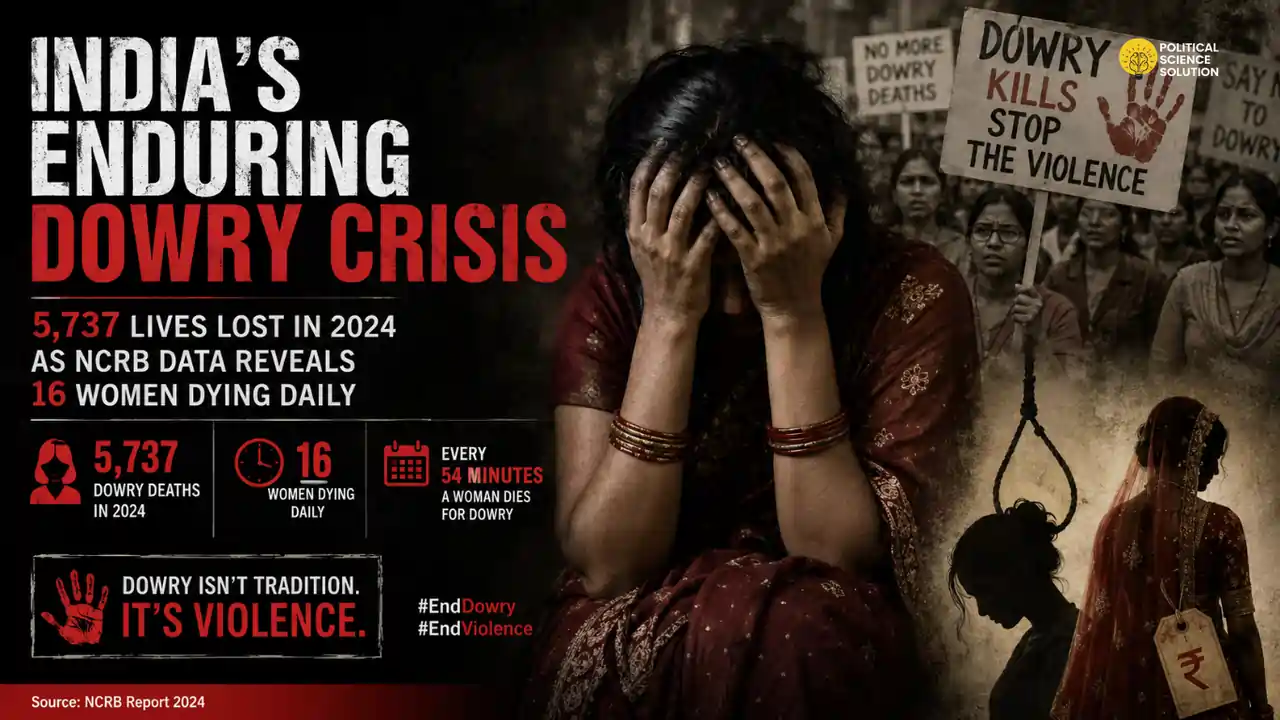
Understanding Dowry: Definition and Prevalence
Under the Dowry Prohibition Act, 1961, dowry is defined as “any property or valuable security given or agreed to be given either directly or indirectly, by one party to a marriage to the other party, at or before or any time after the marriage.” Despite this clear legal stance criminalizing the giving, taking, or demanding of dowry, the custom persists as a social norm in many parts of India, particularly in the northern and central regions.
The NCRB’s Crime in India 2024 report paints a grim picture of crimes against women. Out of 4,41,534 total cases registered, a staggering 27.2% fell under the category of “Cruelty by Husband or Relatives.” Uttar Pradesh reported the highest number of dowry deaths at 2,038, followed by Bihar and Madhya Pradesh. Together, these states contribute significantly to the national burden. Uttarakhand recorded the highest dowry crime rate at 9.8 cases per lakh women, while Delhi, despite lower absolute numbers (109 cases leading to 111 deaths), showed a rate of 1.4 cases per lakh women among metropolitan cities. Kanpur alone accounted for 54 cases.
Cases registered under the Dowry Prohibition Act stood at 12,343 in 2024, down from 15,489 in 2023, yet still indicating a dowry-related incident roughly every half hour somewhere in the country.
Dowry Deaths vs. Dowry-Related Suicides: A Deeper Dive into NCRB Data
The crisis extends beyond outright murders classified as dowry deaths. The NCRB’s Accidental Deaths and Suicides in India 2024 report recorded 1,70,746 total suicides nationally, a slight dip from 1,71,418 in 2023. Within this, economic vulnerability and gender emerged as critical fault lines. Daily wage earners topped the list with 52,910 suicides (31%), but homemakers followed closely at 22,113. Among female suicide victims, homemakers formed the largest occupational group by a wide margin.
Specifically, 1,693 suicides were attributed to dowry-related issues in 2024, with nearly 80% (1,360) being women. Of these, 1,055 victims were aged 18-30 years. Marriage-related family problems accounted for 8,524 suicides, of which dowry-linked cases formed a substantial portion. Historical analysis from 1995 to 2024 reveals a devastating toll: close to 65,000 dowry-related suicides among women, with nearly 48,000 in the 18-30 age bracket. In 1995 alone, there were 2,336 such suicides (about seven daily), including 1,766 in the young adult group. By 2024, while numbers had decreased to 1,360 total and 1,055 in the 18-30 group, the age concentration remained stable—around 75-77% of female dowry suicides consistently falling in this demographic over three decades.
Dowry deaths, prosecuted under Section 80 of the Bharatiya Nyaya Sanhita (BNS, formerly IPC Section 304B), showed a decline from 7,045 in 2020 to 5,811 in 2024 (noting slight variations in reporting across sources). Yet, this still averaged nearly 16 deaths daily. The law covers deaths occurring “otherwise than under normal circumstances” within seven years of marriage where dowry harassment is suspected. Suicides linked to such harassment can also attract these provisions.
Why the Numbers Don’t Tell the Full Story: Underreporting and Systemic Gaps
Experts and researchers consistently highlight significant underreporting of dowry-related crimes. A 2025 paper by Rambooshan Tiwari and Shubham Narayan Dixit on the spatio-temporal analysis of dowry crimes points to gaps where deaths are reported but the underlying dowry practice is not. Social stigma, family pressure, and fear of ostracization often prevent families from coming forward until it is too late.
The “principal offence rule” in NCRB methodology further distorts statistics. Only the most serious crime in a First Information Report (FIR) is recorded, meaning dowry harassment may be subsumed under murder or other categories. Misclassification of burn injuries, poisonings, or drownings as “accidents” is common. A 2015 study in the Journal of Biosocial Science and research in Trauma, Violence and Abuse emphasize how suspicious deaths frequently escape proper categorization. One study of 22 burn injury cases among women found only three were genuine accidents; the rest involved domestic abuse.
Indulekha Guha from Azim Premji University notes that crimes of lesser intensity are even more likely to go unreported due to police familiarity gaps with the Dowry Prohibition Act compared to clearer categories like dowry death. Cross-verification with district court judicial data is recommended for a truer picture.
State-Wise Patterns and the Hindi Belt Dominance
Geographically, the burden is heavily concentrated in certain states. Uttar Pradesh and Bihar together accounted for over half of all dowry deaths in 2024. Adding Madhya Pradesh pushes the share to over 61%. In dowry-related suicides between 2020-2024, Madhya Pradesh led initially, with Uttar Pradesh and Delhi also prominent. In 2024, 66% of female dowry suicides came from Uttar Pradesh, Madhya Pradesh, and Delhi combined.
This “Hindi Belt” dominance points to deep-rooted patriarchal norms, son preference, and economic pressures intertwined with marriage customs in these regions. Karnataka, Jharkhand, and Rajasthan also report elevated rates, showing the issue is national but varies in intensity.
Arrest Patterns and Demographic Insights
Between 2020 and 2024, 70,211 people were arrested in dowry death cases, including 56,498 men and 13,713 women. Over 80% of arrested men were aged 18-45, with nearly half (25,004) in the 18-30 bracket. Women arrests were concentrated in the 30-45 age group (often mothers-in-law). This age profile mirrors the victim demographics, indicating the crime occurs predominantly among young couples and their immediate families.
Arrests declined by about 20% in recent years, aligning with drops in reported deaths and suicides.
Legal Framework: Provisions and Persistent Challenges
India has a multi-layered legal response:
- Dowry Prohibition Act, 1961: Criminalizes giving, taking, or demanding dowry.
- Bharatiya Nyaya Sanhita (BNS): Section 80 (dowry death) and Section 85 (cruelty by husband/relatives, formerly 498A IPC).
- Protection of Women from Domestic Violence Act, 2005: Provides civil remedies for protection.
- Bharatiya Sakshya Adhiniyam (BSA): Section 118 (formerly 113B Evidence Act) creates a presumption of guilt against the accused in dowry death cases.
Despite these, implementation remains uneven due to delays, low conviction rates in some areas, and societal resistance.
Supreme Court Directives Offer Hope for Systemic Reform
In 2025, the Supreme Court in State of U.P. vs. Ajmal Beg issued comprehensive directions to combat the menace:
- Appointment of Dowry Prohibition Officers (DPOs) under the 1961 Act.
- Regular training programs for police and judicial officers.
- High Courts to monitor and expedite disposal of pending dowry cases.
- Grassroots awareness campaigns by district administrations.
- Integration of anti-dowry education into school and college curricula.
These measures aim to strengthen enforcement, improve awareness, and shift societal attitudes from the ground up.
The Broader Social Context: Gender, Economy, and Cultural Fault Lines
Dowry violence intersects with larger issues of gender inequality. While overall suicides show a male majority (73.5:26.5), dowry-related suicides are overwhelmingly female. Homemakers, often financially dependent, face heightened vulnerability. Economic pressures—rising aspirations, inflation, and expectations of “settling” daughters through marriage—fuel the demand for dowry even as families pay hefty sums upfront (cars, gold, cash).
The persistence of the 18-30 age group as the primary victim bracket for nearly 30 years signals a failure to break intergenerational cycles. Education and urbanization have not sufficiently dismantled patriarchal expectations.
Moving Forward: A Call for Collective Action
The dowry crisis in India is not merely a law enforcement issue but a profound social malaise requiring multi-pronged solutions. While NCRB data shows some decline—from higher figures in the late 2010s to 2024—the absolute numbers remain unconscionable. True progress demands stricter implementation of existing laws, better data collection to address underreporting, community-led awareness drives, and economic empowerment of women to reduce dependency.
As cases like those of Deepika Nagar and Twisha Sharma evoke public outrage, they must translate into sustained pressure for change. Families, society, police, judiciary, and policymakers all have roles to play. Until dowry is eradicated as a cultural expectation, India’s daughters will continue to pay the ultimate price. The statistics from 2024 and the historical record since 1995 serve as a sobering reminder that legislative victories alone are insufficient without societal transformation.
This crisis demands urgent national attention. With over 5,737 documented deaths in a single year and tens of thousands more affected by harassment, the time for half-measures is long past. Comprehensive reforms, coupled with cultural shifts, offer the only path toward a future where marriage signifies partnership, not transaction.
FAQs
Q1: How many dowry deaths occur in India every year according to the latest NCRB data?
According to the National Crime Records Bureau’s (NCRB) Crime in India 2024 report, India recorded 5,737 dowry deaths in 2024. This equates to nearly 16 women dying every day due to dowry-related violence, harassment, or suspicious circumstances. While this shows a marginal long-term decline compared to previous years (e.g., 7,045 in 2020), the numbers remain alarmingly high. Uttar Pradesh reported the highest number with 2,038 cases, followed by Bihar (1,078) and Madhya Pradesh (450).
Q2: What is the legal definition of dowry and which laws protect women against it?
As per the Dowry Prohibition Act, 1961, dowry is defined as “any property or valuable security given or agreed to be given either directly or indirectly, by one party to a marriage to the other party, at or before or any time after the marriage.” Key legal provisions include:
- Section 80 of Bharatiya Nyaya Sanhita (BNS) (formerly IPC 304B) – specifically addresses dowry deaths.
- Section 85 of BNS (formerly IPC 498A) – deals with cruelty by husband or relatives.
- Protection of Women from Domestic Violence Act, 2005.
- Section 118 of Bharatiya Sakshya Adhiniyam (BSA) – creates a presumption of guilt against the accused in dowry death cases.
The Supreme Court in 2025 also directed states to appoint Dowry Prohibition Officers and conduct regular training for police and judicial officers.
Q3: Are dowry deaths and dowry-related suicides underreported in India?
Yes, experts believe official figures significantly underrepresent the true scale. Reasons include social stigma, fear of family ostracization, misclassification of deaths as “accidents” (especially burn cases), and the NCRB’s “principal offence rule,” which records only the most serious crime in an FIR. A 2025 research paper and multiple studies (including a 2015 Journal of Biosocial Science study) highlight that many dowry harassment cases go unreported until they turn fatal. Between 1995 and 2024, nearly 65,000 dowry-related suicides among women were recorded, with strong evidence suggesting the actual number is higher.
Q4: Which age group is most affected by dowry-related deaths and suicides?
The 18–30 age group is disproportionately affected. In 2024, out of 1,360 dowry-related suicides among women, 1,055 (nearly 78%) were in the 18–30 years bracket. This pattern has remained consistent for nearly 30 years — in 1995, 75.6% of such suicides were in this age group, rising to 77.5% in 2024. Arrest data also shows that over 80% of men arrested in dowry death cases between 2020–2024 were aged 18–45, with the highest concentration in 18–30 years.
Q5: What steps has the Supreme Court and government recommended to stop dowry deaths?
In the 2025 judgment State of U.P. vs. Ajmal Beg, the Supreme Court issued several key directions:
- Mandatory appointment of Dowry Prohibition Officers across districts.
- Periodic training for police and judicial officers on handling dowry cases.
- Expeditious disposal of pending dowry cases by High Courts.
- Large-scale grassroots awareness programs by district administrations.
- Inclusion of anti-dowry content in school and college curricula.
Despite these measures and existing laws, enforcement remains a challenge, and experts emphasize the need for better data collection, women’s economic empowerment, and cultural change to eradicate the practice.