

New Delhi: In a landmark diplomatic development that could reshape West Asian geopolitics, a 14-point Memorandum of Understanding (MoU) between the United States and the Islamic Republic of Iran has officially come into effect. Signed virtually by President Donald Trump and Iranian President Masoud Pezeshkian, the agreement brings an immediate and permanent ceasefire to nearly four months of direct hostilities that erupted on February 28, 2026.
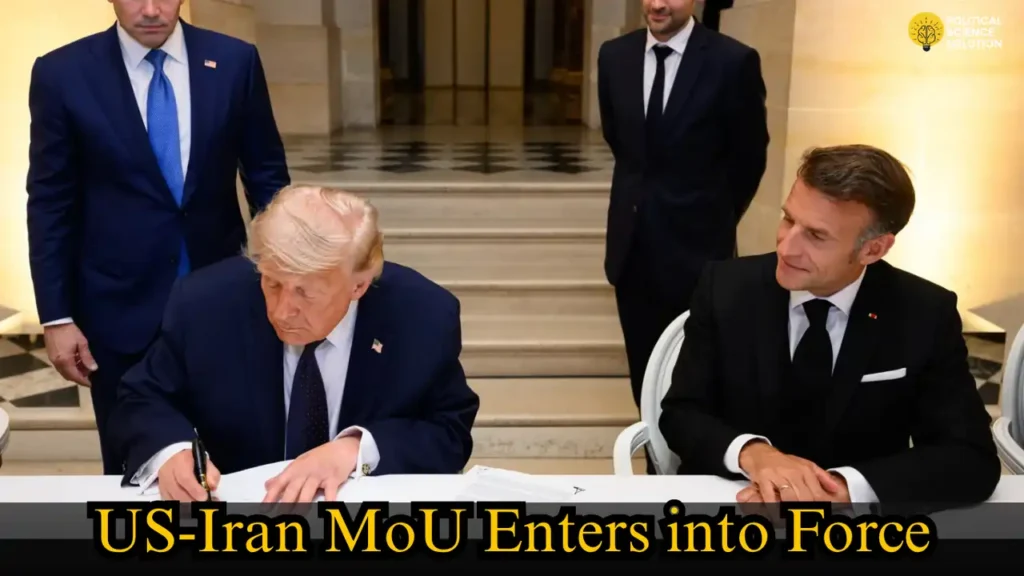
The MoU, described by US officials as performance-based, establishes a fragile but structured pathway toward lasting peace. It addresses core flashpoints including military operations across multiple fronts, freedom of navigation in the critical Strait of Hormuz, sanctions relief, Iran’s nuclear program, and a massive economic reconstruction initiative. Trump formally signed the document at the Palace of Versailles in France—site of the historic 1919 Treaty of Versailles—following the G7 summit in Evian-les-Bains.
This breakthrough arrives amid heightened global concerns over energy security, nuclear proliferation risks, and regional stability. With the 60-day negotiation clock now ticking for a comprehensive final deal, analysts are closely watching whether this initial understanding can translate into enduring commitments.
Background of the US-Iran Conflict and Path to the MoU
The agreement caps a period of intense confrontation that began in late February 2026, involving direct US-Iran clashes and spillover effects in Lebanon involving Israeli operations against Hezbollah. Global oil prices surged when the Strait of Hormuz—a chokepoint carrying roughly one-fifth of the world’s seaborne petroleum—was effectively closed amid the fighting.
President Trump, who has repeatedly emphasized preventing Iran from acquiring nuclear weapons as a top priority, launched what the administration termed Operation Epic Fury. Four months later, both sides have recognized the high costs of continued conflict and opted for de-escalation through this MoU. Iranian officials, including the Foreign Ministry, have stressed that the deal covers Lebanon and signals a broader commitment to sovereignty and non-interference.
The document was read out in detail to media outlets, including the BBC, by senior US officials, underscoring its transparency while leaving several implementation details for future talks.
Comprehensive Breakdown of the 14-Point Memorandum of Understanding
The MoU is structured around 14 specific points that form the foundation for immediate de-escalation and longer-term negotiations. Here is a detailed examination of each:
Point 1: Immediate and Permanent Ceasefire Across All Fronts
The United States, Iran, and their respective allies declare an immediate and permanent end to military operations on all fronts, explicitly including Lebanon. Both parties commit not to initiate war, military actions, threats, or use of force against each other moving forward. The agreement emphasizes preserving Lebanon’s territorial integrity and sovereignty. A final comprehensive deal is expected to formalize this permanent termination of hostilities.
Point 2: Mutual Respect for Sovereignty and Non-Interference
Both nations pledge to respect each other’s sovereignty and territorial integrity while refraining from any interference in internal affairs. This clause is likely to draw mixed reactions, particularly from Iranian opposition groups that had anticipated stronger US support for domestic dissent.
Point 3: 60-Day Window for Final Deal Negotiations
The parties commit to negotiating and concluding a final agreement within a maximum of 60 days from the MoU’s signing, with provisions for extension by mutual consent. This timeline officially began following the virtual and in-person signing processes.
Point 4: Lifting of US Naval Blockade
Immediately upon signing, the US begins dismantling its naval blockade and any related impediments to Iranian ports. The full blockade ends within 30 days. Vessel traffic during this transition will be calibrated proportionally to pre-war levels restored by Iran. Additionally, the US agrees to withdraw forces from Iran’s proximity within 30 days of the final deal’s signing, reverting to pre-conflict military posture.
Point 5: Reopening the Strait of Hormuz
Iran commits to using its best efforts to ensure safe, charge-free passage for commercial vessels through the Strait of Hormuz for an initial 60-day period, facilitating transit between the Persian Gulf and the Sea of Oman. Traffic is set to resume immediately, supported by de-mining and obstacle removal within 30 days. Longer-term, Iran will engage Oman and other Gulf littoral states to establish a broader management framework consistent with international law and coastal sovereign rights. US officials have stressed that no tolling system will be acceptable to Gulf partners.
Point 6: $300 Billion Reconstruction and Economic Development Plan
The US, alongside regional partners, will develop a definitive plan valued at a minimum of $300 billion for Iran’s reconstruction and economic development. The implementation mechanism will be finalized within 60 days of the final deal. While the US will grant necessary licenses and waivers, officials have clarified that America is not obligated to contribute financially. Regional actors, such as the UAE, could potentially lead projects with US approval.
Point 7: Phased Termination of Sanctions
The US commits to ending all sanctions against Iran—including those under UN Security Council resolutions, IAEA-related measures, and unilateral US primary and secondary sanctions—according to an agreed schedule. Both sides recognize the urgency of addressing sanctions relief promptly in upcoming negotiations.
Point 8: Iran’s Commitment Against Nuclear Weapons
Iran reaffirms it will not procure or develop nuclear weapons. The parties will mutually agree on mechanisms to address existing stockpiles of enriched uranium, with down-blending on site under IAEA supervision as the minimum standard. Further discussions on enrichment levels and Iran’s broader nuclear needs will occur within the final deal framework. This nuclear component is central to the performance-based nature of the agreement.
Point 9: Maintenance of Nuclear Status Quo
Pending the final deal, Iran will maintain its current nuclear program status, while the US refrains from imposing new sanctions or deploying additional regional forces.
Point 10: Immediate Waivers for Oil Exports and Related Services
Upon signing and until full sanctions termination, the US Treasury will issue waivers enabling Iranian exports of crude oil, petroleum products, derivatives, and associated services including banking, insurance, and transportation.
Point 11: Release of Frozen Assets
The US undertakes to make frozen or restricted Iranian funds fully available following MoU implementation. Procedures for release, transfer, and use—designated by Iran’s Central Bank—will be mutually agreed during negotiations. All necessary US licenses will be provided.
Point 12: Establishment of Monitoring Mechanism
An executive mechanism will be created to oversee MoU implementation and future compliance with the final deal.
Point 13: Launch of Exclusive Final Deal Negotiations
Following initial implementation of key paragraphs (1, 4, 5, 10, and 11), bilateral negotiations for the final agreement will commence.
Point 14: UN Security Council Endorsement
The eventual final deal will be formalized through a binding United Nations Security Council resolution.
Congressional Scrutiny and the Iran Nuclear Agreement Review Act (INARA)
The MoU has ignited debate in Washington regarding congressional oversight. The 2015 Iran Nuclear Agreement Review Act (INARA) requires the president to submit any Iran-related nuclear agreements to Congress within five days, triggering a 30-day review period during which lawmakers may consider a resolution of disapproval.
Senators like Lindsey Graham have called for review, while legal experts including Jack Goldsmith and former Obama administration adviser Tess Bridgeman argue the current MoU falls under INARA’s scope due to its nuclear provisions and immediate sanctions relief elements. Trump has expressed openness to congressional involvement but has not yet formally submitted the text. Critics highlight perceived inconsistencies in congressional engagement between the war’s initiation and its termination.
Regional and Global Implications
The agreement is expected to ease tensions in Lebanon and stabilize global energy markets by restoring Hormuz traffic. European leaders have welcomed the development as vital for energy security and non-proliferation, while urging strict adherence to commitments. Pro-Israel groups and some US lawmakers continue to voice concerns about implementation and Israel’s security considerations.
Supporters view the MoU as a pragmatic step that prioritizes verifiable Iranian compliance before full benefits accrue. Detractors worry about enforcement challenges and the durability of commitments in a historically fraught relationship.
Outlook for the Next 60 Days and Beyond
With the ceasefire in place and initial de-escalation measures underway, diplomats from both sides face the complex task of bridging remaining gaps on nuclear verification, sanctions timelines, regional security architecture, and economic frameworks. The performance-based structure ties sanctions relief and reconstruction support directly to Iranian actions, particularly regarding its nuclear program.
As the world watches, this MoU represents not the end of US-Iran tensions but a critical inflection point. Success in the coming weeks could herald a new era of managed competition and economic reopening for Iran, while failure risks rapid reversion to confrontation. The coming negotiations in Geneva or elsewhere will determine whether this virtual signing at Versailles becomes a footnote or a turning point in modern diplomatic history.
FAQs
1. What is the US-Iran Memorandum of Understanding (MoU) and when did it come into effect?
The 14-point Memorandum of Understanding between the United States and Iran is a landmark interim agreement signed virtually by President Donald Trump and Iranian President Masoud Pezeshkian. It officially came into effect recently, declaring an immediate and permanent ceasefire across all fronts, including Lebanon. Trump signed the document at the Palace of Versailles in France after the G7 summit. The MoU serves as a performance-based framework to halt nearly four months of conflict that began on February 28, 2026, and opens a 60-day window for negotiating a comprehensive final deal.
2. What are the key provisions of the 14-point US-Iran agreement?
The MoU includes:
- Immediate ceasefire and end to military operations on all fronts.
- Mutual respect for sovereignty and non-interference in internal affairs.
- Lifting of the US naval blockade on Iranian ports within 30 days.
- Reopening of the Strait of Hormuz for free commercial navigation.
- A $300 billion regional reconstruction and economic development plan for Iran (US not required to fund).
- Phased termination of all US and UN sanctions.
- Iran’s commitment not to develop or acquire nuclear weapons, with down-blending of existing enriched uranium under IAEA supervision.
- Release of frozen Iranian assets.
- Issuance of immediate waivers for Iranian oil exports and related services.
- Establishment of a monitoring mechanism and UN Security Council endorsement for the final deal.
3. Does the US-Iran MoU require congressional approval under INARA?
The 2015 Iran Nuclear Agreement Review Act (INARA) requires the President to submit any agreement related to Iran’s nuclear program to Congress within five days for a 30-day review period. Legal experts and lawmakers (including Senator Lindsey Graham) argue that this MoU falls under INARA due to its nuclear provisions, sanctions relief, and enriched uranium management clauses. President Trump has expressed openness to congressional review, but the administration has not yet formally submitted the text. During the review, sanctions relief measures are restricted, though the agreement’s performance-based nature ties benefits to Iranian compliance.
4. How does the agreement address the Strait of Hormuz and Iran’s economy?
Iran commits to ensuring safe, charge-free passage for commercial vessels through the Strait of Hormuz immediately, with full de-mining and obstacle removal within 30 days. Longer-term arrangements will involve Oman and other Gulf states. Economically, the MoU provides for a minimum $300 billion reconstruction plan, full sanctions termination on an agreed schedule, immediate oil export waivers, and release of frozen assets. These measures aim to restore Iran’s integration into global energy markets while maintaining a “status quo” on its nuclear program during negotiations.
5. What happens in the next 60 days following the US-Iran MoU?
The 60-day countdown (extendable by mutual consent) has begun for negotiating a final comprehensive deal. Key immediate steps include implementing the ceasefire, lifting the naval blockade, reopening the Strait of Hormuz, issuing oil waivers, and releasing frozen funds. Negotiations will focus on finalizing sanctions relief timelines, nuclear verification mechanisms (including enriched uranium disposition), monitoring systems, and the reconstruction framework. The final agreement is expected to receive a binding UN Security Council resolution. Success depends on verifiable compliance, as the deal is explicitly performance-based.