

New Delhi: In a significant clarification that addresses widespread public misconceptions, the Ministry of External Affairs (MEA) has firmly stated that an Indian passport serves solely as a travel document and cannot be considered conclusive evidence of citizenship. This announcement comes at a time when questions about the role of passports, Aadhaar cards, and Voter ID cards in proving citizenship and accessing government benefits have intensified across India.
The MEA’s statement, delivered during a detailed briefing on India’s expanding passport and international mobility ecosystem, underscores the fundamental distinction between travel facilitation and legal citizenship status. Senior officials emphasized that while passports are issued exclusively to Indian citizens following rigorous verification, their primary function is to enable seamless international travel, establish identity abroad, and provide access to consular services.
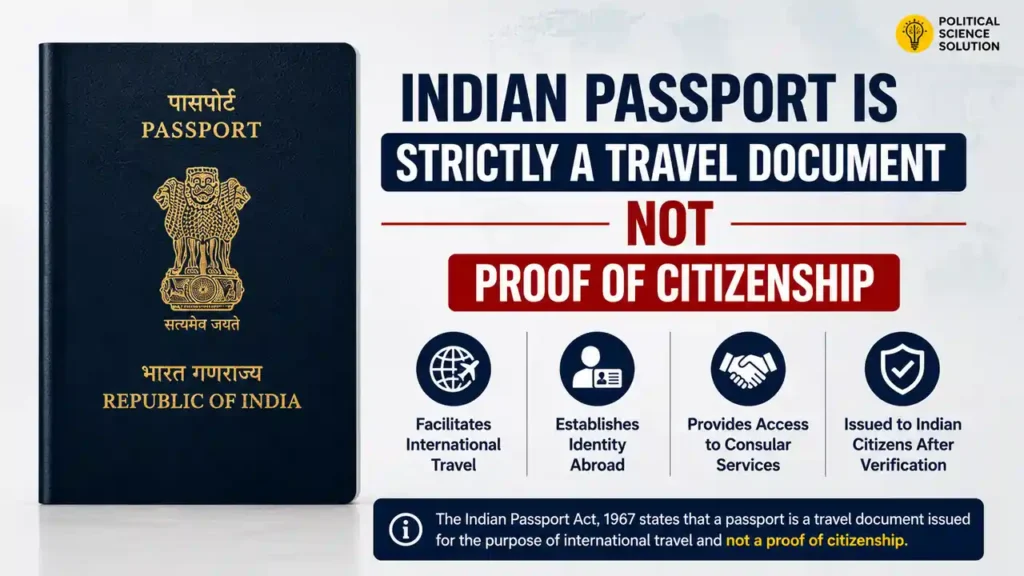
Understanding the Role of Indian Passports in Global Mobility
An Indian passport is an official travel document issued by the Ministry of External Affairs. It proves the holder’s identity and nationality specifically for crossing international borders and seeking assistance from Indian missions overseas. The introduction of ePassports marks a major technological upgrade. These biometric passports combine traditional paper elements with an embedded Radio Frequency Identification (RFID) chip and antenna. The chip securely stores the passport holder’s personal details and biometric data, aligning fully with International Civil Aviation Organization (ICAO) standards for machine-readable travel documents.
This shift to chip-enabled ePassports, rolled out nationwide since May of the previous year, enhances document security, minimizes fraud risks, and ensures smoother processing at global immigration checkpoints. As of now, approximately 10% of Indian passport holders possess these advanced ePassports, with the government accelerating issuance to meet growing demand.
India’s passport infrastructure has undergone transformative expansion. A decade ago, facilities were limited; today, the network includes 545 Passport Seva Kendras (PSKs) spread across the country – a six-fold increase. This extensive coverage now reaches nearly every Lok Sabha constituency, with plans to open 20 additional centers this year. The goal is clear: establish at least one dedicated passport facility in every parliamentary constituency by 2027. Only around 30 districts currently lack a full-fledged center, and special mobile teams are actively bridging gaps in remote and inaccessible regions.
These reforms have delivered tangible results. Passport processing times have plummeted to as little as five working days in many locations. Applicants now spend under 45 minutes at PSKs on average, thanks to technology integration, streamlined workflows, and digital initiatives. Outreach camps conducted last year alone helped issue passports to nearly 300,000 individuals in underserved areas.
Passport Penetration and Broader Implications for Viksit Bharat
Despite impressive growth, passport ownership remains modest, with only about 10% of India’s population holding one. The MEA views expanding access as a national priority, recognizing that international mobility is increasingly vital for education, skilled employment, business, and overall economic progress. External Affairs Minister S. Jaishankar highlighted this vision on Passport Seva Divas (June 24), describing seamless passport services as a key engine for building a prosperous and developed India (Viksit Bharat).
The government’s focus extends beyond issuance. Through upgraded platforms like eMigrate 2.0 (launched in October 2022), nearly 700,000 Indian workers have secured emigration clearance. Randomized processing in 17 passport offices has boosted transparency and reduced corruption risks. Pre-departure orientation programs now equip workers with country-specific cultural knowledge and job skills, while one-stop support centers for distressed Indian women operate in Gulf countries and Singapore, backed by the Indian Community Welfare Fund. Additional centers are planned to address issues like domestic violence and other vulnerabilities faced by overseas Indians.
India’s Global Mobility Partnerships and Visa Advantages
India has forged 27 mobility agreements with 25 countries, including the European Union, United Kingdom, Australia, and key Gulf nations. These pacts facilitate easier movement for students, apprentices, researchers, professionals, and business travelers. Visa access for Indian passport holders continues to improve: 27 countries offer visa-free entry, 47 provide visas on arrival, and 66 extend e-visa options.
Next week, New Delhi will host the Human Resource Mobility Forum involving Germany, Italy, Japan, Russia, and Denmark. The event aims to connect skilled Indian talent with ethical employers abroad while promoting safe, orderly migration. Officials stressed the need to counter myths about irregular pathways to high-income destinations and warned against unscrupulous agents sending workers to conflict zones or high-risk areas.
Legal Context: Citizenship Under the Indian Constitution and Citizenship Act
To fully appreciate the MEA’s clarification, it is essential to understand the constitutional and legal framework governing Indian citizenship, which remains distinct from passport issuance.
Citizenship falls under the Union List in the Seventh Schedule of the Constitution, placing it exclusively within Parliament’s domain. Part II (Articles 5 to 11) outlines categories of persons entitled to citizenship at the commencement of the Constitution but does not provide a single comprehensive definition of the term “citizen.”
The Citizenship Act, 1955, remains the cornerstone legislation, prescribing five primary modes of acquiring Indian citizenship:
- By Birth – Citizenship conferred automatically based on birth in India under specified conditions.
- By Descent – For children born outside India to Indian parents.
- By Registration – Available to certain categories of persons of Indian origin or those married to Indian citizens.
- By Naturalization – A formal process for eligible foreigners after meeting residency and other requirements.
- By Territorial Incorporation – When territories are added to India by the Government of India.
Importantly, the Act prohibits dual citizenship for Persons of Indian Origin. Individuals who acquire foreign citizenship while holding an Indian passport must surrender the Indian document immediately.
Termination and Deprivation of Citizenship
Indian citizenship can end through three main processes:
- Renunciation: Any Indian citizen who voluntarily acquires another country’s nationality and formally renounces Indian citizenship through a prescribed declaration ceases to be an Indian citizen.
- Termination: Automatic loss occurs if a citizen knowingly or voluntarily adopts foreign citizenship.
- Deprivation: The government may deprive a person of citizenship (primarily naturalized citizens) under specific conditions, including:
- Obtaining citizenship through fraud.
- Demonstrating disloyalty to the Constitution of India.
- Unlawfully trading or communicating with enemy nations during wartime.
- Imprisonment for two years or more within five years of naturalization.
- Remaining ordinarily resident outside India for seven continuous years without sufficient reason.
These provisions ensure that citizenship – a deeper legal bond with the nation – is protected and not conflated with travel documents like passports.
Addressing Public Confusion and Electoral Contexts
The MEA’s clarification responds directly to growing public debates, including queries about using passports to challenge exclusions from voter lists during the ongoing Special Intensive Revision (SIR) of electoral rolls in several states. Officials reiterated that passports, while issued after thorough due diligence involving cross-verification with documents like Aadhaar and PAN cards, are not designed as citizenship proofs for domestic purposes.
This distinction becomes particularly relevant amid discussions around the Citizenship Amendment Act (CAA) and related rules, where applicants must declare passport status and surrender any foreign passports. The government’s emphasis remains on maintaining the integrity of both citizenship determination and travel documentation systems.
Future Outlook: More Accessible, Secure, and Efficient Passport Services
As India pushes toward greater global integration, the MEA is committed to further enhancements. Plans include wider deployment of mobile passport teams, expanded outreach, and continued technological upgrades to ePassports. The ultimate aim is to transform passports from a document held by a privileged minority into a universally accessible tool empowering millions of Indians to explore opportunities worldwide while safeguarding national interests.
This comprehensive overhaul of passport services not only boosts India’s soft power and economic diplomacy but also reinforces the principle that while travel documents open doors abroad, citizenship remains a sacred constitutional relationship governed by Parliament and dedicated laws.
The MEA’s firm stance serves as a timely reminder for citizens, policymakers, and administrators alike: passports facilitate movement, but the rights and responsibilities of citizenship flow from the Constitution and the Citizenship Act, 1955. As India marches toward Viksit Bharat, balancing mobility ambitions with legal clarity will remain crucial for inclusive growth and national security.
FAQs
Q1: Is an Indian passport considered proof of citizenship?
No. The Ministry of External Affairs (MEA) has clearly stated that an Indian passport is strictly a travel document issued for international travel, identity verification abroad, and access to consular services. It is not conclusive proof of citizenship. While passports are issued only to Indian citizens after due diligence (including verification with Aadhaar and PAN), they cannot be used as definitive evidence of citizenship for domestic purposes such as voter list challenges or claiming citizenship rights. Citizenship is governed separately by the Constitution and the Citizenship Act, 1955.
Q2: What is an ePassport and how does it differ from a regular passport?
An ePassport is a biometric passport that combines traditional paper pages with an embedded Radio Frequency Identification (RFID) chip and antenna containing the holder’s personal and biometric information. All new Indian passports issued since May last year are ePassports compliant with International Civil Aviation Organization (ICAO) standards. Currently, around 10% of Indian passport holders have ePassports. These enhance security, reduce fraud, and enable faster processing at international borders.
Q3: How can one acquire Indian citizenship?
Under the Citizenship Act, 1955, Indian citizenship can be acquired through five ways:
- By birth
- By descent
- By registration
- By naturalization
- By territorial incorporation.
India does not permit dual citizenship for Persons of Indian Origin. Anyone who acquires foreign citizenship must immediately surrender their Indian passport. Citizenship falls under the exclusive jurisdiction of Parliament as per the Union List in the Constitution.
Q4: What are the recent improvements in India’s passport services?
India’s passport network has expanded dramatically to 545 Passport Seva Kendras (a six-fold increase), covering nearly every Lok Sabha constituency. Processing time has reduced to as little as five working days in many cases, with applicants spending less than 45 minutes at centers on average. The government plans 20 more centers this year and aims for full coverage of every parliamentary constituency by 2027. Special mobile teams and outreach camps have helped issue passports to nearly 300,000 people in remote areas. Only about 10% of India’s population currently holds a passport.
Q5: What should overseas Indian workers and travelers know about mobility initiatives?
India has signed 27 mobility agreements with 25 countries to facilitate easier movement for students, professionals, and workers. Indian passport holders enjoy visa-free entry to 27 countries, visas on arrival in 47 countries, and e-visas in 66 countries. The eMigrate 2.0 platform has cleared nearly 700,000 workers since 2022. The upcoming Human Resource Mobility Forum (June 30–July 1, 2026) in New Delhi will connect skilled Indians with employers in Germany, Italy, Japan, Russia, and Denmark. Pre-departure training and support centers for distressed women in Gulf countries and Singapore are also operational.