

New Delhi: India’s premier platform for digital transformation in public service delivery, the 29th National e-Governance Conference, officially commenced today at the Rajasthan International Centre in the Pink City. This high-profile two-day event is jointly organized by the Department of Administrative Reforms and Public Grievances (DARPG), the Ministry of Electronics and Information Technology (MeitY), and the Government of Rajasthan.
The conference brings together policymakers, technology experts, administrators, startups, and academia under one roof to deliberate on the future of governance in an increasingly digital and AI-driven landscape. With the ambitious vision of Viksit Bharat 2047 at its core, the event underscores how Artificial Intelligence, data analytics, and robust cybersecurity can reshape citizen-centric governance across the nation.
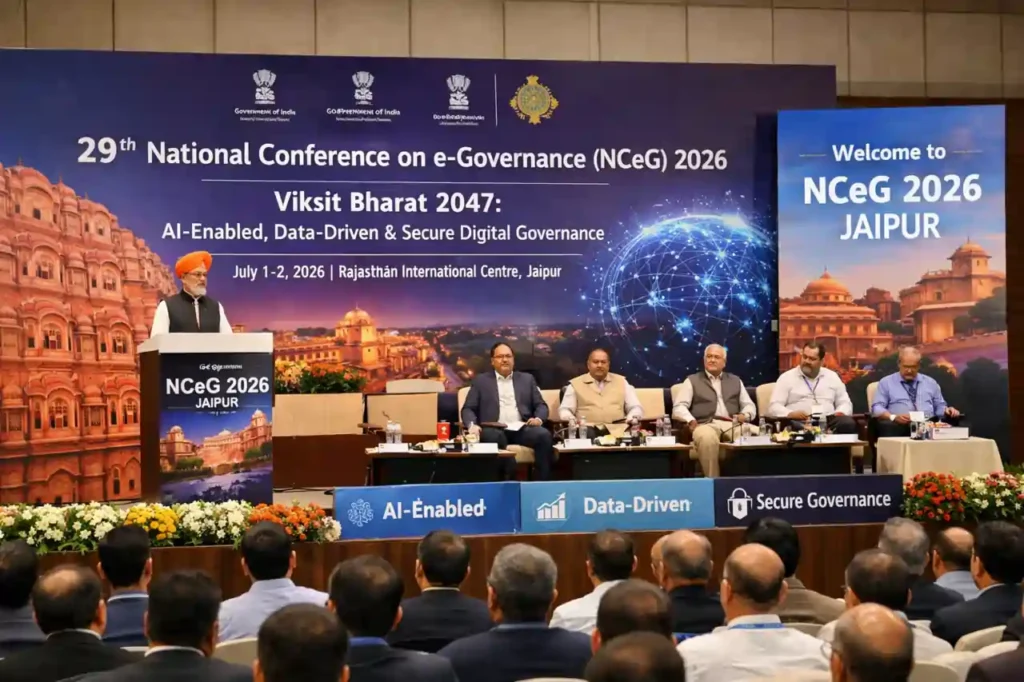
Conference Theme: Viksit Bharat 2047 – AI-Enabled, Data-Driven and Secure Digital Governance
The central theme of the 29th National e-Governance Conference 2026 — “Viksit Bharat 2047: AI-Enabled, Data-Driven and Secure Digital Governance” — perfectly aligns with the nation’s long-term goal of becoming a developed country by its 100th year of independence. The theme highlights three critical pillars: leveraging cutting-edge Artificial Intelligence for smarter decision-making, harnessing the power of data for evidence-based governance, and building secure digital infrastructure that protects citizen information while ensuring seamless service delivery.
Rajasthan Chief Minister Bhajan Lal Sharma formally inaugurated the conference and an accompanying exhibition showcasing the state’s innovative digital governance initiatives. Several new digital projects developed by the Rajasthan Government were also launched during the inaugural session, reflecting the state’s commitment to technology-led public service reforms.
Union Minister of State for Personnel, Public Grievances and Pensions, Dr. Jitendra Singh, is attending the conference, lending significant central government support and insights into national e-governance strategies.
Massive Participation Reflects Growing Ecosystem
The scale of participation at this year’s conference is impressive. Around 2,700 delegates are expected to engage in intensive discussions over the two days. This includes representatives from more than 1,000 startups and over 400 academic institutions. Such broad representation underscores the collaborative approach needed to drive digital governance forward — bringing fresh ideas from young innovators alongside academic research and practical implementation experience from government bodies.
Day-Wise Agenda: Plenary Sessions, Breakouts, and Awards
Day One (July 1, 2026) features a robust schedule with three plenary sessions and six breakout sessions. These sessions will dive deep into transformative technologies including:
- Artificial Intelligence (AI)
- Deep Tech
- Quantum Computing
- Voice-First Solutions
- Secure Digital Infrastructure
- Other emerging technologies
The focus remains on practical applications that can make governance more inclusive, transparent, and responsive to citizen needs.
Day Two (July 2, 2026) will continue with three additional plenary sessions, culminating in the prestigious National e-Governance Awards 2026 ceremony. The awards recognize outstanding contributions in the field of digital governance and serve as a motivational benchmark for states, ministries, and organizations across the country.
National e-Governance Awards 2026: Celebrating Excellence in Digital Public Services
One of the major highlights of the conference is the presentation of the National Awards for e-Governance 2026. A total of 17 projects across multiple categories have been selected for recognition — comprising 10 Gold Awards, 6 Silver Awards, and 1 Jury Award. These initiatives demonstrate remarkable innovation in using technology to solve real-world governance challenges.
Here is the complete list of winners:
Gold Award Winners (each receiving a trophy, certificate, and Rs 10 lakh incentive):
- Agri Stack – Ministry of Agriculture & Farmers Welfare
- e-Jagriti – Ministry of Consumer Affairs
- Mahakumbh 2025 – Prayagraj Mela Authority, Uttar Pradesh
- Blood Bag Traceability Portal – Kerala Development and Innovation Strategic Council
- AI-enabled Clinical Decision Support in eSanjeevani – Ministry of Health and Family Welfare
- District Court Case Management System – High Court of Kerala
- ICMR-MINDS – Indian Council of Medical Research
- Security Product for Threat Intel & DNS Filtering – Space Application Centre, ISRO
- E Nagar Palika with Cyber Security – Urban Development Department, Madhya Pradesh
- Integrated Cyber Security for Digital Banking – Bank of Baroda
Silver Award Winners (each receiving Rs 5 lakh):
- E-Aarogya Dhamni – Health Dept, Zilla Parishad, Nandurbar, Maharashtra
- Pune 360 – Pune Municipal Commission
- Kadepur Gram Panchayat – Sangli District, Maharashtra
- Bijoy Nagar Gram Panchayat – West Tripura District
- TRINETRA AI Surveillance – Mahakaleshwar Temple Trust, Ujjain
- Panchayat Advancement Index – Ministry of Panchayati Raj
Jury Award:
- Real-Time Precise Positioning via CORS Network – Survey of India
The incentive amounts for both Gold and Silver awardees are directed toward further project implementation or bridging critical resource gaps in public welfare schemes. These awards not only honor excellence but also encourage wider adoption of successful digital models across different states and sectors.
Significance of Key Award-Winning Projects
The awarded projects cover diverse domains — from agriculture and healthcare to urban administration, judiciary, cybersecurity, and cultural event management. For instance:
- Agri Stack aims to create a unified digital ecosystem for farmers, enabling better access to services, markets, and government schemes.
- AI-enabled Clinical Decision Support in eSanjeevani demonstrates how telemedicine platforms can be enhanced with artificial intelligence for improved healthcare delivery in remote areas.
- Initiatives like E Nagar Palika with Cyber Security and Integrated Cyber Security for Digital Banking highlight the growing emphasis on protecting digital public infrastructure from emerging threats.
- Gram Panchayat-level projects such as Kadepur Gram Panchayat and Bijoy Nagar Gram Panchayat show how digital tools are empowering local self-governance and improving service delivery at the grassroots level.
The inclusion of projects like Mahakumbh 2025 and TRINETRA AI Surveillance reflects the successful integration of technology even in large-scale cultural and religious events for better crowd management and security.
Broader Impact on India’s Digital Governance Journey
The 29th National e-Governance Conference serves as more than just an annual gathering. It acts as a strategic platform for knowledge sharing, policy formulation, and fostering partnerships between government, industry, and academia. By focusing on emerging technologies like Quantum Computing and Voice-First Solutions, the conference addresses both current challenges and future opportunities in building a resilient digital India.
Discussions are expected to yield actionable insights on how states can replicate successful models, scale innovations, and ensure that digital governance remains truly inclusive — reaching the last mile and benefiting every citizen regardless of location or socio-economic background.
The convergence of over a thousand startups with government officials creates fertile ground for new collaborations, potential pilot projects, and technology adoptions that could significantly accelerate India’s digital transformation journey toward the Viksit Bharat 2047 vision.
Rajasthan’s Leadership in Digital Innovation
Hosting the event in Jaipur highlights Rajasthan’s proactive role in digital governance. The state has been at the forefront of implementing several citizen-centric digital initiatives, many of which are being showcased in the exhibition. The launch of new projects during the conference further strengthens Rajasthan’s position as a leader in leveraging technology for public good.
Looking Ahead: Building a Secure and Citizen-Centric Digital Future
As the conference progresses, participants will explore how AI and data-driven approaches can enhance transparency, reduce corruption, improve efficiency, and ensure accountability in governance. Secure digital infrastructure remains a recurring priority, especially in light of increasing cyber threats.
The National e-Governance Conference has consistently evolved over the years, and the 29th edition is poised to set new benchmarks. By bringing together diverse stakeholders and recognizing exemplary work through the awards, it reinforces India’s commitment to harnessing technology for inclusive growth and effective public service delivery.
The outcomes of these two days of deliberations in Jaipur are likely to influence policy decisions and implementation strategies across various ministries and state governments in the coming months and years.
FAQs
1. When and where is the 29th National e-Governance Conference 2026 being held?
The 29th National e-Governance Conference is being held on July 1-2, 2026 at the Rajasthan International Centre in Jaipur. The two-day event was inaugurated on July 1 by Rajasthan Chief Minister Bhajan Lal Sharma.
2. What is the theme of the 29th National e-Governance Conference?
The official theme is “Viksit Bharat 2047: AI-Enabled, Data-Driven and Secure Digital Governance”. The conference focuses on Artificial Intelligence, Deep Tech, Quantum Computing, Voice-First Solutions, Secure Digital Infrastructure, and other emerging technologies to build inclusive, transparent, and citizen-centric governance.
3. Who is attending the National e-Governance Conference in Jaipur?
Around 2,700 delegates are participating, including representatives from more than 1,000 startups and over 400 academic institutions. Key dignitaries include Rajasthan Chief Minister Bhajan Lal Sharma and Union Minister of State Dr. Jitendra Singh.
4. What are the National e-Governance Awards 2026? Who won the awards?
The National e-Governance Awards 2026 were presented on the second day of the conference. A total of 17 projects received recognition: 10 Gold Awards, 6 Silver Awards, and 1 Jury Award. Major Gold winners include Agri Stack (Ministry of Agriculture), e-Jagriti (Ministry of Consumer Affairs), Mahakumbh 2025 (Prayagraj Mela Authority), AI-enabled Clinical Decision Support in eSanjeevani, and several cybersecurity and health initiatives. Gold winners receive Rs 10 lakh, while Silver winners get Rs 5 lakh each.
5. What is the purpose of the 29th National e-Governance Conference?
The conference serves as a key national platform to discuss, share, and promote best practices in digital governance. It aims to accelerate India’s journey toward Viksit Bharat 2047 by fostering collaboration between government, startups, and academia, recognizing innovative projects through awards, and launching new digital initiatives of the Rajasthan Government.