

New Delhi: The Ladakh administration’s recent decision to establish Autonomous Hill Development Councils (AHDCs) in each of its seven districts has ignited a fresh wave of political contention in the strategically vital Himalayan region. Announced on Monday, the move aims to bolster grassroots governance but has drawn sharp criticism from key civil society organisations negotiating with the Centre for stronger constitutional protections. This development comes amid ongoing discussions for a customised framework under Article 371, highlighting deep-seated concerns about power distribution, institutional overlap, and a growing trust deficit between local leaders and the Union government.
Ladakh, India’s largest Union Territory by area spanning nearly 60,000 square kilometres yet home to only around three lakh people, presents unique administrative challenges. Its rugged terrain, marked by high mountain passes and remote villages requiring hours of travel, has long justified calls for decentralised decision-making. The creation of five new districts in April 2026 — Drass, Sham, Nubra, Changthang, and Zanskar — alongside the existing Leh and Kargil, set the stage for this expansion of local bodies. Until now, AHDCs operated solely in Leh and Kargil.
Chief Secretary Ashish Kundra described the initiative as a “major step towards democratic decentralisation and grassroots governance.” He emphasised that the decision responds to longstanding demands from residents of the newly formed districts. Kundra noted that discussions with the Centre have broadly aligned on establishing a Union Territory-level representative body under a tailored Article 371 arrangement. This body would hold legislative, executive, financial, and administrative powers, positioning the district councils as complementary structures rather than competitors. Section 3 of the Ladakh Autonomous Hill Development Council Act explicitly permits the notification of a council in every district, with only amendments to the Act and constituency delimitation required for implementation.
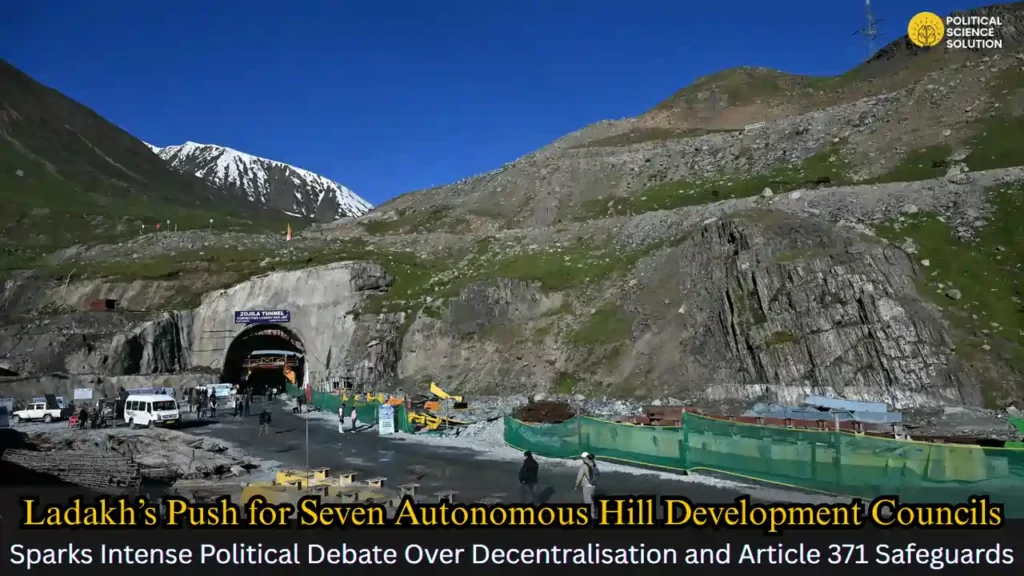
Civil Society Groups Raise Alarms Over Fragmentation of Authority
The Apex Body Leh (ABL) and the Kargil Democratic Alliance (KDA), the primary civil society platforms engaged in talks with the Centre on Ladakh’s political future, have strongly opposed the timing and implications of the seven-council plan. While they acknowledge the necessity of decentralised administration given the region’s geography, they argue that proliferating district-level bodies risks diluting the authority of the proposed UT-wide representative institution under Article 371.
ABL co-chairman Chherring Dorje Lakruk voiced concerns that empowering seven councils could leave minimal substantive powers for the larger body. “This is a plan to dilute the powers of the proposed representative government that is going to take shape under Article 371,” he stated. “If all the powers are going to be given to the hill councils, what will the representative government do?” KDA co-chairman Sajjad Kargili echoed this sentiment, labelling the approach “maximum government and minimum governance.” He questioned the efficacy of additional councils when existing ones have reportedly seen their influence erode over time.
Leaders worry about blurred lines of accountability in a small population base. With seven hill councils, Panchayati Raj institutions, the Union Territory administration, and a future Article 371 body all operating simultaneously, they fear overlapping jurisdictions could undermine effective governance. One negotiator asked: “With so few people and so many representative institutions, what meaningful role will eventually remain for the territorial government? And where does Panchayati Raj fit into this?”
Procedural issues have further fuelled distrust. According to local representatives, the proposal for seven councils appeared in the minutes of a May 22 meeting between the Centre and Ladakh delegations. The groups refused to sign that version, leading to a revised record omitting the proposal, which was then endorsed. The subsequent announcement without fresh consultation has reinforced perceptions of unilateral decision-making by the administration.
Roots of the Widening Trust Deficit Since 2019
The backlash cannot be isolated from the broader context of Ladakh’s evolution since its bifurcation from Jammu and Kashmir and designation as a Union Territory in 2019. Initial optimism quickly faded when it became evident that, unlike its parent region, Ladakh would not receive a legislative assembly. Subsequent negotiations for Sixth Schedule-like protections evolved into deliberations over a customised Article 371 framework, but progress has been slow, breeding frustration among civil society.
Tensions escalated following the September 2025 protests in Leh, the detention of prominent climate activist Sonam Wangchuk under the National Security Act, and statements by some political figures perceived as challenging Ladakh’s patriotic credentials. The emergence of the Voice of Buddhist Ladakh, which claims to represent Buddhist interests, added another layer of suspicion. ABL leaders alleged it was tacitly supported to fracture the unified Leh-Kargil front — a charge the administration has denied.
The April 2026 creation of five new districts intensified divisions, with the KDA claiming the redrawn map disproportionately benefited Buddhist-majority areas. Against this backdrop, even seemingly progressive administrative reforms like the hill councils are scrutinised through the lens of larger constitutional negotiations. Civil society views such steps as potential tools to pre-empt or reshape demands for robust safeguards protecting land, jobs, culture, and identity.
Powers of Ladakh’s Hill Councils: Strong on Paper, Weak in Practice?
The Ladakh Autonomous Hill Development Councils, governed by the 1997 Act, rank among India’s more empowered statutory district-level bodies (excluding Sixth Schedule areas). Responsibilities include district planning and development, budget preparation, implementation of schemes, management of vested lands, collection of specified local taxes, and serving as the district planning board.
Yet, elected representatives from across parties report a steady decline in relevance post-2019. Congress leader and Leader of Opposition in LAHDC-Leh, Tsering Namgyal, highlighted how decision-making has gravitated toward the Lieutenant Governor’s secretariat and departmental secretaries. Council recommendations on land issues are often sidelined, staff are redeployed for UT duties, and budgets have shrunk. Lakruk has called the councils “virtually defunct,” noting that even legally mandated authority over land remains largely unimplemented due to pending approvals and bypassed elected voices.
This paradox — expanding from two to seven councils while existing ones struggle for functionality — lies at the heart of the debate. Critics argue that genuine empowerment of current structures should precede multiplication.
Comparative Lens: Where Do LAHDCs Stand in India’s Federal Landscape?
Ladakh’s councils occupy an intermediate position. Unlike Sixth Schedule Autonomous District Councils in Assam, Meghalaya, Mizoram, and Tripura — which enjoy constitutional status, legislative powers over land, forests, customs, and village administration (subject to gubernatorial assent), and judicial roles — LAHDCs lack such entrenched protections.
They resemble statutory autonomous councils in states like Manipur, where significant formal powers coexist with practical limitations such as financial reliance on the parent government and constrained administrative autonomy. This comparison underscores the debate: should democratic authority in Ladakh concentrate in a potent UT-level body under Article 371, or disperse across multiple district entities?
Article 371 provisions, spanning clauses 371A to 371J, offer tailored safeguards for various states and regions, addressing unique socio-cultural, economic, and geographic needs. The proposed Ladakh model seeks to blend district-level decentralisation with a coordinating UT institution possessing legislative, executive, financial, and administrative heft. Officials describe it as having “no direct parallel,” designed specifically for local betterment without replicating Sixth Schedule structures.
The councils are expected to handle land ownership and allotment, district cadre recruitment and promotions, development planning, health, education, tourism, and welfare schemes. The overarching UT body would link them, aiming to safeguard interests while promoting local participation.
Article 371 as a Potential Bridge for Ladakh’s Aspirations
Article 371 recognises the need for special constitutional arrangements in diverse regions. For Ladakh, the customised framework represents the Centre’s response to persistent demands for protections on land, employment, and cultural identity without full Sixth Schedule extension. Activist Sonam Wangchuk, a vocal advocate who endured prolonged detention following protests, expressed cautious optimism after May discussions, noting an “in-principle understanding” on safeguards.
Whether this model delivers meaningful autonomy depends on the final legislation’s details: the precise powers of the UT body vis-à-vis the Lieutenant Governor and Ministry of Home Affairs, its interplay with district councils, and mechanisms ensuring accountability. Parliamentary panels have engaged with the Ladakh Lieutenant Governor on these challenges, reflecting sustained central attention.
Balancing Decentralisation with Unified Representation
Ladakh’s terrain demands robust local governance, but its tiny population raises legitimate questions about institutional proliferation. Proponents of the seven-council plan see it as fulfilling long-pending aspirations and aligning with the 1997 Act. Opponents fear it preempts or complicates the Article 371 negotiations, potentially creating a fragmented landscape where no single entity holds decisive sway.
The controversy also revives fundamental questions about representative politics in Union Territories: how to reconcile administrative efficiency with democratic depth in sparsely populated, ecologically fragile, and strategically sensitive areas bordering sensitive international boundaries.
As talks continue, the Ladakh administration maintains that the district councils and the proposed UT body are mutually reinforcing. Civil society, however, insists on transparent consultation and prioritising functionality over expansion. The resolution of this debate will likely shape not only governance structures but also the trajectory of trust between Ladakh’s people and the Centre.
The coming months, including necessary legal amendments and delimitation exercises, will test whether this initiative advances genuine empowerment or exacerbates existing fault lines. For a region grappling with climate change, tourism pressures, infrastructure needs, and cultural preservation, the stakes could not be higher. Ladakh’s experiment with seven Autonomous Hill Development Councils thus stands as more than an administrative reform — it is a litmus test for inclusive federalism in one of India’s most distinctive frontiers.
FAQs
1. What exactly has the Ladakh administration announced regarding Autonomous Hill Development Councils?
The Ladakh administration announced the creation of an Autonomous Hill Development Council (AHDC) in each of the Union Territory’s seven districts. This expands the existing system, which previously covered only Leh and Kargil, following the formation of five new districts in April 2026 — Drass, Sham, Nubra, Changthang, and Zanskar. Chief Secretary Ashish Kundra described it as a major step toward democratic decentralisation and grassroots governance, enabled under Section 3 of the Ladakh Autonomous Hill Development Council Act. The move is positioned as complementary to a proposed Union Territory-level representative body under a customised Article 371 framework.
2. Why are the Apex Body Leh (ABL) and Kargil Democratic Alliance (KDA) opposing the seven hill councils plan?
ABL and KDA support decentralisation due to Ladakh’s vast geography but oppose the timing and scale. They argue that seven district councils could fragment political authority and leave little meaningful power for the proposed Article 371 UT-level body. Leaders like Chherring Dorje Lakruk and Sajjad Kargili have raised concerns about “maximum government and minimum governance,” institutional overlap with Panchayati Raj and the UT administration, and blurred accountability in a region with only about three lakh people. They also cite procedural issues, claiming the proposal appeared in unsigned May 22 meeting minutes and was advanced without full consultation.
3. How does this development relate to the trust deficit between Ladakh’s civil society and the Centre?
The opposition stems from a widening trust deficit since Ladakh became a Union Territory in 2019 without a legislature. Slow progress on constitutional safeguards, the 2025 Leh protests, detention of activist Sonam Wangchuk, and controversies over new districts and groups like the Voice of Buddhist Ladakh have deepened mistrust. Civil society views administrative decisions, including the hill councils expansion, through the lens of broader negotiations for Article 371 protections on land, jobs, and cultural identity, fearing they may pre-empt stronger demands.
4. What powers do Ladakh’s Hill Councils have on paper versus in practice?
On paper, under the 1997 Act, the councils are quite powerful for statutory bodies. They handle district planning, budgets, development schemes, land management, local taxes, and act as planning boards. In practice, however, elected representatives report diminished relevance post-2019, with decision-making shifting to the Lieutenant Governor’s secretariat, ignored land recommendations, reduced budgets, and redeployed staff. This has created a paradox: the administration wants to expand to seven councils while many argue the existing two need genuine empowerment first.
5. How does the proposed Ladakh model under Article 371 differ from the Sixth Schedule?
Article 371 offers customised special provisions tailored to specific regional needs, unlike the Sixth Schedule, which grants constitutional status, legislative powers over land/forests/customs, and judicial roles to Autonomous District Councils in certain northeastern states. The Ladakh proposal combines seven district AHDCs with a UT-level body having legislative, executive, financial, and administrative powers. It aims to provide safeguards for land, jobs, and culture without extending Sixth Schedule status, though exact details will depend on final legislation. Officials describe it as a unique model designed for Ladakh’s context.