
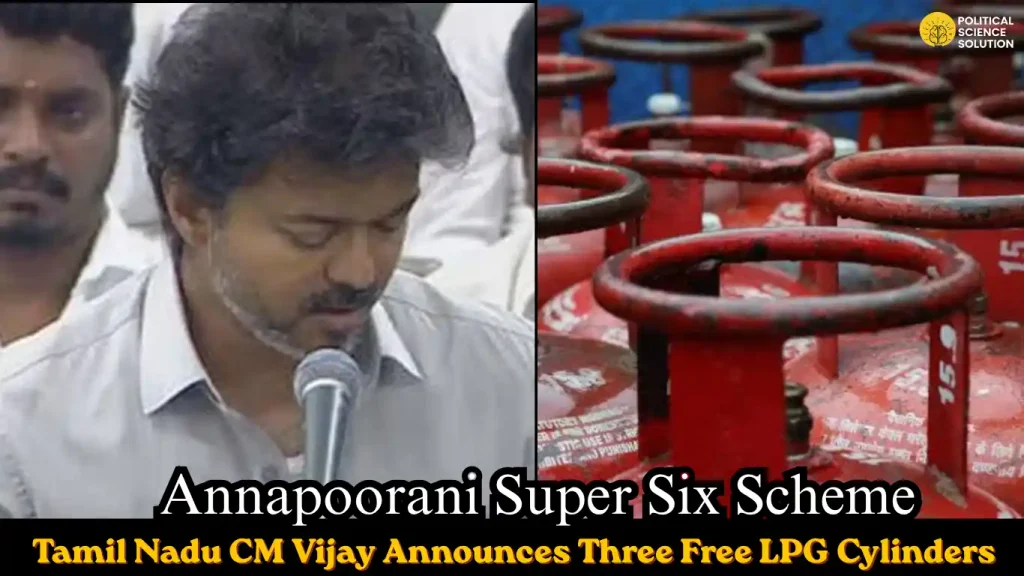
New Delhi: Tamil Nadu Chief Minister C. Joseph Vijay on Monday, August 24, 2026, announced a major welfare measure in the state Assembly that has quickly become the centre of political debate. Under the newly named Annapoorani Super Six scheme, eligible families will receive reimbursement for the cost of three domestic LPG cylinders every year. The financial assistance will begin from Thai Pongal in January 2027 and is projected to reach more than 1.3 crore households. The move has drawn sharp criticism from the Bharatiya Janata Party, which has accused the government of scaling back an election pledge of six free cylinders for every household.
The announcement forms part of a broader set of decisions presented by the Chief Minister that also include expanded free bus travel for women and the decision to drop the proposed second airport for Chennai at Parandur. Together these measures touch cooking fuel costs, public transport access, and land-use priorities, and they have triggered discussion about the gap between campaign commitments and fiscal realities.
What the Annapoorani Super Six Scheme Offers
The core of the scheme is direct reimbursement rather than the physical distribution of free cylinders. Eligible households will receive the monetary value of three LPG cylinders annually. The amount will be credited straight into the bank accounts of the women who head those households. Reimbursement will be processed after the cylinder is booked and delivered, and it will be calculated on the basis of official billing records from the oil marketing companies.
Chief Minister Vijay told the Assembly that the decision was taken against the backdrop of rising LPG prices and supply disruptions linked to the ongoing conflict in the Gulf region. He said these factors had increased the financial pressure on ordinary families. Even while operating under constrained fiscal conditions, the government chose to provide this support in order to reduce the burden on households, safeguard welfare, and address the commitment made to the public.
The scheme is scheduled to take effect from Pongal 2027. Official estimates place the annual cost to the state exchequer at approximately ₹4,000 crore. The number of families expected to benefit stands at 1,30,16,104.
Who Qualifies for the Benefit
Eligibility is restricted to households whose annual income does not exceed ₹2.5 lakh. The scheme also covers economically weaker sections, families of small and marginal farmers, and families of differently-abled persons. The focus on women heads of households is explicit: the reimbursement will be deposited only into their bank accounts. This design is intended both to ensure the money reaches the person primarily responsible for household cooking fuel and to create a clear audit trail based on official cylinder billing data.
The name Annapoorani Super Six itself echoes the original election-period language. During the 2026 Assembly election campaign, the Tamilaga Vettri Kazhagam had promised six free cooking gas cylinders each year to every household. The scheme announced on Monday delivers half that quantity and limits the coverage to a defined income and category threshold rather than extending it universally.
Political Reaction and the Manifesto Gap
BJP spokesperson Narayanan Thirupathy responded the same day by highlighting the difference between the manifesto and the final scheme. He recalled that the TVK had pledged six cylinders annually for all households. The government, he said, had now restricted the benefit to three cylinders and to families earning below ₹2.5 lakh a year. Thirupathy asked why both the number of cylinders and the number of beneficiaries had been reduced, and he described the outcome as a deception of the people of Tamil Nadu. He insisted that the government should deliver exactly what it had promised during the campaign, noting that the commitment was made for households.
The criticism has framed the announcement as a partial fulfilment rather than a complete one. Supporters of the government point to the fiscal constraints cited by the Chief Minister and to the fact that the reimbursement mechanism still places money directly in the hands of women. Critics argue that an election promise of universal free cylinders has been narrowed in both quantity and coverage.
Expanded Free Bus Travel for Women
Alongside the LPG scheme, the Chief Minister announced a significant expansion of the existing free bus travel facility for women. The benefit will now cover state-run buses as well as express and deluxe services. There will be no income ceiling and no restriction on the number of trips. The earlier version of the scheme had applied more narrowly; the new version removes those limitations so that women can travel without fare on a wider range of government buses.
This measure is presented as an extension of existing women-centric transport support. By eliminating income and trip caps, the government aims to make public transport fully accessible for women across different routes and service categories.
Decision to Drop Chennai’s Proposed Second Airport at Parandur
The Chief Minister also informed the Assembly that the plan to build a second airport for Chennai at Parandur would be dropped for the time being. He noted that the existing Meenambakkam airport, operated by the Airports Authority of India, currently has the capacity to handle 30 million passengers annually. While acknowledging the need for additional capacity in view of the city’s growth, industrial expansion and rising cargo traffic, he stated that any new airport should be located where the impact on agricultural land and residential areas is minimal.
The Parandur site, according to the government, would have affected farmland and disrupted the livelihoods of farmers and local residents. By setting aside the project in its present form, the administration has signalled a preference for alternative locations that avoid large-scale conversion of agricultural land.
Context and Broader Implications
The Annapoorani Super Six scheme arrives roughly eight months after the 2026 Assembly elections in which the Tamilaga Vettri Kazhagam formed the government. The original manifesto promise of six free LPG cylinders for every household was one of the more prominent welfare commitments of the campaign. The decision to implement a three-cylinder reimbursement limited to lower-income and specific vulnerable categories reflects a recalibration between political commitment and budgetary capacity.
The ₹4,000-crore annual outlay is substantial. Direct bank transfers based on verified oil company invoices are intended to reduce leakage and ensure the benefit reaches the intended recipients. Linking the payment to the female head of household further aligns the scheme with the government’s stated focus on women-led households.
The timing of the launch—Pongal 2027—gives the administration several months to finalise operational details, including the precise mechanism for capturing booking and delivery data from oil marketing companies and routing reimbursements into bank accounts. It also allows time for public communication about eligibility criteria so that eligible families can prepare the necessary documentation.
On the transport side, the removal of income and trip limits from the free bus scheme for women is expected to increase ridership on state-run, express and deluxe services. The government has not released revised cost estimates for this expansion, but the decision removes earlier barriers that restricted access for some women.
The airport decision closes one chapter of a longer debate over Chennai’s aviation capacity. By citing both the current 30-million-passenger capacity of Meenambakkam and the need to protect agricultural and residential land, the Chief Minister has left open the possibility of a future site that better balances growth requirements with land-use concerns.
Taken together, the announcements of August 24 present a package that combines cooking-fuel support, expanded mobility for women, and a revised approach to large infrastructure. The LPG scheme in particular will be watched closely for its implementation details, the accuracy of beneficiary identification, and the political conversation around the difference between the six-cylinder universal pledge and the three-cylinder targeted reimbursement that is now scheduled to begin at Pongal 2027.
The coming months will test how effectively the reimbursement system functions, how many of the projected 1.30 crore families actually receive the benefit, and whether the political debate over the original manifesto promise continues or shifts to questions of delivery and impact on household budgets.
FAQs
1. What is the Annapoorani Super Six scheme announced by Tamil Nadu CM Vijay?
The Annapoorani Super Six scheme is a welfare programme under which eligible families will receive reimbursement for the cost of three domestic LPG cylinders every year. The amount will be credited directly to the bank accounts of the women heading those households after the cylinders are booked and delivered, based on official billing from oil marketing companies. Chief Minister C. Joseph Vijay announced it in the Tamil Nadu Assembly on 24 August 2026. It is scheduled to begin from Thai Pongal in January 2027 and is expected to benefit about 1.30 crore (1,30,16,104) families at an annual cost of approximately ₹4,000 crore.
2. Who is eligible for the three free LPG cylinders under the scheme?
Eligibility is limited to households with an annual income not exceeding ₹2.5 lakh. It also covers economically weaker sections, families of small and marginal farmers, and families of differently-abled persons. The reimbursement is paid only to the female head of the household. This is a targeted scheme, unlike the original Tamilaga Vettri Kazhagam election manifesto promise of six free cylinders for every household.
3. When will the Annapoorani Super Six scheme start and how will the money be paid?
The scheme will be implemented from Pongal (Thai Pongal) in January 2027. Reimbursement for the cost of three cylinders per year will be transferred directly into the bank account of the woman heading the eligible family. Payment will be processed after the cylinder is booked and delivered, using the official invoices issued by oil marketing companies.
4. Why has the BJP criticised the scheme?
BJP spokesperson Narayanan Thirupathy has accused the government of scaling back its election promise. The TVK manifesto had promised six free LPG cylinders annually for all households. The announced scheme provides only three cylinders and restricts eligibility to families earning below ₹2.5 lakh a year. Thirupathy described this as a reduction in both the number of cylinders and the number of beneficiaries, and said the government had deceived the people of Tamil Nadu by not delivering the full commitment made during the campaign.
5. What other major announcements did CM Vijay make alongside the LPG scheme?
CM Vijay expanded free bus travel for women so that it now covers state-run buses as well as express and deluxe services, with no income ceiling and no limit on the number of trips. He also announced that the proposed second airport for Chennai at Parandur would be dropped for now, citing the impact on agricultural land and the livelihoods of farmers and residents. He noted that the existing Meenambakkam airport already has capacity for 30 million passengers a year and said any future airport should minimise disruption to farmland and residential areas.