
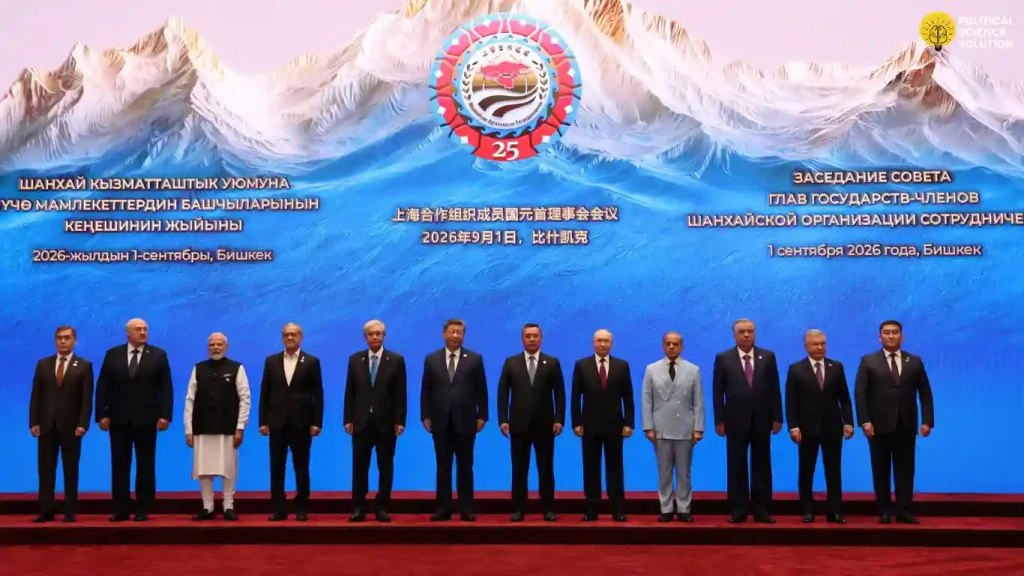
New Delhi: Leaders of the Shanghai Cooperation Organisation wrapped up their two-day summit in the Kyrgyz capital on 1 September 2026 by adopting the Bishkek Declaration, a document that directly addressed military action against Iran, Western sanctions, nuclear rights, economic cooperation and the fight against terrorism. The 26th Meeting of the Council of Heads of State took place at Yrys Ordo under the chairmanship of Kyrgyz President Sadyr Japarov and marked the organisation’s 25th anniversary. The official theme, “25 Years of the SCO: Together Towards Sustainable Peace, Development and Prosperity,” guided discussions that brought together the ten full members: China, Russia, India, Pakistan, Iran, Belarus, Kazakhstan, Kyrgyzstan, Tajikistan and Uzbekistan.
Prime Minister Narendra Modi represented India throughout the proceedings and left Bishkek for New Delhi after the formal sessions concluded. His interventions and the side meetings he held formed a significant part of the Indian contribution to the gathering.
Summit Background and Membership Growth
The Shanghai Cooperation Organisation traces its roots to the Shanghai Five framework created in 1996 by China, Russia, Kazakhstan, Kyrgyzstan and Tajikistan to manage border and security questions after the Cold War. The group became the SCO on 15 June 2001 in Shanghai when Uzbekistan joined. India and Pakistan entered as full members in 2017, Iran followed in 2023 and Belarus completed the current roster in 2024. Today the organisation represents roughly 43 percent of the world’s population and about 23 percent of the global economy. Its permanent institutions are the Secretariat in Beijing and the Regional Anti-Terrorist Structure in Tashkent. Russian and Chinese remain the official languages, and decisions rest on consensus guided by the Shanghai Spirit of mutual trust, respect for sovereignty and non-interference.
Kyrgyzstan used its 2025-2026 chairmanship to host the anniversary summit and several preparatory meetings. The expanded SCO Plus format also brought representatives from dialogue partners and international organisations. On 31 August the sixth World Nomad Games opened in Bishkek, with several SCO leaders attending the ceremony.
Bishkek Declaration Condemns Strikes on Iran and Sanctions
The joint statement signed by Chinese President Xi Jinping, Russian President Vladimir Putin, Indian Prime Minister Narendra Modi, Pakistani Prime Minister Shehbaz Sharif and the other heads of state focused first on the military campaign against Iran. Member states condemned the strikes on Iranian territory that produced numerous civilian deaths and heavy economic damage. They described the actions as violations of international law and the United Nations Charter that create serious risks to global peace and stability.
The declaration offered sincere condolences to the Iranian people and government on the death of Supreme Leader Seyyed Ali Khamenei and to the families of those killed. SCO members reaffirmed their support for Iran’s sovereignty and territorial integrity and insisted that the conflict must be resolved only through political and diplomatic channels.
The same document noted that Israeli military actions against Palestine had destabilised West Asia. Leaders stated that a comprehensive and just settlement of the Palestinian question remains the only realistic path to lasting peace and stability in the Middle East.
Without naming individual countries, the declaration rejected unilateral coercive measures that run counter to United Nations and World Trade Organization rules and that risk harming the global economy. These passages were understood as references to sanctions imposed on Iran and on Russia.
Backing Iran’s Rights Under the Nuclear Non-Proliferation Treaty
SCO leaders explicitly upheld Iran’s rights as an NPT member. They stressed the inalienable right of every state to research, produce and use atomic energy for peaceful purposes and to engage in equitable international cooperation in the nuclear field without discrimination. Any restriction on this right, they said, contradicts international law.
The position came against a background of long-running disagreements. Iran has maintained that its programme is entirely civilian. The 2015 nuclear agreement had limited enrichment to levels suitable for power reactors. Subsequent military actions and demands for the complete abandonment of domestic enrichment capacity were rejected by Tehran as an attempt to strip away NPT-guaranteed rights. The Bishkek Declaration aligned the organisation with Iran’s interpretation.
Economic Cooperation and Energy Strategy
The ongoing conflict has disrupted key maritime routes, including the Strait of Hormuz, and unsettled global energy and financial markets. In response, SCO members committed to an open, transparent, fair, inclusive and non-discriminatory multilateral trading system grounded in accepted international rules. They pledged to implement the SCO Economic Development Strategy through 2030, deepen financial cooperation and expand energy collaboration under the SCO Member States’ Energy Cooperation Strategy to 2030.
Russian President Vladimir Putin called for the creation of an independent SCO Development Bank insulated from financial systems that have been used as economic pressure tools. He noted that Russia’s trade with other SCO countries had already surpassed 400 billion dollars in the previous year. Discussions also covered the China-Kyrgyzstan-Uzbekistan railway, improved transit corridors, investment facilitation and the possible formation of an SCO Energy Consortium. Sustainable development, green energy, water resources and climate response formed additional agenda items.
Counter-Terrorism and the Rejection of Double Standards
Security remained a core priority. The Bishkek Declaration condemned terrorism, separatism and extremism in all forms. Member states declared double standards unacceptable and called for collective action against cross-border terrorist movement, organised crime and cyber threats. Plans for an International Centre for Combating Organised Crime were advanced as part of institutional strengthening.
Indian and Pakistani positions diverged sharply on the subject. Prime Minister Modi described terrorism as a grave challenge to humanity and demanded the dismantling of the entire ecosystem of financing, recruitment, radicalisation and safe havens. He insisted there can be no place for double standards and that countries which treat terrorism as a policy tool must understand it can never serve as a strategic asset. He referred to the Pahalgam attack and thanked nations that had supported India.
Pakistani Prime Minister Shehbaz Sharif responded by highlighting Pakistan’s own sacrifices in the fight against terrorism and repeating that the phenomenon must be condemned in every form and manifestation. The exchange mirrored earlier confrontations at the United Nations and other multilateral forums.
India’s Three Pillars and PM Modi’s Broader Message
Modi framed India’s SCO engagement around Security, Connectivity and Opportunity. He argued that regional stability, better physical and digital links, and expanded chances for young people and start-ups must advance together. He expressed satisfaction that the first session of the SCO Civilisation Dialogue Forum, an Indian proposal from the previous year, would take place in India later in 2026. He stressed that any effort to connect markets and open trade routes must fully respect the sovereignty and territorial integrity of every country.
On conflict resolution he stated that wars offer no lasting solutions and that dialogue and diplomacy remain the only viable path. He called for an end to prolonged fighting, describing peace as the shared teaching of the traditions associated with Gandhi and Buddha. Governance, he said, should follow the mantra of Reform, Perform, Transform.
Bilateral Meetings on the Sidelines
While the formal summit proceeded, several bilateral encounters took place. Modi met Russian President Putin to discuss bilateral ties, the Ukraine conflict and regional developments. Separate conversations occurred with Iranian President Masoud Pezeshkian, Kyrgyz President Japarov, Tajik President Emomali Rahmon and Armenian representatives. An Iranian journalist described the Modi-Pezeshkian meeting as sending a positive signal about stronger trilateral cooperation among India, Iran and China. Modi also met Mongolian President Ukhnaa Khurelsukh and conveyed Independence Day greetings to Uzbekistan.
External Affairs Minister S. Jaishankar held talks with Chinese Foreign Minister Wang Yi, Iranian Foreign Minister Abbas Araghchi, Russian Foreign Minister Sergey Lavrov and the Tajik foreign minister. These encounters reinforced the pattern of parallel diplomacy that typically accompanies SCO gatherings.
Significance of the Bishkek Meeting
The summit combined anniversary reflection with concrete commitments on security, connectivity, energy and development finance. Central Asian transport corridors received particular attention, reflecting Kyrgyzstan’s interest in positioning itself as a transit hub. The organisation’s consensus-based approach continued to accommodate diverse national interests while producing a clear collective voice on Iran, sanctions and terrorism.
After the final sessions, Prime Minister Modi departed Bishkek, ending a two-day visit that mixed multilateral statements with focused bilateral diplomacy. The Bishkek Declaration and the accompanying decisions now form the reference points for SCO work through the remainder of the decade, setting the stage for practical implementation of the economic and energy strategies already adopted.
Frequently Asked Questions
1. What was the SCO Summit 2026 in Bishkek and why was it significant?
The 26th Meeting of the Council of Heads of State of the Shanghai Cooperation Organisation took place in Bishkek, Kyrgyzstan, from 31 August to 1 September 2026. Hosted under Kyrgyzstan’s rotating chairmanship at the Yrys Ordo venue, the gathering marked the organisation’s 25th anniversary. The official theme was “25 Years of the SCO: Together Towards Sustainable Peace, Development and Prosperity.” Leaders from the ten member states signed the Bishkek Declaration and discussed security, connectivity, trade, energy and sustainable development. The summit carried added weight because it occurred while conflicts involving Iran and Ukraine continued to affect global markets and regional stability.
2. Which countries are members of the SCO and who attended the Bishkek summit?
The SCO currently has ten full members: China, Russia, India, Pakistan, Iran, Belarus, Kazakhstan, Kyrgyzstan, Tajikistan and Uzbekistan. The organisation began as the Shanghai Five in 1996 and was formally established in 2001. India and Pakistan joined in 2017, Iran in 2023 and Belarus in 2024. At the Bishkek summit the heads of state present included Chinese President Xi Jinping, Russian President Vladimir Putin, Indian Prime Minister Narendra Modi, Iranian President Masoud Pezeshkian, Pakistani Prime Minister Shehbaz Sharif, Belarusian President Alexander Lukashenko, Kazakh President Kassym-Jomart Tokayev, Tajik President Emomali Rahmon, Uzbek President Shavkat Mirziyoyev and Kyrgyz President Sadyr Japarov. Expanded sessions also involved dialogue partners and representatives of international organisations.
3. What did the Bishkek Declaration say about the situation in Iran?
The joint declaration strongly condemned military strikes on Iranian territory that caused civilian casualties and economic damage. Member states described the attacks as violations of international law and the United Nations Charter that create serious risks to global peace and security. They expressed condolences over the death of Supreme Leader Seyyed Ali Khamenei and reaffirmed full support for Iran’s sovereignty and territorial integrity. The declaration insisted that the conflict must be resolved only through political and diplomatic means. It also noted that Israeli actions against Palestine had destabilised West Asia and that a comprehensive, just settlement of the Palestinian question remains essential for regional stability. In addition, the leaders opposed unilateral coercive measures that contradict United Nations and World Trade Organization rules and harm the global economy.
4. How did the SCO address Iran’s nuclear programme and rights under the NPT?
SCO leaders upheld Iran’s inalienable right, as a party to the Nuclear Non-Proliferation Treaty, to research, produce and use atomic energy for peaceful purposes. They affirmed the right to equitable international cooperation in the nuclear field without discrimination and stated that any attempt to restrict this right runs contrary to international law. This position aligned with Iran’s long-standing claim that its programme is civilian in nature and rejected demands that would require the complete abandonment of domestic uranium enrichment capacity.
5. What were Prime Minister Narendra Modi’s main messages at the summit?
Prime Minister Modi called for the complete dismantling of the ecosystem of terrorist financing, recruitment, radicalisation and safe havens. He stated there can be no place for double standards on terrorism and that countries using terrorism as a policy tool must understand it can never be a strategic asset. He framed India’s approach around three pillars—Security, Connectivity and Opportunity—and stressed that market-linking and trade initiatives must fully respect the sovereignty and territorial integrity of all countries. Modi also said wars and prolonged conflicts offer no lasting solutions and that disputes should be resolved through dialogue and diplomacy. He expressed satisfaction that the first session of the SCO Civilisation Dialogue Forum, proposed by India, would be held in India later in 2026, and highlighted “Reform, Perform, Transform” as a governance principle.
6. What decisions were taken on economic cooperation, energy and counter-terrorism?
Member states committed to an open, transparent, fair and non-discriminatory multilateral trading system and agreed to implement the SCO Economic Development Strategy up to 2030. They also endorsed the SCO Member States’ Energy Cooperation Strategy to 2030 and discussed stronger financial mechanisms, including a possible independent SCO Development Bank. Russian President Vladimir Putin noted that Russia’s trade with other SCO countries had already exceeded 400 billion dollars. On security, the declaration condemned terrorism, separatism and extremism in all forms, rejected double standards, and called for joint action against cross-border terrorist movement, organised crime and cyber threats. Practical projects such as the China-Kyrgyzstan-Uzbekistan railway and improved regional connectivity also featured in the discussions.